
Acrylic Sign Thickness: 3 mm vs 6 mm for Designers & Small Business
Most acrylic signs use 1/8" (3 mm) or 1/4" (6 mm) sheet stock, with 1/16" through 1" also available for specific jobs. Pick 1/8" for standard indoor panels, 1/4" for heavier-duty or light exterior use, and 3/8" or thicker for freestanding or structural pieces. Illuminated signs are their own category: LED-grade acrylic runs 3.0 mm or 4.5 mm, not the standard gauges.
TL;DR:
- For outdoor panels, 1/4" acrylic is the minimum recommended thickness, especially when paired with UV-stable material and proper backing, to prevent warping.
- Illuminated signs require LED-grade acrylic, typically 3.0 mm or 4.5 mm thick, to ensure even light diffusion and structural stability.
- Thicker acrylic, such as 3/8" or 1/2", is suitable for freestanding or structural signs that need to support their own weight and resist sagging.
- Using a thickness one step higher than needed provides extra durability and reduces the risk of warping, cracking, or sagging over time.
- Custom fabrication options allow for precise thickness selection and finishing, ensuring the sign's performance matches its specific environment and use case.
Table of Contents
- What Are the Standard Acrylic Sign Thickness Options?
- How Do You Choose the Right Acrylic Sign Thickness?
- Which Thickness Fits Your Specific Sign Project?
- How Does Thickness Affect Mounting and Installation?
- What Do the Technical Specs Say About LED-Grade and PMMA Acrylic?
- An Editorial Take On Getting Thickness Right
- Get Your Acrylic Signage Fabricated to the Right Spec
- Sources
- FAQ
What Are the Standard Acrylic Sign Thickness Options?
Acrylic sheet comes in a handful of common gauges, and each one exists because it solves a different problem. Once you know what each thickness is built for, matching it to your project takes minutes instead of guesswork.
Here's how the standard acrylic board thickness options break down, inch to millimeter:
- 1/16" (1.5 mm): The lightest option, mostly used for small tags, room numbers, or short-run wayfinding where cost and weight matter more than rigidity. It flexes noticeably and isn't a good fit for large panels without a backing surface.
- 1/8" (3 mm): The workhorse. Many print shops and sign fabricators use 3 mm as their standard stock for indoor plaques, nameplates, and printed or laser-cut signage, and Vistaprint's own acrylic sign line defaults to this same gauge. Hold three stacked credit cards in your hand and you're feeling roughly what 1/8" acrylic feels like.
- 3/16" (4.5 mm): A middle ground between the flexible 1/8" and the noticeably stiffer 1/4". Less common as off-the-shelf stock, but some fabricators offer it for signs that need a bit more heft without the added cost of quarter-inch material.
- 1/4" (6 mm): The step up when you need real rigidity. Commercial sign vendors commonly list 6 mm alongside 3 mm as a selectable option, and it's the go-to for wall panels, dimensional letters, and signage that will see occasional contact or light outdoor exposure.
- 3/8" (9.5 mm): Used where a panel needs to stand largely on its own, without a full frame or backing structure. Heavier and pricier, but it resists warping and sagging far better than anything thinner.
- 1/2" (12.7 mm): Common in freestanding signs, base panels, and applications where the acrylic itself is doing structural work, not just displaying graphics.
- 1" (25.4 mm): Reserved for specialty pieces: architectural elements, thick dimensional lettering, or display bases where mass and solidity are part of the design.
Thicker material costs more per square foot and weighs more to ship, so the jump from 1/8" to 1/4" roughly doubles the material weight for the same panel size. That trade only makes sense when the application actually calls for the added durability.
How Do You Choose the Right Acrylic Sign Thickness?
Picking the right gauge comes down to five practical questions, not a single rule of thumb.
- How far will people be viewing it from? Small nameplates read fine at 1/8", but larger panels meant to be seen from a parking lot or across a lobby benefit from the added rigidity of 1/4" or more, since bigger sheets flex and warp more visibly over time at thinner gauges.
- How will it mount? Standoffs, French cleats, and adhesive mounts all interact differently with panel thickness. Thin panels can crack around drilled holes if the hardware is oversized for the material.
- What's the exposure? Indoor, climate-controlled environments are forgiving. Anything facing sun, temperature swings, or moisture needs at least 1/4" and UV-stable material.
- Will people touch it? Signage near doors, counters, or high-traffic walkways takes more incidental contact. Go thicker or add a backing panel to reduce flex and scratching risk.
- What's the budget and weight ceiling? Thicker acrylic costs more and adds shipping weight, which matters if you're mounting multiple panels or shipping to a job site.
Pro Tip: When you're unsure between two thicknesses, size up one step rather than down. A slightly heavier sign rarely causes problems, but an underspecified one can warp, sag, or crack at the mounting points within a year.
If your project spans more than a few square feet, sits outdoors, or needs to support its own weight without a wall behind it, talk to a fabricator before ordering. Getting the acrylic sign material thickness wrong on a large panel is an expensive mistake to fix after the fact.
Which Thickness Fits Your Specific Sign Project?
The best thickness for acrylic signs depends entirely on where the sign lives and what it needs to survive. Here's how that breaks down by common use case.
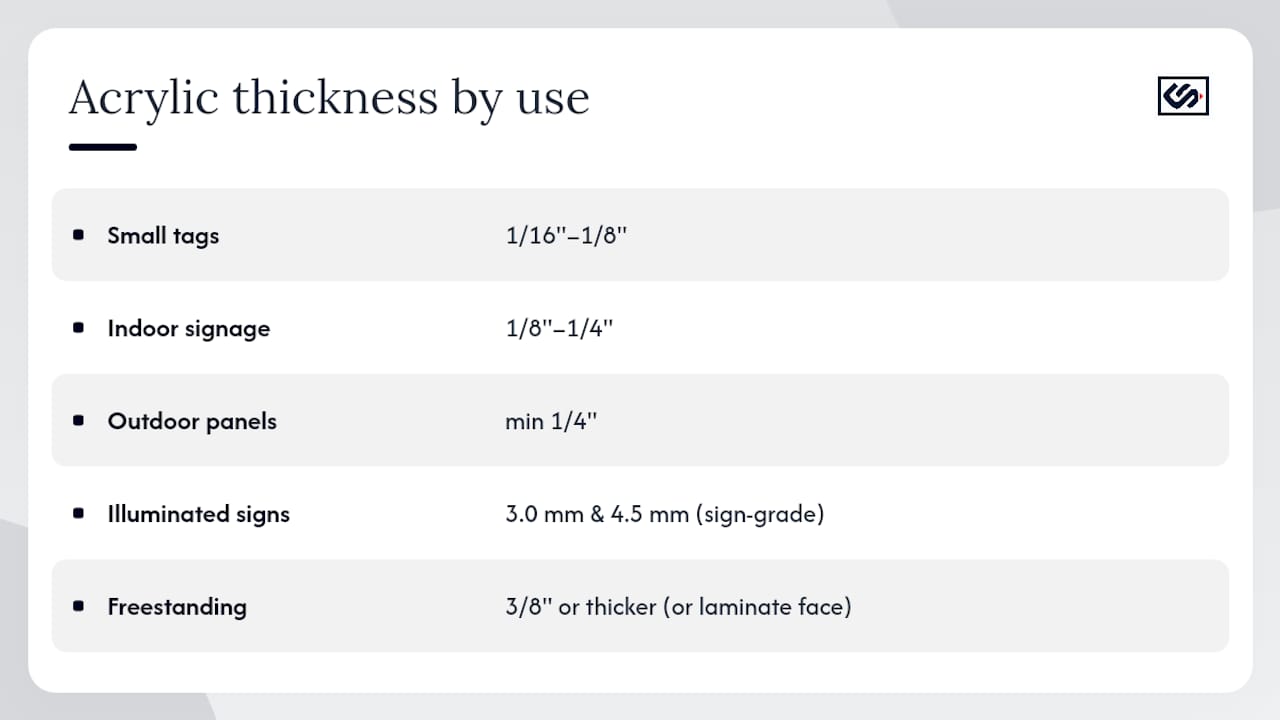
Indoor lobby and office signage does well at 1/8" to 1/4". Directory panels, door plaques, and interior wayfinding rarely face stress beyond the occasional bump, so 1/8" keeps costs down while still looking sharp under indoor lighting. Step up to 1/4" for larger interior panels or anywhere a cleaner, more substantial edge matters to the design.
Outdoor-exposed panels need 1/4" as a floor, not a ceiling. Sun, wind, and temperature swings put more stress on a sheet than most people expect, and thinner material will show that stress first through warping at the edges. Pair outdoor panels with proper backing or a support frame, and confirm the sheet is UV-stable, since standard cast or extruded acrylic without UV additives can yellow faster outdoors.
Illuminated and LED-backed signs don't follow the standard thickness ladder at all. ACRYLITE LED sign-grade acrylic is manufactured specifically at 3.0 mm and 4.5 mm, thicknesses chosen to control how evenly light diffuses across the face of the sign. Standard 1/8" or 1/4" sheet, which isn't formulated for backlighting, tends to show hot spots around individual LEDs rather than a smooth, even glow.
Freestanding and structural signage is where thickness stops being about looks and starts being about physics. Monument-style signs, standalone directory panels, and anything without a wall behind it should run 3/8" or thicker, or use a thinner acrylic face laminated to a rigid substrate for support.
Small wayfinding and tags are the one case where thinner is the right call. Room numbers, small directional markers, and short-run indoor tags at 1/16" to 1/8" keep material costs and shipping weight down without sacrificing legibility at close range.
How Does Thickness Affect Mounting and Installation?
Thickness dictates almost every hardware decision that comes after your sign design is finalized, from drill bit selection to how far the panel sits off the wall.
- Drilling: Thin panels (1/16" to 1/8") are more prone to cracking around drilled mounting holes. Use a slower drill speed, a pilot hole slightly smaller than the final size, and back the panel with sacrificial material to prevent chip-out on the exit side.
- Standoff hardware: Standoff diameter and barrel length should scale with panel thickness. A 1/8" panel typically pairs with smaller-diameter standoffs and shorter barrels, while 1/4" and above can support the larger, more substantial hardware that reads well on bigger signs.
- Edge finishing: Polished edges give a premium, seamless look and show up more clearly on thicker material where the edge itself is visible from an angle. Flame-polished edges are common on 1/4" and up; thinner sheets often skip this step since the edge is barely noticeable.
- Backers and laminates: Laminating a thinner acrylic face to a rigid backer (foam board, aluminum composite, or plywood) reduces flex without paying for the weight and cost of solid thicker acrylic. This is a common workaround when budget rules out going to 3/8" or 1/2".
- Thermal expansion: Acrylic expands and contracts with temperature more than metal or glass. Outdoor installations need mounting hardware with a little play, oversized holes with washers or grommets, rather than a rigid, flush bolt that leaves no room for the material to move.
Pro Tip: If a sign will sit outdoors year round, drill mounting holes about 1/16" larger than the hardware diameter. That small gap lets the panel expand and contract with the seasons instead of cracking around a bolt that never moves.
What Do the Technical Specs Say About LED-Grade and PMMA Acrylic?
Acrylic sign material, technically PMMA or poly(methyl methacrylate), earns its place in signage because it delivers glass-like clarity at a fraction of the weight, with far better impact resistance. That combination is why it dominates storefront and interior signage over glass or rigid PVC, but PMMA has its own limits worth knowing before you specify a thickness.
Manufacturer datasheets for LED sign-grade material list a maximum recommended service temperature around 160°F, along with tensile strength and impact values that inform whether a given sheet is suited to illuminated or outdoor use. That thermal ceiling matters most for backlit signs, where LED modules generate heat directly against the acrylic face.
LED-grade sheets in 3.0 mm and 4.5 mm exist because diffusion and structural stiffness pull in opposite directions. The thinner 3.0 mm sheet diffuses light more evenly across individual LED modules, which is usually the priority for channel letters and backlit panels. The thicker 4.5 mm option trades a little diffusion performance for more uniform color and better rigidity across larger sign faces, which matters on bigger installations where sag or flex would otherwise show. LED-grade stock is typically used any time a design calls for backlighting, while standard sheet thicknesses are reserved for non-illuminated panels, since standard acrylic simply isn't engineered for even light transmission.
Cleaning acrylic signs correctly protects that clarity regardless of thickness. PMMA is softer at the surface than glass, and ammonia or alcohol-based cleaners cause fine surface cracking called crazing over repeated use.
Acrylic's surface scratches more easily than glass even though the material itself resists impact far better. That trade-off is exactly why high-traffic signs often benefit from a slightly thicker panel or a protective backing, rather than relying on surface hardness alone.
For acrylic sign cleaning, stick to mild soap, water, and a high-GSM microfiber cloth. Skip paper towels and household glass cleaners entirely; both leave fine scratches over time that dull an otherwise crisp sign face.
An Editorial Take On Getting Thickness Right
Most buyers overthink material grade and underthink thickness, when thickness is actually the variable doing more work for durability and visual impact. A well-chosen 1/4" panel in a common acrylic grade will outperform a premium-grade sheet cut too thin for its application, every time. For storefront panels specifically, 1/4" is the sweet spot: rigid enough to mount cleanly without a backing frame, substantial enough to read as quality from the sidewalk, and priced reasonably for most small-business budgets.
— Nick
Get Your Acrylic Signage Fabricated to the Right Spec
Choosing the right acrylic sign thickness on paper is only half the job. The other half is getting a sheet cut, finished, and mounted without guesswork on hardware or lead times.
Custom acrylic panels can be fabricated across the full range of standard thicknesses, from lightweight 1/8" plaques to structural 1/2" freestanding pieces, built to exact specifications and shipped nationwide. Designing online, specifying thickness, and receiving a production-ready sign can remove the need for multiple vendor calls. Coordinated professional installation is sometimes available, and streamlined production workflows keep turnaround faster than the traditional back-and-forth quoting process most sign shops still use. If you already know the thickness your project needs, request a quote or upload your artwork and get a production-ready acrylic sign moving toward your storefront.
Sources
- ACRYLITE LED color changing / back-lit physical properties (product information)
- How thick are acrylic signs? | Sticker Mule support FAQ
- How to clean acrylic signs: A professional guide | Image Square Printing
FAQ
How Thick Should Acrylic Be for a Sign?
For most indoor signs, 1/8" (3 mm) balances cost and durability well, while 1/4" (6 mm) suits larger panels, outdoor use, or anywhere the sign takes occasional contact.
Is 1/4 Inch Plexiglass Strong Enough for Outdoor Use?
Yes, 1/4" acrylic is a common minimum for outdoor-exposed panels, though it should be paired with proper backing or a support frame and UV-stable material to resist warping.
How Thick Is 3/16 Acrylic Compared to Other Options?
3/16" (4.5 mm) sits between the flexible 1/8" and the sturdier 1/4", offering more rigidity than the thinnest stock without the added weight and cost of quarter-inch material.
How Thick Is Acrylic Sign Material Generally?
Acrylic sign material typically ranges from 1/16" (1.5 mm) for small tags to 1" (25.4 mm) for structural pieces, with 1/8" and 1/4" covering the majority of everyday signage.
What Thickness Does Crispsign Recommend for Storefront Signs?
A general recommendation for storefront panels is 1/4" acrylic, as it offers enough rigidity to mount cleanly while staying practical on weight and cost for many small businesses.