What Advertising Hoardings Actually Mean for Your Storefront
For this guide, advertising hoardings are custom storefront and exterior signs, from channel letters to window vinyl, that make your business findable and push people through the door. If your storefront sees any foot or car traffic after dark, prioritize illumination and clear sightlines from your customers' actual approach. On-premise signage additions have been linked to substantial increases in site sales revenue, and window displays act as a diagnostic cue for store image. Crispsign handles the production end once you know what you need.
Key Takeaways
Visibility, measured in viewing distance, contrast, and after-dark illumination, determines whether a storefront sign earns its cost or gets ignored.
| Point | Details |
|---|---|
| Match sign type to distance | Use channel letters or monument signs for road visibility and window vinyl or blade signs for foot traffic. |
| Illuminate if open after dark | A non-illuminated sign loses roughly half its daily exposure window once the sun sets. |
| Check permits before ordering | Confirm municipal sign codes, lease restrictions, and electrical permit needs before fabrication starts. |
| Budget realistically | A complete layered signage system typically runs $1,500 to $8,000 depending on materials. |
| Work with a turnkey fabricator | Crispsign builds to spec from a scaled storefront proof and ships nationwide with optional installation coordination. |
Table of Contents
- What Types of Storefront Signs Work Best?
- How Do You Choose the Right Sign for Your Location?
- What Makes a Sign Actually Legible From the Street?
- Do You Need a Permit Before You Order a Sign?
- How Much Does a Storefront Sign Cost, and How Long Does It Take?
- How Should You Install and Maintain Your Sign?
- How Does a Provider Like Crispsign Handle a Signage Project?
- A Sign-Maker's Take: Common Mistakes and Quick Wins
- Ready to Order Your Storefront Sign?
- Sources
- FAQ
What Types of Storefront Signs Work Best?
Every storefront needs a mix of signage working at different ranges, not one hero piece doing all the work.
- Channel letters: illuminated, dimensional letters mounted on the facade. Best for building identification from the street or parking lot; readable from 50 to 300 feet depending on size.
- Lightbox/cabinet signs: a backlit box with your logo. Good all-hours visibility at a lower cost than channel letters, though the look is flatter.
- Blade/projecting signs: mounted perpendicular to the building. Essential on pedestrian streets where storefronts sit shoulder to shoulder and a flat facade sign gets lost.
- Window vinyl: hours, promotions, and brand cues at arm's length. Cheap to update, ideal for close-range decision making.
- A-boards/sandwich boards: portable sidewalk signage for daily specials. Low cost, but limited to business hours and foot traffic only.
- Monument/pylon signs: freestanding signs near the road or parking lot entrance, critical for shopping centers or set-back buildings.
- Banners: temporary advertising structures for events, sales, or grand openings.
Pro Tip: Layer at least two ranges: something readable from the road (channel letters or a pylon sign) and something readable on foot (window vinyl or a blade sign). One sign rarely covers both jobs well.
How Do You Choose the Right Sign for Your Location?
Start where your customer starts, not where you stand behind the counter. Are people approaching across a four-lane road, walking a downtown sidewalk, or pulling into a shared parking lot? Each answer points to a different sign type and size.
- Map your decision points. Identify the spot where someone decides to turn in, park, or walk over. That distance sets your minimum letter height.
- Match sign types to distance bands. Long sightlines need channel letters or a monument sign; short sightlines need window vinyl, an A-board, or a blade sign.
- Check illumination needs. If your storefront gets meaningful traffic after sunset, a non-illuminated sign is invisible for roughly half the day.
- Confirm one-glance legibility. Someone driving or walking past should read your name in under three seconds.
Pro Tip: Before you order fabrication, tape a scale mockup, printed paper is fine, to your storefront and check it from your customer's actual approach. Cheap paper catches sizing mistakes that are expensive to fix in acrylic or metal.
What Makes a Sign Actually Legible From the Street?
Legibility is math, not taste. A common rule of thumb ties letter height to viewing distance and readable speed: bigger letters for faster traffic and longer sightlines, smaller letters for foot traffic up close. Layered systems built around this rule, along with a single dominant message, are a recurring recommendation in small business signage guides, and a typical complete package runs $1,500 to $8,000 depending on materials and installation.
Keep the checklist simple:
- One primary message plus, at most, one small secondary line. Cramming in hours, a slogan, and a phone number kills readability.
- High contrast between letter color and background; dark-on-light or light-on-dark, not similar tones.
- Open sans-serif faces read better at speed than thin scripts or condensed fonts.
- Give letters room to breathe. Tight tracking looks like a smudge from a moving car.
- Material choice affects lifespan: Dibond/ACM panels and cast vinyl hold up well outdoors; channel-letter LEDs typically outlast fluorescent lightbox faces and cost less to run.
Pro Tip: A maximum of one core message and fonts that hold up in motion are two of the most repeated rules among designers who focus on walk-in retail. Both are free to apply and expensive to ignore.
Do You Need a Permit Before You Order a Sign?
Almost always, yes, and finding that out after fabrication is the most common expensive mistake in this business. Run through this before you place an order:
- Check your municipal sign code for size limits, projection distance, and illumination rules; codes vary block to block in some cities.
- Review your lease. Many landlords restrict sign size, placement, or style regardless of what the city allows.
- If you're in a historic district, expect additional design review and longer approval timelines.
- Illuminated signs usually require an electrical permit and inspection, separate from the sign permit itself.
Walk the site itself before you finalize a design. Check sightlines from each direction customers approach, note anything blocking the view (awnings, trees, utility poles), confirm what your mounting surface can support, and check where power is available. Photograph everything. A good fabricator will ask for these photos to build an accurate proof, and many, Crispsign included, can help coordinate permitting and electrical inspection so you're not chasing city hall alone.
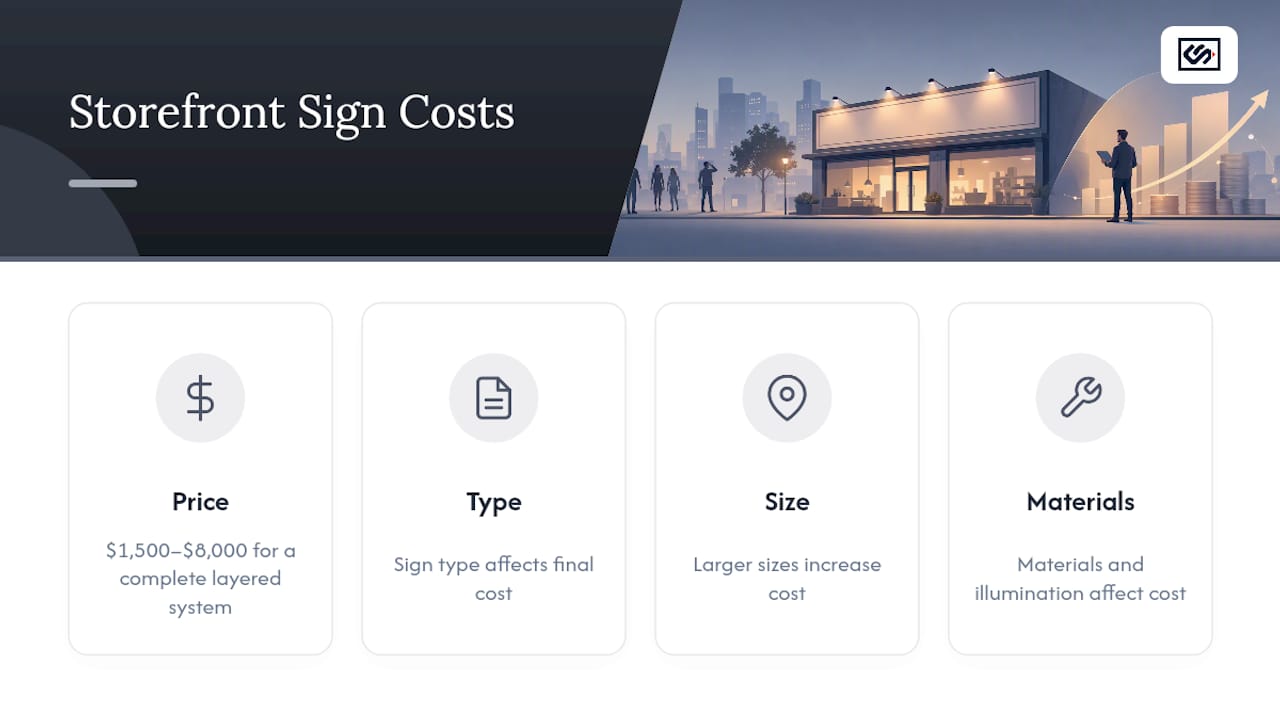
How Much Does a Storefront Sign Cost, and How Long Does It Take?
Price depends on a handful of variables you control more than you'd think.
- Sign type and size drive material and labor costs more than any other factor.
- Illumination adds cost upfront and in electrical work, but non-illuminated signs go dark exactly when visibility matters most.
- Custom fabrication versus a printed panel changes both price and lifespan.
- Permits, structural work, and installation difficulty vary by site and city.
Typical timeline: design and proofing take 1 to 2 weeks, fabrication runs 2 to 6 weeks depending on complexity, permitting timelines vary widely by jurisdiction, and installation itself usually wraps in 1 to 3 days. Skipping illumination or doing a DIY install can be a reasonable tradeoff for a low-traffic side entrance. It's a poor tradeoff for your primary storefront identity, where visibility is the entire point.
How Should You Install and Maintain Your Sign?
Installation splits into two paths: coordinated professional installation, which typically covers mounting hardware, electrical hookup, and site cleanup, or DIY, which works fine for lightweight items like window vinyl and A-boards but gets risky fast with anything illuminated or wall-mounted at height.
Once it's up, a short maintenance routine keeps it working like new:
- Clean faces and letters on a regular schedule; grime dulls contrast faster than most owners expect.
- Check LEDs and ballasts periodically; a dark section of a lit sign reads as neglect, not charm.
- Re-seal vinyl edges before they curl and trap moisture.
- Inspect mounting hardware seasonally, especially after storms or freeze-thaw cycles.
Measure whether it's working. Track baseline foot traffic and store capture rate, run simple rotation tests on window promotions, and compare sales before and after a sign change. Retailers who treat signage as a system, tracking foot traffic, capture rate, and conversions, consistently get more out of every dollar spent on it than those who install once and forget it.
How Does a Provider Like Crispsign Handle a Signage Project?
A reputable production partner turns the checklist above into a repeatable workflow instead of a guessing game. Here's roughly what that looks like with Crispsign:
- Brief and files. You submit your logo, brand colors, and project goals; vector artwork and Pantone matching keep colors consistent across every material.
- Scaled proof on your actual storefront. Rather than a generic mockup, you see the design placed on a photo of your building, so sizing mistakes get caught before fabrication, not after.
- Itemized quote. Design, materials, fabrication, permitting support, and installation are broken out separately, so you know exactly what you're paying for.
- Fabrication and shipping. Signs are built to spec and shipped nationwide.
- Installation coordination. Choose DIY or a coordinated professional install, depending on complexity and local requirements.
Expect production timelines communicated upfront and material warranties backing the finished product, the kind of transparency that turns a one-time sign order into a repeat vendor relationship.
A Sign-Maker's Take: Common Mistakes and Quick Wins
The single biggest mistake I see is designing a sign to look good from behind the counter instead of from the street. Owners fall in love with a font or a logo treatment that reads beautifully on a laptop screen and disappears entirely at 40 feet. Undersized letters, no plan for night visibility, and cramming five messages onto one panel round out the list. Each one quietly taxes conversion, because a sign that isn't read might as well not exist.
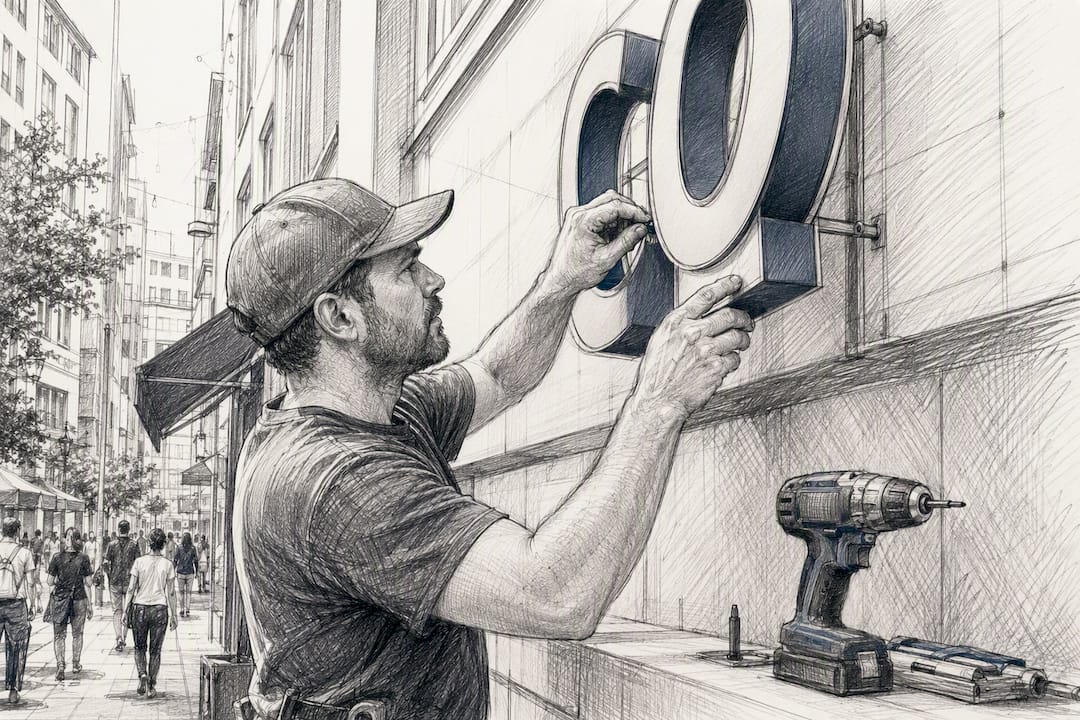
The fixes are almost always cheap. Bump contrast between letters and background before you touch anything structural. Add a blade sign if you're on a pedestrian block and your facade sign only faces traffic. If you're open past dusk and your current sign isn't lit, that single change often recovers more visibility than any redesign.
Ready to Order Your Storefront Sign?
Crispsign is built for exactly the project this guide walks through: custom storefront signage designed online, fabricated to spec, and shipped nationwide, with a scaled proof on your actual building before anything goes into production. No agency retainer, no showroom visit required, just a clear quote and a production timeline you can plan around.
If you're ready to move past the planning stage, request a proof and quote for your storefront and see exactly how your design looks on your building before you commit to fabrication.
Sources
- The Economic Value of On-Premise Signage (University of San Diego study)
- Beyond window signs: Understanding the affect-based effects of window signs on store patronage intentions
- Retail signage: types, design tips, and examples (Shopify blog)
FAQ
What Counts as an Advertising Hoarding for a Small Business?
In this context, it means custom storefront and exterior signage, channel letters, cabinet signs, window vinyl, banners, blade signs, A-boards, and monument signs, used to promote a business at its own location.
How Much Does a Storefront Sign Typically Cost?
A complete layered signage system usually runs $1,500 to $8,000, depending on sign type, size, materials, and illumination.
How Long Does It Take to Get a Custom Sign Installed?
Design and proofing typically take 1 to 2 weeks, fabrication runs 2 to 6 weeks, and installation itself generally takes 1 to 3 days, with permitting timelines varying by city.
Do I Need a Permit for an Illuminated Sign?
Almost always. Illuminated signs typically require both a sign permit and a separate electrical permit with inspection, on top of any lease restrictions your landlord may impose.
Can Crispsign Handle Both Design and Installation?
Yes. Crispsign produces signs to spec from an online brief and scaled storefront proof, ships nationwide, and offers coordinated professional installation alongside DIY options.