
Save 25–40% on Sign Costs With Anti Graffiti Laminate for Buyers
For high-abuse outdoor signage and fleet graphics, PVF (Tedlar) laminate is the strongest long-term choice, delivering 7 to 10+ years of protection. For curved surfaces, tighter budgets, or shorter campaigns, 3M cast overlaminates and polyester (PET) films from Mactac or Avery Dennison do the job well. Request a technical data sheet and sample before you buy, or talk to a signage provider about a laminated sign built to your specs.
TL;DR:
- PVF (Tedlar) laminate offers the highest durability and outdoor life, lasting over 10 years but at a higher cost per square foot.
- Cast overlaminates like 3M 1160 and 3M 8590M excel in conformability, making them ideal for curved surfaces and complex vehicle contours.
- Polyester films are cost-effective, suitable for short-term or flat applications, and often used when budget is a primary concern.
- Proper installation, including outgassing and sealing edges, is crucial to prevent failures like bubbling and edge lifting, especially on curved surfaces.
- Choosing the right laminate depends on substrate, shape, cleaning frequency, UV exposure, and verifying manufacturer data sheets and warranty coverage.
Table of Contents
- What Are the Best Anti-Graffiti Laminate Options?
- What Should You Check Before Buying Anti-Graffiti Laminate?
- How Should Anti-Graffiti Laminate Be Installed?
- How Do You Clean and Maintain Anti-Graffiti Laminate?
- Is Anti-Graffiti Laminate Worth the Cost?
- What Certifications and Standards Apply to Anti-Graffiti Laminate?
- What Happens to Anti-Graffiti Laminate After It's Removed?
- What Do Anti-Graffiti Laminate Warranties Typically Cover?
- How Crispsign Approaches Anti-Graffiti Protection
- Get a Laminated Sign Built to Your Specs
- What Manufacturers Get Wrong When Selling You on Laminate
- Sources
- FAQ
What Are the Best Anti-Graffiti Laminate Options?
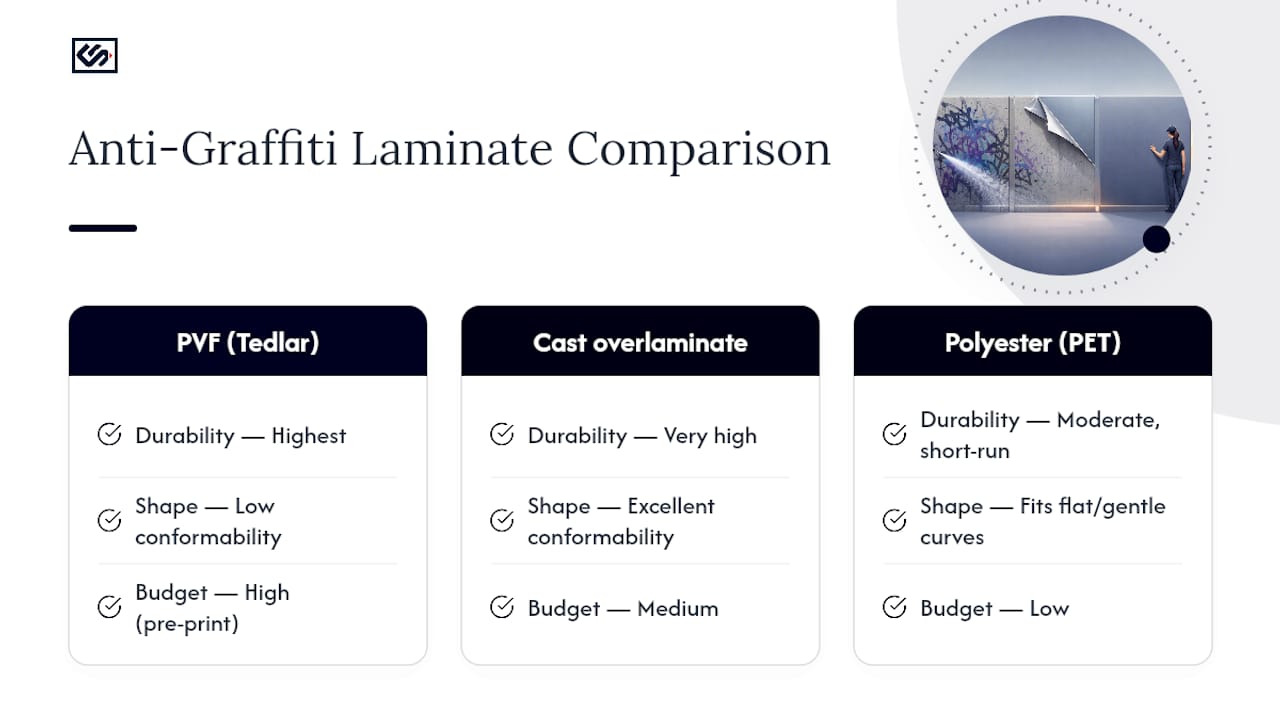
Every anti-graffiti laminate on the market falls into one of three chemistry families, and the family determines almost everything else: how long it lasts outdoors, how well it wraps around curves, and how it holds up against solvents.
PVF (Tedlar) films sit at the top of the durability chart. DuPont Tedlar laminate uses a fluoropolymer chemistry that resists solvent staining and UV breakdown better than any other film class, which is why transit authorities and fleet operators specify it when swapping out a damaged sign isn't an option. General Formulations 108 Tedlar and Drytac's Tedlar-based laminates follow the same chemistry and target the same high-stakes applications.
Cast overlaminates, led by the 3M 1160 Series Premium Protective Anti-Graffiti Overlaminate and the 3M 8590M Anti-Graffiti Wrap Overlaminate, trade a bit of raw chemical resistance for something PVF struggles with: conformability. These films stretch over rivets, curves, and complex vehicle contours without lifting. The 3M 8991 Scotchgard Graphic and Surface Protection Film and 3M 8993 Scotchgard Graphic & Surface Protection Film round out the family for flatter applications where gloss retention matters as much as scratch resistance.
Polyester (PET) films are the budget and short-run option. Mactac's LUV 7036, along with the Mactac SAG38 Permacolor and SAG53 Permacolor lines, and Avery Dennison's OL1000 and DOL 6060 anti-graffiti films, work well on flat or gently curved surfaces for shorter campaigns. Arlon's Series 3350 Vinyl Film anti-graffiti overlaminate and Drytac's Interlam Eco, Interlam Pro, and Protac lines occupy similar territory, with Drytac's WipeErase Clear PET laminate serving a niche use: dry-erase surfaces that also resist marker and paint staining.
The trade-off boils down to three variables: durability, shape, and budget. PVF wins on lifespan but costs more per square foot and needs to be printed before laminating, never after, since its low-energy surface rejects ink adhesion. Cast overlaminates win on shape flexibility. Polyester wins on price when the graphic has a defined shelf life anyway.
What Should You Check Before Buying Anti-Graffiti Laminate?
A laminate that looks identical to the one that worked at your last location can fail at a new one if the substrate, curvature, or climate is different. Run through this checklist before signing off on any order:
- Confirm substrate compatibility. Aluminum cabinets, acrylic panels, and vinyl-wrapped composite each bond differently, and a laminate rated for one won't always adhere to another.
- Map the shape. Flat panels can use any laminate family; curved cabinets, rounded pylons, or vehicle rivets need a cast-vinyl-compatible film rated for complex curves.
- Estimate cleaning frequency. High-visibility urban storefronts near transit stops get hit more often than a suburban office park, and that changes which cleaning-cycle rating matters most.
- Check UV exposure. South-facing and high-altitude installs fade faster, which pushes the decision toward PVF or a higher-grade cast overlaminate.
- Pull the datasheet. Confirm service temperature range, adhesive type, laminate thickness in mils, and the manufacturer's stated warranty or expected life before you commit to a quantity.
When you talk to a supplier, ask directly what solvents the laminate tolerates, whether the warranty covers gloss loss or just adhesion failure, and how many cleaning cycles the film is rated for. A vendor who can't answer with a specific number is a red flag.
Pro Tip: Ask for a sample swatch and test it with your actual cleaning crew's solvent before ordering a full run. Datasheets are written for average conditions. Your janitorial supply closet is not average.
How Should Anti-Graffiti Laminate Be Installed?
Most laminate failures trace back to rushed installation, not bad material. Printed graphics need to outgas for at least 24 hours before lamination; skip that step and trapped solvents will cause bubbling under the film within weeks.
- Use cast-vinyl-compatible laminates, not PET, for anything with rivets, tight radii, or deep curves.
- Print first, then laminate, especially with PVF films, since their surface doesn't accept ink well after the fact.
- Seal edges completely and overlap seams by at least an inch to block moisture intrusion.
- Apply within the manufacturer's stated temperature window, typically 50°F to 90°F, to avoid poor adhesion or silvering.
Complex curves and rivets are where most PET failures start, since the film simply won't stretch far enough without lifting.
How Do You Clean and Maintain Anti-Graffiti Laminate?
Cleaning protocol depends on which material you installed, and getting it wrong shortens the laminate's life; for detailed professional guidance, see Professionelle Glasreinigung | Glanz Gebäudereinigung.
- PVF/Tedlar: mild solvents remove most paint and marker without damaging the film's low-energy surface.
- Polyester (PET): use tested, biodegradable graffiti removers; aggressive solvents can haze or cloud the finish.
- Vinyl overlaminates: proceed cautiously with strong solvents, since some formulations soften the film's edge seal.
Speed matters more than the cleaner you choose. Practitioner guidance on protective coatings warns that leaving graffiti in place for more than about 10 days makes it bond more tightly, forcing you toward stronger solvents that stress the laminate itself. A film cleaned within a day or two of an incident typically wipes clean with the mildest recommended product; the same tag left untouched for two weeks can require repeated scrubbing that dulls the gloss.
Once a laminate shows persistent haze, edge lifting, or solvent staining that won't clear, replacement is cheaper than continued cleaning labor.
Is Anti-Graffiti Laminate Worth the Cost?
Permanent laminate systems typically deliver 25% to 40% in savings compared to abrasive cleaning and repainting cycles, mainly by eliminating repeat reprints and labor-heavy paint jobs.
Your total cost stacks up across a few line items:
- Laminate material, priced per square foot and driven by chemistry (PVF costs more than PET)
- Lamination labor, whether done in-house or by a fabricator
- Installation, including surface prep and any professional application fee
- Ongoing cleaning supplies and labor hours
- Eventual replacement, timed to the laminate's rated outdoor life
A rough rule of thumb: if a sign gets tagged more than twice a year, the higher upfront cost of PVF or a premium cast overlaminate usually pays for itself within two to three cleaning cycles, since you're not reprinting the underlying graphic each time.
What Certifications and Standards Apply to Anti-Graffiti Laminate?
Anti-graffiti laminate doesn't operate under a single unified certification body the way fire-rated materials do. Instead, buyers should look for two things: a documented technical data sheet from the manufacturer, and evidence the product has been tested by transit, fleet, or DOT specification programs, which routinely reference laminate performance in their own signage standards.
A legitimate TDS states service temperature range, expected outdoor life, adhesive chemistry, and tested cleaning-cycle resistance. Manufacturers like 3M back certain overlaminates, including versions of the 8588 wrap family, with multi-year performance warranties, which functions as a practical stand-in for third-party certification. Fleet and transit agencies often specify laminates by name in procurement documents precisely because those products have a track record under real-world graffiti-removal cycles, not lab conditions alone.
When evaluating a laminate, ask whether the manufacturer publishes independent test data or only marketing claims. A TDS with specific numbers for chemical resistance, UV stability, and cleaning-cycle counts is worth far more than a generic "graffiti-resistant" label with no backing data. If a supplier can't produce a data sheet on request, treat that as disqualifying, not a minor gap.
What Happens to Anti-Graffiti Laminate After It's Removed?
Used laminate is mixed material, typically a polymer film with an adhesive backing, which makes it unsuitable for standard curbside recycling. Most facilities treat it as general waste unless a specialty recycler in your area accepts laminated films.
Some manufacturers and fabricators offer take-back or recycling programs for large-volume laminate waste, particularly for PVF and PET films used in fleet-scale operations. If your business replaces laminate across multiple locations or vehicles at once, it's worth asking your supplier directly whether a recycling or disposal program exists before you send rolls of used film to a landfill. For smaller single-sign jobs, the environmental footprint is modest, but the calculus changes fast once you're stripping laminate off dozens of vehicles or storefronts on a replacement cycle.
What Do Anti-Graffiti Laminate Warranties Typically Cover?
Warranty terms vary by manufacturer and product tier, but most cover a defined window against specific failure modes rather than general wear. Expect coverage for adhesion failure, cracking, and excessive fading or yellowing within the warranty period, which commonly runs from 3 years on entry-level PET films up to 8 years or more on premium cast overlaminates from brands like 3M.
What warranties typically exclude matters just as much as what they include. Damage from improper installation, use of non-recommended cleaning chemicals, or exposure outside the stated service temperature range usually voids coverage. That's why matching the laminate to your actual conditions during the buying stage protects your warranty as much as it protects the sign.
Always request the specific warranty document for the exact product and thickness you're ordering, not a generic brand-level warranty summary, since coverage terms can shift meaningfully between a base product and its premium tier.
How Crispsign Approaches Anti-Graffiti Protection
A signage provider typically starts every signage order by looking at substrate, shape, and exposure before recommending a laminate class. A flat acrylic panel gets a different recommendation than a curved illuminated cabinet or a fleet of wrapped vehicles. That evaluation shapes both the material choice and how the sign gets built to spec.
Custom signs can be fabricated to order and shipped nationwide, with installation often coordinated through a third-party installer when a business wants professional setup rather than a DIY install.
Get a Laminated Sign Built to Your Specs
You've seen the trade-offs between PVF, cast overlaminates, and polyester films. Here's the simplest next step if you'd rather skip the vendor comparisons: a signage company can build your channel letters, cabinet signs, monument signs, or vehicle graphics to order and specify protective lamination as part of the build, so you're not sourcing film separately and hoping your fabricator applies it correctly.
That matters most for multi-location businesses juggling consistent branding across several storefronts or a vehicle fleet. Instead of managing separate laminate vendors and fabricators at each site, the Crisp Corporate portal lets multi-location brands order and coordinate signage from one place, with installation scheduled through a third-party installer where needed. If graffiti exposure or fleet visibility is a real concern at your locations, request a quote through Crisp Corporate and ask about lamination options for your specific sign type before you order.
What Manufacturers Get Wrong When Selling You on Laminate
Every laminate manufacturer's marketing page reads the same way: maximum durability, maximum protection, minimum maintenance. That framing skips the actual decision businesses face, which isn't "protection versus no protection." It's matching a specific film chemistry to a specific shape, budget, and abuse level, and manufacturers have no incentive to tell you their premium PVF film is overkill for a flat storefront panel that gets tagged twice a year.
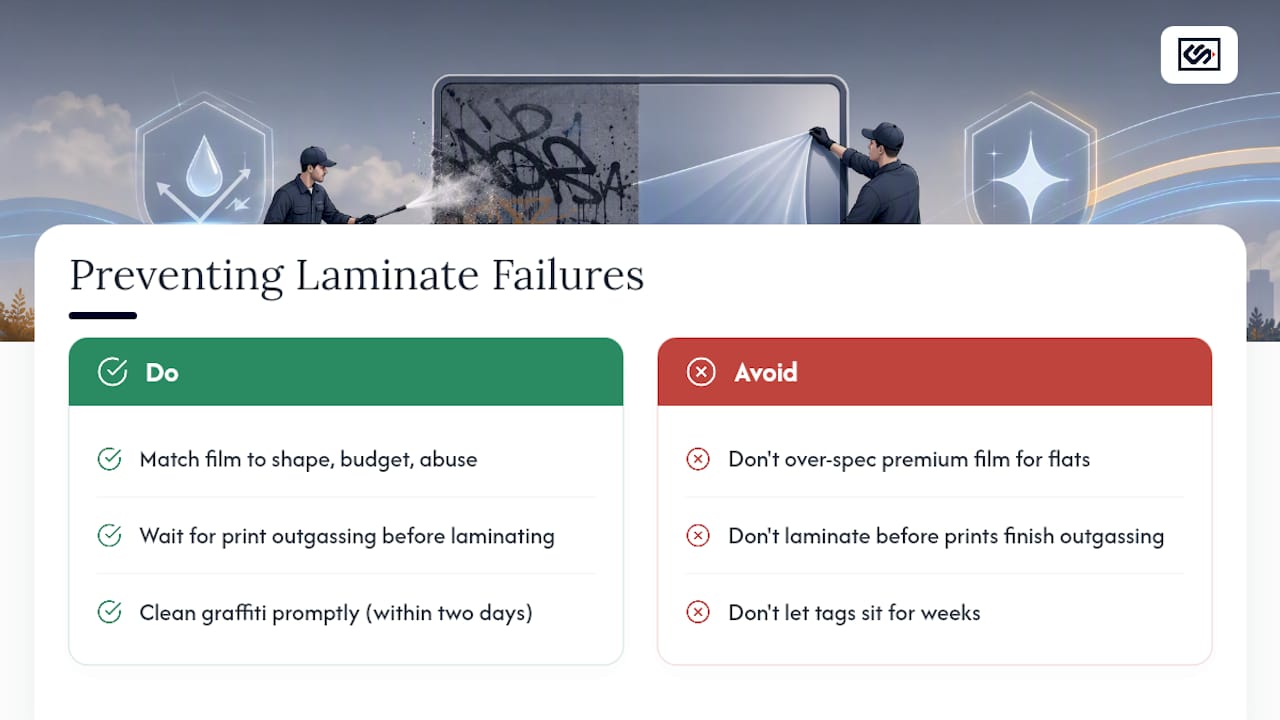
The bigger blind spot is installation. A sign shop can hand you the best PVF film on the market, but if it goes on before the printed graphic finishes outgassing, you'll see bubbling within a month regardless of how good the datasheet looked. Most of the graffiti-laminate failures I've seen traced back to installation shortcuts, not material defects. That's a harder problem to market around, so it rarely gets mentioned until a business has already learned it the expensive way.
The other overlooked variable is dwell time on the graffiti itself. Buyers fixate on which laminate resists which solvent, but the practitioner guidance on stronger cleaning chemicals is clear: a tag cleaned within two days behaves nothing like the same tag left for two weeks. Your cleaning schedule matters as much as your material choice, and most procurement conversations never get to that part.
— Nick
Sources
- Tedlar UV Anti-Graffiti Laminate | Durable Surface Protection Film
- 3M™ Anti-Graffiti Wrap Gloss Overlaminate 8588G, 1220 mm x 50 m, 1 Roll/Case | 3M United States
- Anti-Graffiti Coating | Sherwin-Williams
FAQ
How Does Anti-Graffiti Laminate Work?
It creates a sacrificial or permanent barrier over your graphic. Permanent laminates form a low-surface-energy film that lets paint and marker wipe off with solvents across repeated cleaning cycles, rather than bonding into the printed surface below.
Does Anti-Graffiti Coating Actually Work?
Yes, when matched correctly to the substrate. Films work well on printed graphics and flat or curved panels, while liquid permanent coatings are the better choice for porous substrates like concrete or brick that a film can't adhere to.
How Much Does Anti-Graffiti Protection Cost?
Cost varies by material, with PVF and cast overlaminates priced higher per square foot than polyester film, but permanent systems typically save 25% to 40% over time versus repeated abrasive cleaning and repainting.
What Is the Best Anti-Graffiti Material for Business Signage?
For high-abuse or hard-to-replace signage, PVF (Tedlar) laminate offers the longest outdoor life. For curved cabinets or vehicle wraps, a 3M cast overlaminate handles complex shapes better. Crispsign can help match the right laminate to your specific sign type during the build process.