How to Manage a Bulk Sign Order Production Workflow
A bulk sign order production workflow moves in six stages: RFQ intake, design proofing and approval, production kickoff, in-process quality checks, packaging and shipping, and installation confirmation. To start, send your vendor a quote request that includes quantities, exact dimensions, site photos, full delivery addresses, and your target install date. A well-run vendor responds with a written quote that carries a turnaround estimate and an expiration date, assigns you a single project manager, and issues a timestamped digital proof before a single sign goes into fabrication.
- Request a written quote with a turnaround estimate and explicit expiry date.
- Confirm an assigned project manager as your single point of contact.
- Expect a timestamped digital proof before production begins.
Pro Tip: Send your RFQ with a target install date, not just a "need it soon" note. Vendors can back-schedule from that date and flag conflicts before they become delays.
Key Takeaways
A complete bulk sign order production workflow runs from a detailed RFQ through timestamped proof approval, QC-verified fabrication, insured freight shipping, and documented installation sign-off.
| Point | Details |
|---|---|
| Start with a complete RFQ | Submit quantities, dimensions, vector files, site photos, addresses, and permit status upfront. |
| Lock approval windows | Limit proof rounds to two and set a 24–48 hour approval window per round to protect the schedule. |
| Confirm payment terms | Orders under $500 typically require full payment; larger orders commonly use a 50% deposit with balance due before shipping. |
| Insist on SLA contract language | Require guaranteed lead times, a quote expiry date, QC photos, and freight insurance in writing. |
| Crispsign for bulk orders | Crispsign ships custom storefront signage nationwide with assigned project managers and optional coordinated installation. |
Table of Contents
- What does a bulk sign order production workflow look like step by step?
- What are realistic lead times for a large-scale sign order?
- Who is responsible for what in a bulk sign order?
- What drives cost in a bulk sign order?
- How do shipping and installation work for multi-location orders?
- What contract clauses protect you in a bulk sign order?
- Your ready-to-send RFQ checklist and email template
- An editorial perspective on bulk sign orders
- Crispsign handles your bulk sign order from proof to install
- Sources
- FAQ
What does a bulk sign order production workflow look like step by step?
Managing a mass sign order process is straightforward when each stage has a clear owner and a defined handoff. Here is the sequence:
- RFQ intake. Submit quantities, dimensions, material/finish preferences, vector artwork or brand guidelines, site photos, full delivery addresses, mounting substrate details, and permit status.
- Design proofing. Your vendor builds a digital proof for every sign. Many bulk sign vendors include free design assistance and issue proofs for customer review before production.
- Approval window. Review and approve within the agreed window (typically 24–48 hours per round). Limit revision rounds to two to keep the schedule intact.
- Production kickoff. Your deposit triggers fabrication. For orders under $500, full payment is typically required at checkout; larger orders commonly require a 50% deposit with the balance due before shipping.
- In-process QC. Production includes quality checks at each fabrication stage. Require your vendor to send QC photos before the order ships so you can confirm acceptance without waiting for delivery.
- Packaging and shipping. Signs ship via parcel or LTL freight depending on size and quantity, with options for single or multi-address delivery.
- Installation confirmation. Once installed, request a photo sign-off from your on-site contact and confirm the warranty terms in writing.
Pro Tip: Ask for SLA language in the quote itself: guaranteed lead times, what happens if production runs late, and the exact expiry date of the quoted price.
What are realistic lead times for a large-scale sign order?
Material choice and order volume are the two biggest variables in any large-scale sign production schedule. Vinyl graphics and acrylic panels move fastest; channel letters and illuminated cabinet signs require more fabrication time.
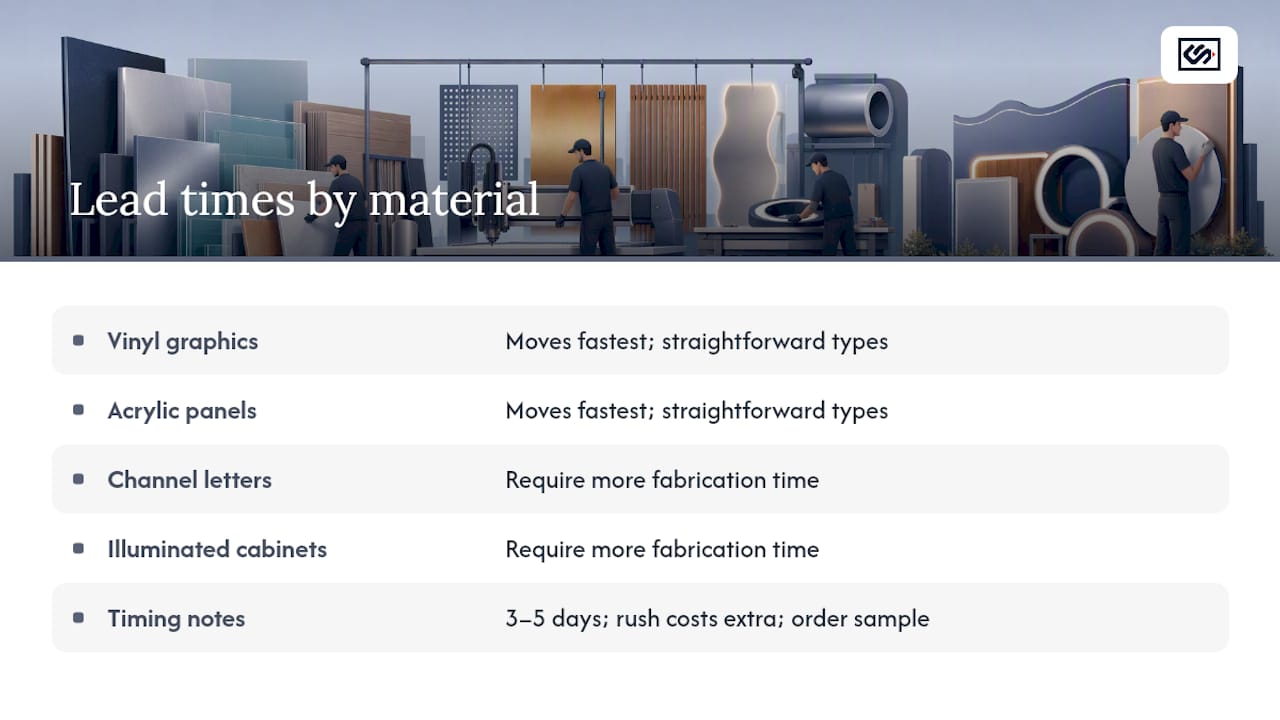
Standard bulk production typically runs 3–5 business days for straightforward sign types, with rush and priority options available when your timeline is tighter.
Rush production compresses the fabrication window but typically adds a premium to the per-unit cost. Build at least two business days of buffer between your estimated ship date and your install date to absorb transit variability.
Pro Tip: Order a sample or prototype unit before committing to a full run on a new material. A single sample can catch a color or finish mismatch that would cost far more to fix across 200 signs.
Who is responsible for what in a bulk sign order?
Clarity on responsibilities prevents the most common delays. Here is how the split typically works:
Vendor responsibilities:
- Fabricate signs to approved proof specifications.
- Conduct QC checks and provide production photos before shipping.
- Package and coordinate nationwide shipping, including multi-address drops.
- Assign a project manager as your single point of contact.
- Coordinate optional professional installation through a third-party installer.
- Honor warranty terms covering materials and workmanship.
Customer responsibilities:
- Provide accurate site photos, mounting substrate details, and exact delivery addresses.
- Secure any required local permits before the install date.
- Approve digital proofs within the agreed window.
- Pay the deposit to trigger production and the balance before shipping.
- Ensure site access and a point of contact on installation day.
Crispsign operates as a direct-to-business e-commerce platform: payment is collected at checkout, and optional installation is coordinated for a flat fee passed to a third-party installer.
What drives cost in a bulk sign order?
Per-unit price drops as quantity rises. Volume discounts typically begin at around 10 signs, with custom pricing available for orders of 100 or more units. Beyond quantity, these are the primary cost drivers:
- Material and finish: Vinyl graphics cost less per unit than channel letters or illuminated cabinets.
- Setup and engineering fees: One-time costs that spread across the run; larger orders absorb them more efficiently.
- Design charges: Many vendors include basic design assistance, but complex custom artwork may carry an additional fee.
- Rush fees: Priority production adds a premium, typically applied per order rather than per unit.
- Shipping: Freight (LTL) for large or heavy signs costs more than parcel; multi-address drops add per-stop fees.
- Installation: Coordinated professional installation is billed separately, usually as a flat fee per location.
When building your budget, request an itemized written quote that separates unit cost, setup, finishing, shipping, and installation as distinct line items. Ask specifically for the shipping insurance estimate and the installer rate per location.
Pro Tip: Compare your per-unit cost at two or three quantity tiers before finalizing your order size. Ordering 50 instead of 40 units sometimes costs less per sign than the smaller run.
How do shipping and installation work for multi-location orders?
Signs ship via parcel for smaller pieces and LTL freight for large-format or heavy fabrications. For multi-location businesses, vendors can ship to a single warehouse or split the order across multiple addresses, which reduces your internal distribution burden.
What to expect in packaging:
- Vinyl graphics: rolled or flat-packed with protective liner.
- Acrylic panels and cabinet signs: foam-padded and crated.
- Channel letters and monument signs: palletized with corner protection.
Shipping options to confirm with your vendor:
- Lift-gate service if your location lacks a loading dock.
- White-glove delivery for fragile or oversized pieces.
- Freight insurance and the claims process if damage occurs in transit.
For installation, you have three paths: DIY using the vendor's supplied templates and hardware, coordinated professional installation arranged by the vendor for a flat fee, or your own third-party installer working from the vendor's specs.
Installation day checklist:
- Confirm site access and a point of contact on location.
- Verify electrical is ready for any illuminated signs.
- Have mounting hardware and any required permits on site.
- Request a photo sign-off from the installer once complete.
What contract clauses protect you in a bulk sign order?
Most delays and cost surprises trace back to gaps in the contract. Lock these items down before you pay a deposit:
- Scope of work: Exact quantities, dimensions, materials, and finishes per SKU.
- Itemized pricing: Unit cost, setup, finishing, shipping, and installation as separate line items.
- Deposit and payment timeline: Deposit amount, when the balance is due, and accepted payment methods.
- Revision and refund policy: Number of included proof rounds, cost of additional revisions, and refund conditions.
- Lead-time SLA: Guaranteed production and ship dates, with remedies if the vendor misses them.
- Warranty terms: Coverage period, what is included (materials and workmanship), and the claims process.
- Shipping insurance and damage claims: Who files the claim, the timeline, and whether replacement or credit is offered.
- Installer liability: Who is responsible if installation damages the substrate or the sign.
- Quote expiration date: The date after which pricing and lead times are no longer guaranteed.
The most common problems in large-scale sign production are incomplete site info, late proof approvals, artwork that needs conversion from raster to vector, missed permits, and transit damage. Each one has a documented fix: lock approval windows in the contract, require timestamped proofs, specify vector file formats in the RFQ, confirm permit status before production starts, and include a freight insurance clause.
Pro Tip: Require production QC photos as a contractual deliverable, not a courtesy. A vendor who sends photos before shipping gives you a documented acceptance point that protects both sides.
Your ready-to-send RFQ checklist and email template
Send this checklist with every bulk sign quote request to get accurate pricing and realistic lead times on the first pass.
Order intake checklist:
- Quantity per sign type/SKU
- Exact dimensions (width x height x depth)
- Material and finish (e.g., acrylic, vinyl, aluminum, channel letters)
- Vector artwork files (PDF or AI) or brand guidelines (Pantone or hex color references)
- High-res print files (PNG or JPG at 150 DPI minimum at final size)
- Site photos showing mounting surface and surroundings
- Full delivery addresses for each location
- Target install date
- Permit status (secured, pending, or not required)
- Name and contact for proof approvals
Sample RFQ email:
Subject: Bulk Sign Quote Request — [Your Company Name]
Hi, I'd like a quote for a bulk sign order. Details below: Quantity: [X] signs across [Y] locations Sign type/material: [e.g., exterior channel letters, acrylic lobby panels] Dimensions: [W x H per unit] Artwork: [attached as vector PDF / brand guidelines attached] Delivery addresses: [attached list] Target install date: [date] Permit status: [secured / pending / not required] Please include itemized pricing, lead time with an expiry date, and shipping insurance options. Contact for approvals: [Name, email, phone]
Pro Tip: Always reference Pantone or hex codes rather than describing colors by name. "Forest green" means something different to every production team; PMS 357 C does not.
An editorial perspective on bulk sign orders
Most purchasing managers underestimate how much of the production timeline they control. The vendor's fabrication window is largely fixed once the order is in queue. What moves the schedule is how fast you approve proofs, how complete your site information is at RFQ, and whether your permits are secured before the install date arrives.
The contract checklist in this article is not bureaucratic caution. It is the difference between a smooth 6-week rollout and a 10-week scramble with rework charges. Vendors who push back on SLA language or refuse to issue timestamped proofs are telling you something about how they handle disputes. The ones who offer QC photos before shipping and assign a named project manager are the ones worth building a relationship with.
Bulk sign orders reward preparation. The buyers who send complete RFQs with vector files, site photos, and a real install date get accurate quotes faster, hit fewer revision cycles, and almost never pay rush fees.
Crispsign handles your bulk sign order from proof to install
Ordering 20 signs for a franchise rollout or 200 for a retail chain involves the same workflow, and the difference between a smooth launch and a costly delay usually comes down to who manages it. Crispsign delivers custom storefront signage nationwide, from exterior channel letters and illuminated cabinet signs to vinyl graphics and lobby panels, with an optimized production workflow built for SMB purchasing timelines.
Every order includes a written quote with a turnaround estimate and expiry date, a timestamped digital proof, production QC photos before shipping, freight insurance, and an assigned project manager. Optional coordinated installation is available as a flat-fee add-on. Request your quote with the RFQ checklist above and get a guaranteed lead time back the same day.
Sources
- Bulk Ordering – Popsigns Studio
FAQ
How long does a bulk sign order take from RFQ to install?
A standard bulk order typically runs 6 weeks from RFQ to installation. Standard production alone is 3–5 business days, with transit and installation adding time on top; expedited schedules can compress the full timeline to around 3 weeks with rush production.

What files do I need to submit for a bulk sign order?
Submit vector artwork as a PDF or AI file for cut lines, and high-resolution PNG or JPG files for print elements. Include Pantone or hex color references so production matches your brand standards exactly.
Who handles permits for storefront signs in the U.S.?
Permits are the customer's responsibility. Local sign codes vary by municipality, so confirm permit requirements with your city or county before your install date to avoid delays.
What happens if signs arrive damaged?
File a freight damage claim immediately with the carrier and notify your vendor in writing. A contract with explicit shipping insurance and a damage-claims SLA specifies the timeline and whether you receive a replacement or credit.
Does Crispsign support multi-location sign orders?
Yes. Crispsign ships to single or multiple addresses and offers optional coordinated professional installation per location, making it a practical choice for franchise rollouts and multi-site retail deployments.