
12×18 and 30 mil: Car Magnet Sizes with Shop Ready Specs

For most vehicles, the default car magnet size is 12"×18," which fits standard car and SUV doors with room to spare. Trucks and vans typically need 12"×24" or 18"×24" for door and side panels, compact cars often do better with 9"×12," and a 6"×18" strip works well for a phone-number-only sign. Whatever you choose, order at least 30 mil thickness for highway driving, and measure your vehicle's largest flat steel panel before you pick a size.
TL;DR:
- The most common car magnet size is 12×18 inches, suitable for most car doors, while larger sizes like 12×24 or 18×24 are designed for trucks and vans.
- Thicker magnets at 30 mil are recommended for highway driving, as thinner options like 20 mil are prone to lifting and damage at high speeds.
- Proper sizing depends on measuring the vehicle’s largest flat steel panel and subtracting about an inch of margin to ensure full contact and readability.
- Design should prioritize large, high-contrast fonts for quick three-second reading and limit clutter to maintain clarity at a distance.
- Ordering proofs and measuring panels beforehand helps prevent size inaccuracies, with custom die-cut options available for unusual vehicle shapes.
Table of Contents
- What Are the Standard Car Magnet Sizes?
- How Do I Choose the Right Size for My Vehicle?
- What Thickness Should Car Magnets Be?
- How Do You Make a Car Magnet Easy to Read?
- What's the Best Way to Order and Install Car Magnets?
- CrispSign's Production Approach to Custom Car Magnets
- Why Most Businesses Overthink Magnet Size and Underthink Everything Else
- Get Your Custom Car Magnets Made to Spec
- Sources
- FAQ
What Are the Standard Car Magnet Sizes?
Every print shop stocks a handful of go-to dimensions because they cover most vehicles on the road and keep production fast. Knowing what each size fits saves you a round of guessing and a possible reorder.
- 9"×12": Best for compact cars, hatchbacks, and any door with a tight, narrow flat zone.
- 12"×18": The most common car door magnet size, and the safe default for sedans, coupes, and mid-size SUVs.
- 12"×24": Sized for taller pickup and van doors where there's more vertical room to work with.
- 18"×24": Built for van and box truck side panels, giving fleet logos and messaging real presence.
- 24"×36": A large-format option for full-size fleet panels or box truck sides where you want maximum visibility.
- 6"×18": A slim strip perfect for a phone number, website, or short tagline placed under a larger logo.
- Small bumper and tailgate sizes (typically under 12"×12") for a secondary logo or contact info near the rear.
The most common car door magnet size is 12×18 inches, with 12×24, 9×12, and 18×24 rounding out the standard lineup for trucks, compact cars, and vans.
Whatever size you land on, keep the magnet fully inside the flat area of the panel. Don't let it bridge a door crease, wrap around a handle, or drape over a curved wheel well. Those spots stress the material, cause lifting, and make your message harder to read at a glance. Custom die-cut sizes are available if your vehicle has an unusual panel shape, but sticking to a standard size keeps ordering simple and your text legible from the street.
How Do I Choose the Right Size for My Vehicle?
Picking a size isn't about guessing what "looks right." It comes down to measuring the actual flat steel area you're working with and applying a simple margin rule.
- Find the largest flat panel. Usually the front door on a sedan, or the sliding door on a van. Avoid areas with body lines, trim, or curves.
- Measure width and height of that flat zone with a tape measure, not your eye.
- Subtract about 1 inch of margin on all sides as a rule of thumb, so the magnet doesn't hang off an edge or catch wind at the corners.
- Match your measurement to the nearest standard size that fits comfortably within it, rounding down if you're between two options.
- Test the panel with a small refrigerator magnet before you order. If it grabs firmly, you're set. If it barely holds, check for reduced steel content common in some newer vehicle panels and aluminum-bodied trucks.
The most common ordering mistakes aren't about picking the "wrong" style. They're measurement errors: magnets ordered too small to read from a lane over, or too large and bridging a door crease that eventually creases and peels the material itself. Body-filled or repainted panels can also cause weak spots where the steel doesn't sit flush.
Pro Tip: Snap a photo of your door with a tape measure held against it before you order. It takes ten seconds and eliminates almost every sizing mistake we see.
What Thickness Should Car Magnets Be?
Magnet thickness is measured in mil (one mil equals one-thousandth of an inch), and it directly affects how well your sign holds up at speed. Thin 20 mil material works fine for short trips around town, but it flexes and lifts more easily once you're cruising at 60 mph.
- 20 mil: Lightweight, budget-friendly, best for occasional local driving only.
- 30 mil: The practical minimum for regular vehicle use and highway miles.
- 40 mil and up: Best for curved panels, high-mileage fleets, or vehicles that live on the freeway.
Industry buyer guides recommend 30 mil or thicker as the baseline for vehicles that see regular highway use, since thicker material resists wind lift and conforms better to panels with a slight curve. If your driving is mostly city streets and parking lots, a lighter gauge can save you a little cost. But if you're logging freeway miles every week, don't cut corners here. Thicker stock also holds its shape better over time, so it won't develop the wavy, lifted edges that make a sign look worn out after a few months. Laminate finishes add another layer of UV and weather resistance, which matters more than most buyers expect once a magnet has spent a full summer on a dark-colored vehicle.
How Do You Make a Car Magnet Easy to Read?
A car magnet only works if someone can read it in the time it takes to pass your vehicle at a stoplight or on the highway. Designers call this the three-second read rule: if a driver can't absorb your main message in three seconds, the design has failed before it ever gets printed.
- Keep letter height for your primary message (your business name) large enough to read from 50 to 75 feet away. This generally means letters at least 3 inches tall on a 12"×18" magnet.
- Phone numbers and secondary text can run smaller, but shouldn't drop below 1.5 to 2 inches tall.
- Stick to one primary message and one clear call to action, like a phone number or website. Crowding a magnet with services, hours, and three social handles kills readability.
- Use high contrast, dark text on a light background or vice versa, and avoid thin, decorative fonts that disappear at a distance.
- Round your corners. It's a small design choice, but rounded corners reduce wind resistance at speed and hold up better over the life of the magnet than sharp square corners.
- Build in 1/8" to 1/4" of bleed around your artwork, and keep essential text inside a defined safe area so nothing critical gets trimmed during production.
Pro Tip: Print a test page at actual size and tape it to a wall. Walk back until you can just barely read it, then measure that distance. If it's under 30 feet, your text is too small for the road.
What's the Best Way to Order and Install Car Magnets?
Getting the size and thickness right only pays off if the ordering and install process is just as careful.
- Request a printed proof scaled to actual size before full production runs. A PDF preview on a screen doesn't reveal spacing or legibility issues the way a full-size printout does.
- Order at least two magnets so you can advertise on both sides of the vehicle, not just one.
- Clean the panel thoroughly with soap and water before applying, since dirt and wax buildup weaken the magnetic hold.
- Remove the magnet every 2 to 3 days, or follow the manufacturer's specific guidance, to prevent moisture and paint issues underneath.
- Store magnets flat, dry, and away from heat when not in use. Never fold or roll them. If edges start to lift or curl, re-laminate or replace rather than pushing a worn sign back onto the vehicle.
If you're ordering for a fleet, build in extra lead time and ask for a reusable template so every additional vehicle gets a consistent size and layout without starting the design process from scratch.
CrispSign's Production Approach to Custom Car Magnets
Getting a magnet from idea to installed sign comes down to five steps: measure, proof, print, quality check, ship. Custom vehicle magnet orders typically start with your actual panel measurements rather than a generic template, so the proof you approve reflects the real flat area on your vehicle.
For most vehicles, that still means landing on a standard size like 12"×18" or 12"×24" at 30 mil thickness, printed with UV-resistant laminate and rounded corners baked into the die-cut. If you're ready to move from measurements to a real proof, the corporate ordering portal walks multi-location brands through sizing and quantity in one pass.
Why Most Businesses Overthink Magnet Size and Underthink Everything Else
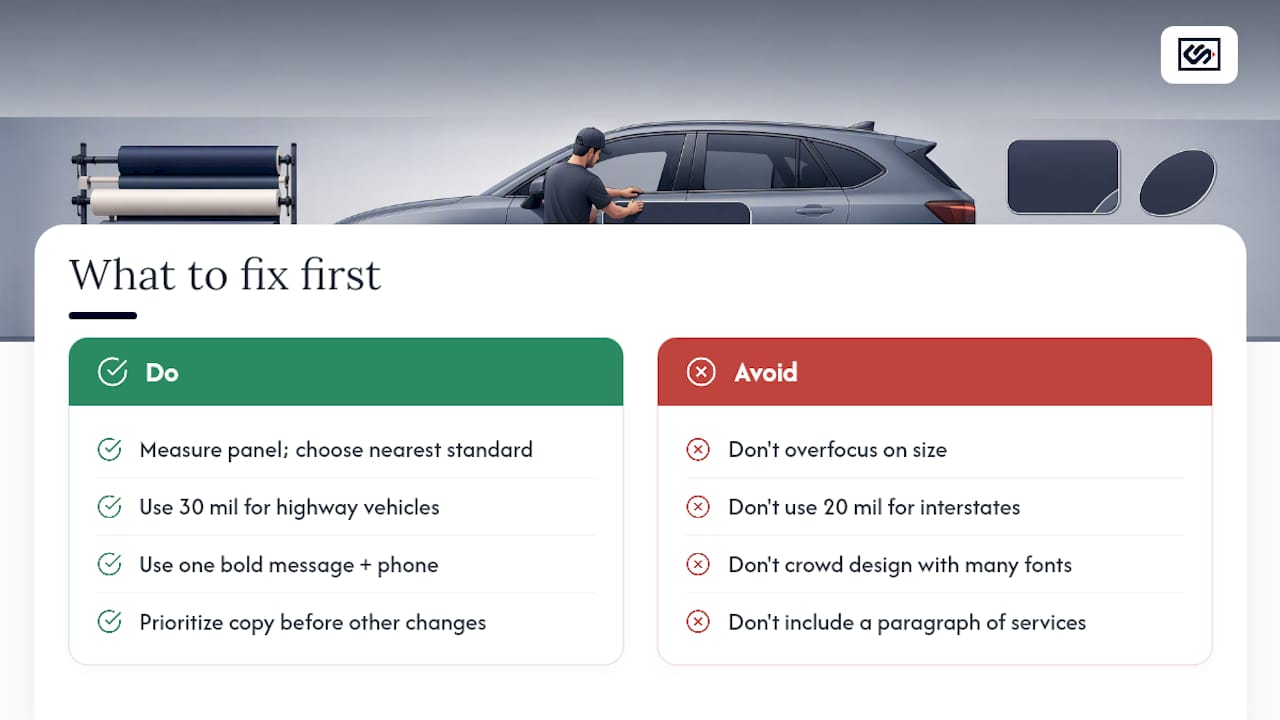
The research on this topic points to a clear imbalance: buyers spend most of their decision-making energy on size, when size is actually the easiest variable to get right. Measure the panel, pick the nearest standard dimension, done. Where businesses actually lose money is thickness and design. A 20 mil magnet on a car that spends real time on the interstate is a magnet you'll be reordering within a year, and a crowded design with four different fonts and a paragraph of services is a magnet nobody reads at all.
Conventional advice treats these as separate checklist items. They're not. A perfectly sized magnet with weak thickness and cluttered copy performs worse than a slightly smaller magnet at 30 mil with one bold message and a phone number. If you only fix one thing after reading this, fix the copy. Most vehicle magnets fail at the three-second read test long before they fail at the material level, and that's the cheapest problem to solve.
— Nick
Get Your Custom Car Magnets Made to Spec
Vehicle magnets are generally built around specs like standard sizing such as 12"×18" for cars or 18"×24" for van panels, 30 mil thickness as a baseline for highway driving, and rounded corners with laminate protection. That's a different starting point than ordering blind off a generic template and hoping the size fits when it arrives.

Instead of guessing at dimensions, you can measure your panel, request a free proof, and see exactly how your design looks at true size before anything gets printed. If you're outfitting a single vehicle or a full fleet, the Crisp Corporate portal is built to handle both, with sizing and quantity options in one order flow. Head over, enter your measurements, and get a proof back before you commit to a print run.
Sources
- Custom Car Magnets: The Complete Buyer's Guide — Promotional Product Inc.
- Car & Vehicle Magnet Sizes (Standard Dimensions + Print Specs) — Kapa99
FAQ
What Is the Standard Size for a Car Magnet?
The most common standard size is 12"×18," which fits most car and SUV doors. Trucks and vans often use 12"×24" or 18"×24" instead, depending on panel size.
What Are the Standard Sizes of Magnets for Vehicles?
Common standard sizes include 9"×12" for compact cars, 12"×18" for standard doors, 12"×24" for trucks and vans, 18"×24" for van side panels, and 24"×36" for large fleet panels. A 6"×18" strip is also common for phone-number-only signs.
What Is the Best Thickness for Car Magnets?
A 30 mil thickness is the practical minimum for regular vehicle use, especially highway driving, since it resists wind lift better than thinner material. Vehicles that log heavy freeway miles or sit on curved panels often do better with 40 mil or thicker.
How Do I Know What Size Magnet Fits My Car?
Measure the largest flat steel panel on your vehicle, subtract about an inch of margin on each side, then choose the nearest standard size that fits within that space. Avoid panels with creases, handles, or curves, since magnets need full contact with a flat surface to stay in place.
Can I Order a Custom Size Instead of a Standard One?
Yes, most print shops including Crispsign can produce custom die-cut sizes for unusual panels, though standard sizes like 12"×18" are faster to produce and easier to read at a glance since they're designed around common vehicle dimensions.