
20 Year Durability: Cedar vs Redwood for Decks, Fences, Siding
Redwood is the better pick for premium decking, exposed siding, and any build where color consistency and long-term density matter, especially in clear or old-growth grades. Western red cedar wins for moisture-prone sites, fencing, and budget-driven projects thanks to its natural rot resistance and lighter price tag. Climate and grade shift both answers: knotty cedar in a humid climate won't outlast clear redwood, and young-growth redwood won't match old-growth performance. The sections below break down appearance, longevity, cost, and a buying checklist so you can match the wood to your actual project.
TL;DR:
- Redwood's durability mostly applies to old-growth heartwood, which resists decay for over 20 years, while young-growth redwood offers only moderate resistance.
- Knotty cedar is generally more affordable and easier to work with but has lower density and less decay resistance than clear-heart redwood.
- Both woods weather to a silver-gray patina in outdoor use and require reapplication of sealers or stains every one to three years to maintain appearance.
- Redwood's limited supply and regional scarcity can cause price volatility, especially for high-quality or reclaimed grades.
- For longevity in high-exposure projects, redwood typically outperforms cedar, but cedar works well in moisture-prone sites and is easier to install.
Table of Contents
- Cedar vs Redwood Appearance: Color, Grain, and Aging
- Redwood Durability vs Cedar: What the Research Actually Shows
- Cedar vs Redwood Cost: What You'll Actually Pay
- How to Maintain Cedar and Redwood for Maximum Lifespan
- Best Uses for Cedar and Redwood by Project Type
- How to Tell Cedar From Redwood at the Lumberyard
- Buying Checklist: How to Pick the Right Boards
- Workability and Installation Notes
- Sustainability and Sourcing: Where Each Wood Comes From
- Cedar vs Redwood: A Straightforward Rule of Thumb
- A Professional Alternative for Carved Cedar Signage
- Sources
- FAQ
Cedar vs Redwood Appearance: Color, Grain, and Aging
Redwood heartwood runs from soft pink to a deep, wine red, with a straight, tight grain that reads as almost uniform from board to board. Western red cedar swings wider, from pale honey tones to reddish amber, often with more visible knots and a looser grain pattern unless you're buying clear stock. That density difference isn't just cosmetic. Denser, straight-grained coast redwood tends to hold a finish more evenly, while cedar's varied grain can take stain unevenly across a single board.
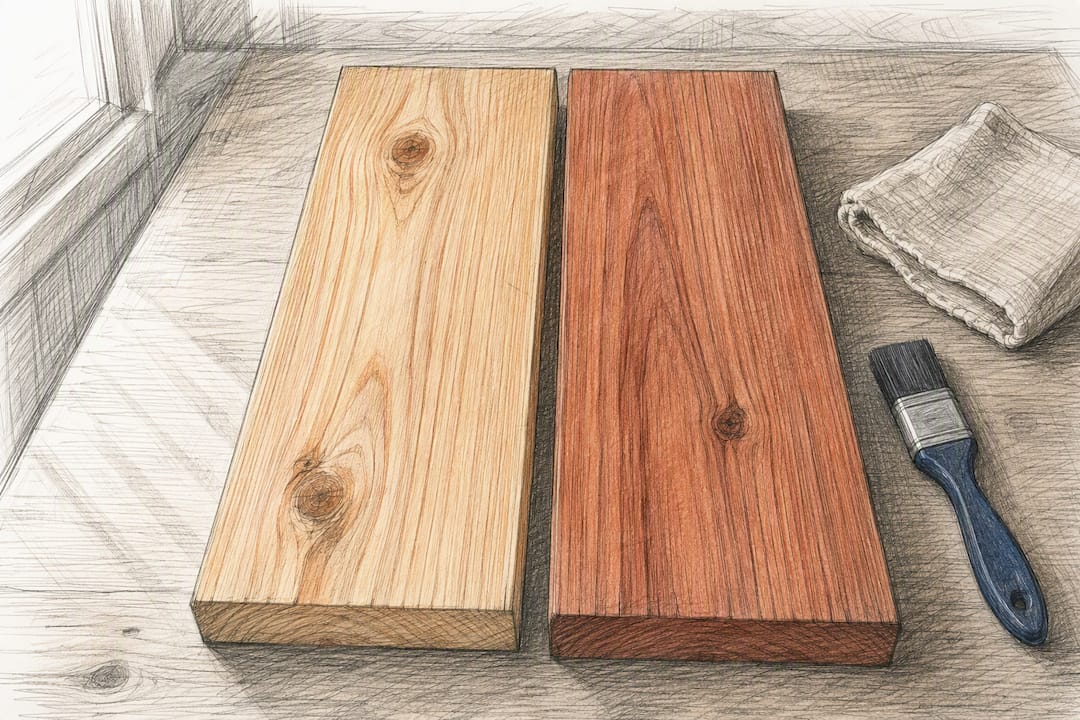
Left unfinished, both woods weather to a similar silver-gray patina within one to three years outdoors, which surprises a lot of first-time buyers who assumed the rich color was permanent. Sealers and semi-transparent stains slow that shift and let you keep the original tone, but both species need recoating to maintain it.
Grade changes the picture as much as species does:
- Clear-heart redwood or cedar shows no knots and the most consistent color, at the highest price point.
- Knotty grades in either species cost less but show more visual variation and small voids.
- Sapwood streaks (paler, less durable wood) lower both appearance grade and decay resistance.
Pro Tip: Order one sample board of your intended grade before committing to a full order. Photos on a supplier's site rarely capture how much a knotty grade varies board to board.
Redwood Durability vs Cedar: What the Research Actually Shows
Redwood's reputation for durability isn't marketing talk. Old-growth heartwood is rated "resistant or very resistant" to decay by the USDA Forest Products Laboratory, largely because of natural extractives that build up over centuries of slow growth. Young-growth redwood, which is what most retail lumber actually is today, only rates "moderately resistant." That's a meaningful gap, and it's why two boards labeled "redwood" can perform very differently outdoors.
Western red cedar closes some of that distance with its own defense mechanism: natural compounds called thujaplicins that resist both fungal decay and insects.
Long-term exposure testing has grouped redwood and western red cedar heartwood together in the most decay-resistant category for above-ground use, with expected service life often exceeding 20 years in moderate climates.
Hardness tells a different part of the story. On the Janka hardness test, western red cedar rates around 350 lbf, soft enough that a dropped tool or a dog's claws can leave a mark. Redwood generally runs denser and harder, which is part of why it dents less on high-traffic decking. Neither wood approaches hardwood territory, but the gap matters if you're comparing a busy deck to a low-traffic fence.
Climate is the wildcard in every one of these numbers. Coastal fog, high humidity, and heavy rainfall shorten service life for both species compared to the drier, moderate climates where most exposure studies land their 20-year estimates.
Cedar vs Redwood Cost: What You'll Actually Pay
Price is where cedar usually wins outright, but the range within each species is wider than most first-time buyers expect. Clear-heart grades in either wood cost noticeably more than knotty stock, and that price gap often outweighs the difference between the two species at the same grade level.
- Knotty western red cedar tends to sit closest to budget territory, priced as a step up from pressure-treated pine but well below premium hardwoods.
- Clear-heart cedar climbs sharply from there, since clear boards are harder to mill from a knotty log.
- Redwood, especially old-growth or certified reclaimed stock, commands the highest board-foot prices of the two because supply is geographically limited to a narrow strip of the Pacific coast.
That limited redwood supply also means price volatility. A regional shortage or a bad wildfire season can swing redwood pricing more than cedar's broader, more distributed supply chain typically sees.
Pro Tip: Run the math on lifecycle cost, not just sticker price. A clear-heart board that lasts 25 years without warping can cost less per year of service than a cheap knotty board you refinish or replace every five.
How to Maintain Cedar and Redwood for Maximum Lifespan
Neither wood is maintenance-free outdoors, no matter what a showroom display implies. Both benefit from a finish applied before the first season of exposure and reapplied on a predictable schedule.
- Choose a penetrating oil or semi-transparent stain for color retention on either species, and expect to recoat every one to three years depending on sun and rain exposure.
- Use stainless steel or silica-coated fasteners. Redwood's natural tannins react with standard steel hardware, causing dark streaking, and galvanized fasteners can corrode faster in cedar's acidic wood chemistry.
- Keep both species out of direct ground contact unless the lumber is specifically rated for it. Ground moisture defeats even old-growth redwood's natural resistance over time.
- Leave an air gap behind siding installations. Trapped moisture behind cedar or redwood boards is one of the most common causes of premature rot, and it has nothing to do with the wood's inherent quality.
Pro Tip: If you see dark streaks running down a redwood fence or deck board, that's tannin bleed, not rot. A wood brightener followed by a proper sealer usually restores the surface.
Best Uses for Cedar and Redwood by Project Type
Matching the wood to the job matters more than picking an overall "winner." Redwood's density and color consistency make it the stronger choice for high-end decking and exposed siding where a uniform, rich appearance justifies the higher board-foot cost. It also holds up well in dry to moderate climates where its natural decay resistance gets to do its job without constant saturation.
Western red cedar fits moisture-prone sites, fencing, and any project where dimensional stability and easy workability matter more than raw density. Cedar resists warping and cupping as humidity swings, which is exactly the behavior you want in a fence that sees rain one week and blazing sun the next.
- Decking: redwood for premium, color-consistent builds; cedar for a lighter-weight, budget-friendly deck.
- Siding: redwood for uniform appearance-grade exteriors; cedar for shingle-style siding in wetter regions.
- Fencing: cedar, most of the time, for cost and stability across seasonal moisture swings.
- Furniture: either, depending on whether you want redwood's density or cedar's lighter weight and easier hand tooling.
- Carved or architectural signs: cedar, almost universally, because its softness and workability let a carver cut fine detail without fighting the grain, and it holds paint and stain exceptionally well.
How to Tell Cedar From Redwood at the Lumberyard
Mislabeled boards happen more often than suppliers like to admit, so a quick check protects your budget. Redwood runs pink to deep red with a tight, straight grain, while cedar shows a wider color range and looser grain with more visible knots. Cedar also has a noticeably stronger, spicier aromatic smell when cut. Redwood carries a milder scent.
- Pick up a board. Redwood feels denser and heavier for its size.
- Check the sapwood, the paler outer wood. A wide band of pale sapwood on either species means lower decay resistance.
- Ask for the grade stamp or mill certificate. A supplier who can't produce one is a red flag.
Buying Checklist: How to Pick the Right Boards
Work through this order before you sign off on a lumber order or a contractor's quote:
- Define your exposure. Full sun, ground contact, coastal humidity, and deep shade each favor different grades.
- Pick species and grade together, not separately. A knotty redwood board isn't automatically better than a clear cedar board.
- Confirm heartwood percentage and kiln-drying status. More heartwood means more natural decay resistance; kiln-dried stock resists warping better than air-dried.
- Compare board-foot pricing across at least two suppliers before committing to a large order.
- Verify FSC certification if sustainable sourcing matters to your project.
- Inspect a physical sample, not a photo, before ordering in volume.
Watch for red flags: vague species labeling ("cedar-look" or "redwood-style" instead of a named species), no visible grade stamp, or pricing well below the regional norm.
Pro Tip: A quick formula that works for most homeowners: high exposure plus high budget points to clear redwood; high moisture plus tighter budget points to knotty cedar.
Workability and Installation Notes
Cedar is the more forgiving wood to work with on a job site. Its lower density means it cuts, drills, and sands faster with less tool wear, and it takes screws and nails without pre-drilling in most cases. That workability is exactly why cedar dominates detailed millwork and hand-carved signage: cedar's low density lets a carver chase fine detail that would fight a denser wood.
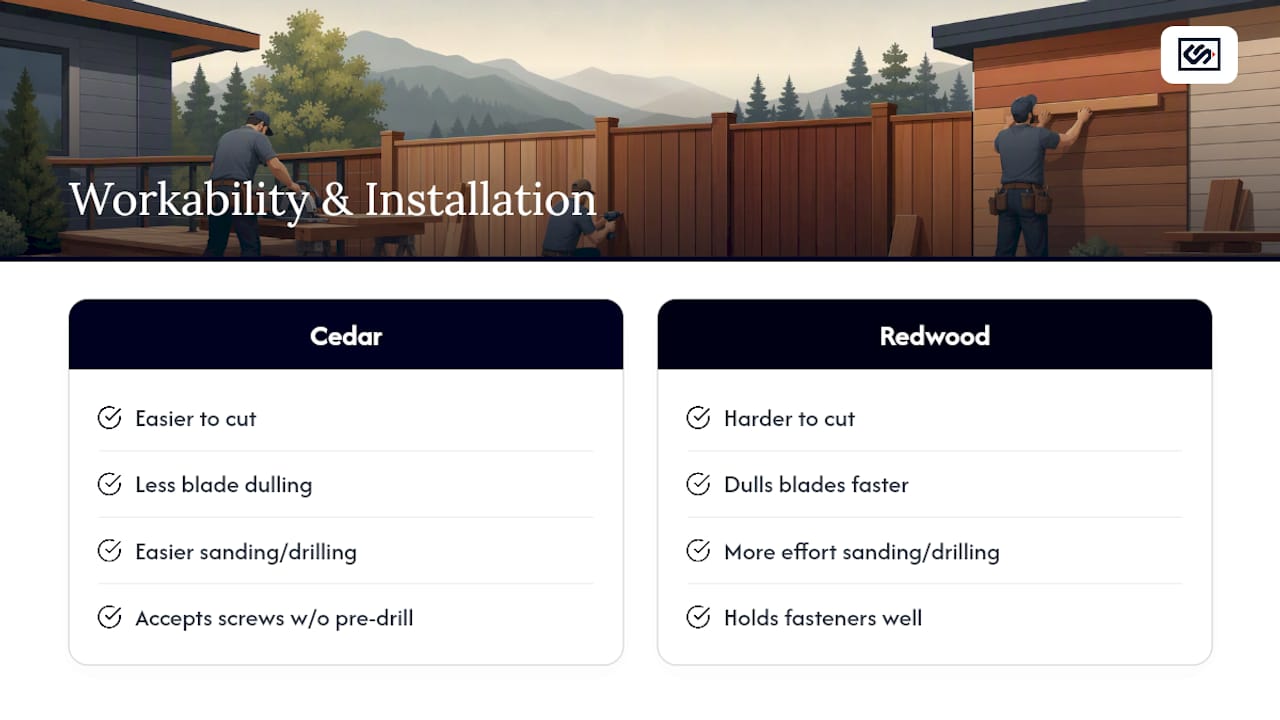
Redwood's added density is a double-edged sword during installation. It holds fasteners well and resists splitting near board ends, but it dulls blades faster and requires slightly more effort to cut cleanly, especially in old-growth stock. Both woods respond well to standard woodworking tools, so a homeowner with a basic circular saw and drill can handle either species for a DIY deck or fence.
One installation detail trips up a lot of first-timers: pre-drilling near board ends. Skipping this step on either species, especially in colder weather when wood is more brittle, is a common cause of split boards during fastening. If you're working with reclaimed or old-growth material, a project like the ones detailed in reclaimed redwood lumber sourcing shows how grade and harvest history affect how a board behaves under the saw. Acclimating lumber to your local humidity for a few days before installation also reduces warping after the fact, a step worth the patience on any project you want looking good five years from now.
Sustainability and Sourcing: Where Each Wood Comes From
Redwood's biggest sourcing constraint is geography. It grows naturally only along a narrow coastal strip from central California into southern Oregon, which means every board traveled a real distance to reach most lumberyards outside that region. Old-growth harvesting is heavily restricted today, so the vast majority of retail redwood is young-growth, farmed on a rotation, and carries the "moderately resistant" decay rating rather than old-growth's stronger numbers.
Western red cedar has a wider natural range across the Pacific Northwest and into Canada, giving it a more distributed, generally more stable supply chain. That geographic spread is part of why cedar pricing swings less than redwood's during regional shortages.
For buyers who care about sourcing, FSC certification is available for both species and worth asking about directly, since it's not always advertised on a price tag. Reclaimed redwood, salvaged from old structures or fallen old-growth trees, offers a way to get old-growth-level density and character without new old-growth harvest. If sourcing philosophy matters as much as performance for your project, material selection choices like these tend to affect installation outcomes as much as long-term durability.
Cedar vs Redwood: A Straightforward Rule of Thumb
The choice usually comes down to one honest question: how much maintenance will you actually do, and how much does the exposure demand? Match the species to that reality rather than to whichever wood photographs better online. If appearance is the priority, buy clear grades in either species and commit to a real recoating schedule. If budget is the priority, knotty cedar is a sound choice as long as you accept more visual variation and a shorter maintenance interval. Either way, confirm the grade stamp and get a sample board before placing a large order. That five-minute check prevents most of the regret buyers feel a year later.
— Nick
A Professional Alternative for Carved Cedar Signage
If your project has shifted from decking or fencing toward a carved sign for your storefront, DIY carving is a much bigger undertaking than staining a deck board. Professional signmakers build custom carved cedar signs designed to customer specifications, using cedar's natural workability and finish-holding qualities to produce crisp lettering and detail that stays sharp for years outdoors.

Every sign ships nationwide, and you can choose straightforward DIY mounting or coordinated professional installation if you'd rather not climb a ladder yourself. Cedar's low density and classic amber-to-red coloring make it the standard choice for exterior signage precisely because it takes carved detail and stain evenly, the same qualities that make it a favorite for fencing and siding. If you want a professional-grade result without sourcing lumber and carving it yourself, get a quote for a custom carved cedar sign and see your design specs turned into a finished sign built to order.
Sources
- USDA Forest Products Laboratory — Redwood (Sequoia sempervirens) summary
- Wood Database — Coast redwood
- Cedar wood benefits and uses — WoodworkingAdvisor
FAQ
What lasts longer, redwood or cedar?
Old-growth redwood typically outlasts cedar thanks to its "resistant or very resistant" decay rating, but young-growth redwood, most of what's sold today, performs closer to western red cedar. Both land in the same top decay-resistance class for above-ground use, with service life often exceeding 20 years in moderate climates.
How can you tell if wood is redwood or cedar?
Check color first: redwood runs pink to deep red with a tight, straight grain, while cedar shows a wider honey-to-amber range with more visible knots. Cedar also has a stronger, spicier smell when freshly cut, and redwood feels noticeably denser in hand.
What's more expensive, redwood or cedar?
Redwood generally costs more than cedar at comparable grades, largely because its natural growing range is limited to a narrow Pacific coastal strip. Grade matters just as much as species, though, since clear-heart boards in either wood cost significantly more than knotty stock.
What are the disadvantages of cedar wood?
Cedar's biggest drawback is its low hardness, rated around 350 lbf on the Janka scale, which makes it prone to dents and dings compared to denser woods like redwood. Knotty cedar grades also show more visual variation, and inconsistent grain can take stain unevenly without careful prep.
Is cedar or redwood better for a deck?
Redwood tends to be the stronger pick for high-end decking because of its density, dent resistance, and color consistency. Cedar remains a solid, lighter-weight, and generally more affordable alternative, especially in wetter climates where its natural rot resistance holds up well.