
Cut Sign Lighting Energy 60% For Facilities With Code Metrics & Controls
LED modules, paired with photocell or timer controls, deliver the most energy efficient sign lighting available today, cutting electricity use significantly compared to neon or fluorescent systems. ENERGY STAR and the U.S. Department of Energy both back LEDs as the baseline technology for commercial lighting upgrades. But the technology alone isn't enough. You also need to meet local wattage limits and use basic controls to capture the full savings.
TL;DR:
- Switching to LED modules, strips, or retrofit kits significantly reduces energy use and prolongs sign lifespan compared to neon and fluorescent options.
- Local wattage limits and code requirements must be confirmed before selecting fixtures to avoid failed inspections or costly retrofits.
- Installing controls such as photocells, timers, and dimming systems can cut operational costs further by optimizing sign brightness according to ambient light and time.
- Proper fixture placement, maintenance, and correct specification adherence are essential to sustain energy savings and prevent early system failures.
- Utility rebates and ENERGY STAR guidance can further accelerate return on investment in energy-efficient sign upgrades.
Table of Contents
- Energy Efficient Sign Lighting Technologies Worth Specifying
- Sign Lighting Energy Limits and Compliance Metrics
- Controls That Multiply Your Savings
- How to Calculate the Right Light Level for Your Sign
- What Retrofit Payback Actually Looks Like
- Installation and Maintenance That Protects Your Investment
- Why Efficiency Starts at the Spec Sheet, Not the Install
- Get an Energy-Conscious Sign Quote
- Where to Verify Codes and Efficiency Data
- Sources
- FAQ
Energy Efficient Sign Lighting Technologies Worth Specifying
LED technology now covers nearly every sign format a business owner might need, and each format trades off differently on brightness, lifespan, and installation complexity.
- LED module strings are discrete point sources wired in series, common in channel letters and cabinet signs. They're easy to replace individually if one fails.
- Edge and linear LED strips run along the perimeter of a cabinet or channel, throwing light inward for even coverage without hot spots. Some edge systems, like the Tetra EdgeStrip line, report energy savings of up to roughly 78% versus T8 fluorescent retrofits in comparable cabinet applications.
- Backlight modules sit behind the face of shallow cabinet signs, built for even illumination across large panel areas.
- Retrofit kits swap fluorescent or neon components for LED equivalents inside an existing cabinet, avoiding a full sign replacement.
Efficacy for quality LED sign products typically runs well above older lamp technologies on a lumens-per-watt basis, and rated lifetimes commonly stretch into the tens of thousands of hours. Neon tubing and fluorescent lamps burn out faster and run hotter, which drives up both energy use and replacement labor. For shallow cabinets, edge strips usually win on uniformity. For channel letters, discrete modules remain the standard. For exterior flood-lit monument or building signage, higher output LED floods with tighter beam control handle the job most efficiently.
Sign Lighting Energy Limits and Compliance Metrics
Before you pick a fixture, you need to understand the numbers that govern how much light your sign is legally allowed to use and how bright it actually needs to be.
Many jurisdictions cap illuminated signage under watts-per-square-foot rules modeled on Title 24-style energy codes, which set a maximum lighting power allowance per square foot of sign face. Exceeding that allowance can mean a failed inspection or a required retrofit before a certificate of occupancy is issued. Local code officials, not national guidance, set the exact enforcement numbers for your address, so confirm your jurisdiction's specific limit before finalizing a design.
A few terms show up constantly in spec sheets and code language:
- Lumens measure total light output from a source.
- Lumens per watt (efficacy) measures how much light you get for the electricity spent, the core metric for comparing LED, fluorescent, and neon options.
- Candelas measure light intensity in a specific direction, relevant for beam-focused fixtures like exterior floods.
- Footcandles measure how much light actually lands on a surface, which is what determines legibility.
- Light loss factor (LLF) accounts for dirt, lens degradation, and driver aging over a fixture's life, and it should be built into every design calculation, not just the initial output number.
LED bulbs typically use significantly less energy than incandescent lighting, and ENERGY STAR's lighting upgrade guidance treats LED conversion as one of the single highest-impact steps a commercial property can take. The Department of Energy reinforces this, noting LED fixtures typically draw far less electricity than incandescent or fluorescent alternatives while delivering comparable or better output.
Controls That Multiply Your Savings
Swapping to LEDs is step one. Controls are what turn a good sign into a genuinely low-cost one to operate, and they're some of the cheapest upgrades available.
- Photocells switch signs on at dusk and off at dawn automatically, eliminating the wasted daylight hours a manual timer often misses.
- Astronomical timers track sunrise and sunset by date and location, adjusting run times across the seasons without any manual resetting.
- Selectable dimming lets you run signage anywhere from 10% to 100% output, useful for reducing brightness during off-peak overnight hours.
- Networked, scheduled controls apply different lighting levels by time block, useful for multi-sign or multi-location operations that want centralized adjustments.
The Lighting Controls Association notes that photocells and timers remain the cheapest first step for exterior signage, with networked dimming layered on top for further reductions once the basics are in place. Placement matters: mount photocells where they read ambient light accurately, away from the sign's own glow or nearby floodlights, or you'll get false triggers that switch the sign on during daylight.
Pro Tip: Set a dimming schedule that steps sign brightness down after your last regular closing hour and back up before your busiest morning traffic. Most passersby won't notice the difference, but your utility bill will.
How to Calculate the Right Light Level for Your Sign
Overspecifying brightness is one of the most common ways businesses waste money on signage, and it usually happens because nobody ran the numbers before ordering.
The calculation starts with a target footcandle level for your sign's viewing conditions, then adjusts for real-world losses. Signage lighting guides commonly recommend starting around 40 footcandles for typical urban signage applications, with adjustments up or down depending on your local lighting zone (LZ1 through LZ4), which reflects how much ambient light already exists in the area.
From there:
- Apply a light loss factor, commonly around 0.8, to account for dirt buildup and driver aging over the fixture's life.
- Convert your adjusted footcandle target into required lumens or candelas based on the fixture's throw distance and beam angle.
- Set setback roughly equal to sign height, and space fixtures at about twice the setback distance for even coverage without visible hot spots.
- Factor in face material reflectance. A duller or more textured face absorbs more light and needs a brighter source to hit the same footcandle target.
Beam spread and optics decide the rest. Asymmetric optics throw light unevenly on purpose, useful for grazing a tall monument sign from a low mounting point. Linear edge lighting suits flat, evenly lit cabinet faces, while point modules work better where you need to steer light around interior structural elements. Getting setback and reflectance right the first time avoids the common trap of over-lighting to compensate for poor placement.
What Retrofit Payback Actually Looks Like
The math on an LED retrofit is straightforward once you lay out every cost line, not just the fixture price.
Total cost includes the LED modules or strips themselves, compatible drivers, installation labor, and disposal of the old neon or fluorescent hardware. Operating cost comes down to kilowatt-hours consumed multiplied by your utility rate, plus ongoing maintenance, which drops sharply with LEDs since you're no longer replacing burned-out tubes every year or two.
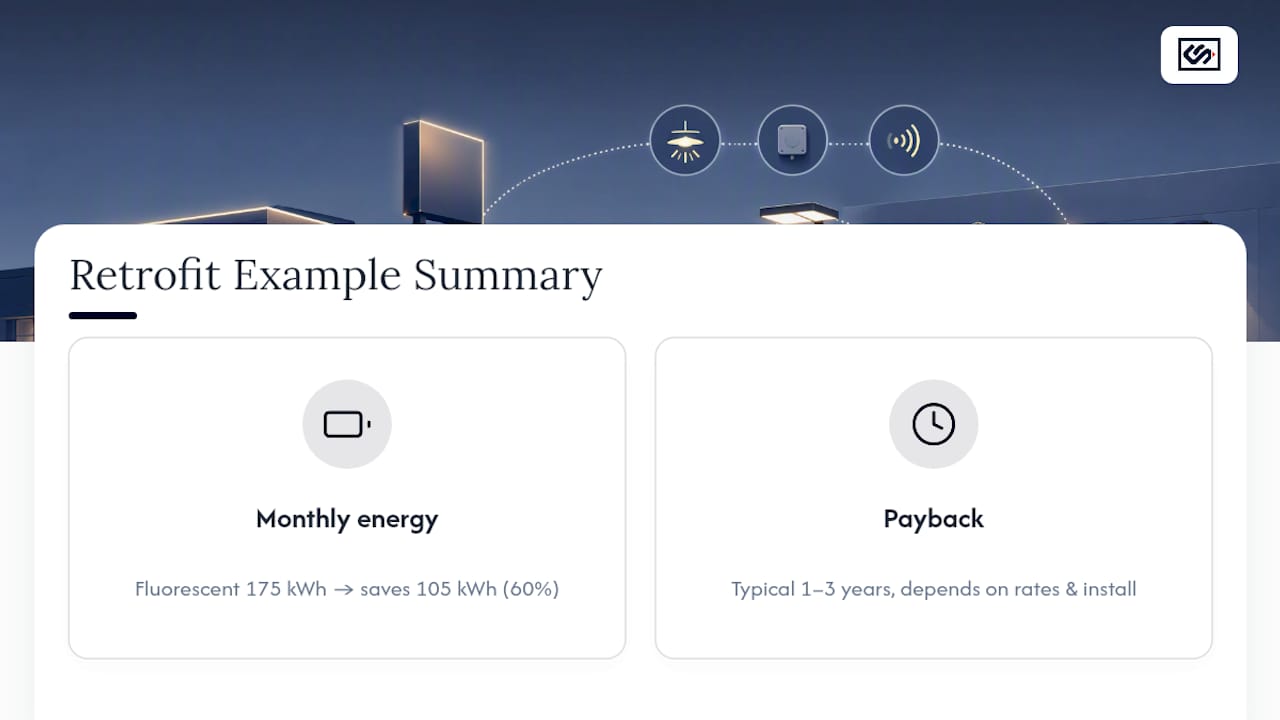
A simplified example: a cabinet sign drawing 400 watts of fluorescent lighting running 12 hours a day consumes roughly 175 kilowatt-hours a month. An LED retrofit cutting that load by 60% saves around 105 kilowatt-hours monthly, which at typical commercial utility rates can pay back the retrofit cost within one to three years depending on local electricity pricing and installation complexity.
Commercial lighting represents a substantial share of total electricity use in U.S. buildings according to EIA data, which is exactly why lighting retrofits remain one of the most reliable places to find real operating savings. Before finalizing a budget, check for utility rebate programs and ENERGY STAR product guidance on qualifying signage displays, since many utilities offer direct incentives that shorten payback further.
Installation and Maintenance That Protects Your Investment
A well-chosen LED system can still underperform if it's installed or maintained poorly.
- Confirm driver wattage headroom before installation. A driver running at its absolute limit degrades faster and shortens the life of the whole fixture.
- Check IP and IK ratings for any exterior-facing components. Weather sealing and impact resistance matter more on street-facing signs than most buyers expect.
- Add surge protection on exterior circuits, since power spikes are a leading cause of premature LED driver failure.
- Match color temperature to your brand and surroundings. Mismatched white points make signs look dim even when the raw output is fine.
- Set a cleaning and inspection schedule. Dirty lenses and loose connectors quietly steal light output over time, and a lens 20% dirtier than spec can push your effective footcandle level below your design target.
Avoid overdriving LEDs beyond their rated current just to squeeze out more brightness. It cuts lifespan dramatically for a marginal gain. Poor ventilation inside cabinet housings causes the same problem from a different angle, since heat is the primary driver of LED degradation over time.
Why Efficiency Starts at the Spec Sheet, Not the Install
Most sign lighting failures aren't really lighting failures. They're specification failures that show up later as a dim sign, a blown driver, or a utility bill nobody budgeted for.
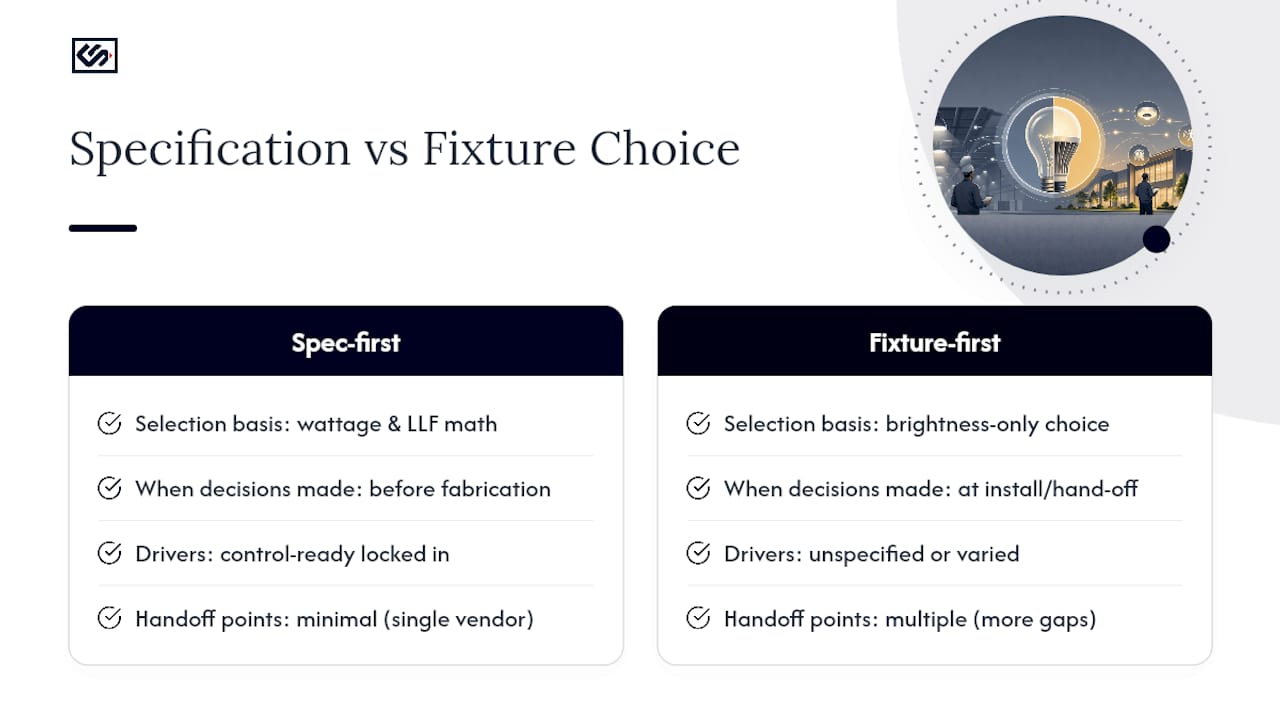
The pattern is consistent: someone picks a fixture based on brightness alone, skips the wattage-per-square-foot math, ignores light loss factor, and ends up either overspecified (wasting energy) or underspecified (looking dim within a year as components degrade). Some sign production processes are designed to avoid exactly that gap. Design specifications for LED modules and control-ready drivers can be locked in before fabrication starts, so the sign that ships matches the sign that was calculated, not a rough approximation of it.
That matters more than most buyers realize, because a design → fabrication → optional installation coordination workflow removes the handoff points where specification errors usually creep in. When one vendor controls the process from module selection through build quality, the uniformity and efficiency you designed for is the uniformity and efficiency you actually get on the wall.
— Nick
Get an Energy-Conscious Sign Quote
You've seen what separates an efficient sign from an expensive mistake. Some sign providers build that difference directly into the ordering process, so you're not left guessing whether your channel letters or cabinet sign will actually hit the wattage and brightness targets you calculated.
Order custom LED-lit cabinet signs, channel letters, or retrofit-ready parts online, built to your specifications and shipped nationwide, with optional coordinated professional installation if you'd rather not handle mounting yourself. If you manage signage across multiple locations, the Crisp Corporate portal gives multi-location brands a single place to order consistent, energy-conscious signage across every site. Upload your artwork or request a spec sheet today, and get a quote built around the efficiency numbers that actually matter for your sign.
Where to Verify Codes and Efficiency Data
Local code enforcement varies by jurisdiction, so treat these as starting points, not final answers, and confirm Title 24-style wattage limits with your local code official before finalizing a design.
- ENERGY STAR's lighting upgrade guidance and signage display specs for product-level efficiency benchmarks.
- EIA's commercial lighting consumption data for baseline energy use figures.
- The International Dark-Sky Association for guidance on limiting glare and spill light from exterior signage.
Sources
FAQ
What is the most energy-efficient lighting for signs?
LED modules and LED strips are the most energy-efficient option for illuminated signage, using far less electricity than neon or fluorescent systems while lasting significantly longer.
What lighting change actually lowers an electric bill?
Switching sign lighting from fluorescent or neon to LED, then adding photocells or timers to eliminate daytime and off-peak run time, produces the largest measurable drop in electricity cost.
What is the symbol for energy efficiency on lighting products?
The ENERGY STAR label is the primary symbol used in the U.S. to identify lighting and electronics that meet federal energy efficiency benchmarks.
What are the most energy-efficient lighting options for commercial signage?
LED module strings, edge and linear LED strips, and LED backlight modules cover most commercial sign formats, each suited to different cabinet depths and mounting styles.
Does this company help with energy-efficient sign specifications?
Yes. Some companies build custom LED-lit channel letters, cabinet signs, and retrofit parts to your design specifications, with control-ready drivers built into the production process.