Signmaker's Frosted Acrylic Panels: 0.080–0.220 In Picks That Hold Up to Cutting
For most privacy screens and backlit signage, choose a continuously processed frosted acrylic panel between 0.080" and 0.220" thick. That thickness range holds diffusion quality through cutting and drilling without adding unnecessary weight. If fingerprints and abrasion matter more than diffusion, upgrade to a premium satin finish instead. Either way, the next move is simple: measure your opening, pick a thickness, and order cut-to-size or request a quote from a fabricator.
TL;DR:
- Continuously processed frosted acrylic sheets maintain their matte finish even after cutting, drilling, or thermoforming, unlike surface-frosted options that can lose texture during fabrication.
- The typical thickness range for privacy screens and signage is between 0.080" and 0.220", balancing diffusion quality, weight, and ease of fabrication.
- Light transmission is critical, with around 70% transmission ideal for backlit signage to ensure even illumination without hotspots or shadows.
- For projects involving frequent handling or impact resistance, impact-resistant polycarbonate is preferable, but for most signage, frosted acrylic offers a good balance of clarity, weight, and durability.
- Custom fabrication, including cutting and finishing, is best ordered from specialists to ensure the material's properties are preserved, especially when selecting continuously processed frost for cutting or drilling needs.
Table of Contents
- What Are Frosted Acrylic Panels Used For?
- Surface-Frosted vs. Continuously Processed: Which Finish Holds Up?
- What Thickness and Light Transmission Do You Actually Need?
- How Do You Cut, Drill, and Finish Frosted Acrylic Without Ruining It?
- What Should You Expect to Pay for Frosted Acrylic Panels?
- Your Frosted Acrylic Buying Checklist
- How Durable Is Frosted Acrylic Outdoors and Under Daily Wear?
- How Do You Clean and Maintain a Frosted Acrylic Panel?
- Is Frosted Acrylic Recyclable and Fire-Safe?
- Frosted Acrylic vs. Frosted Glass vs. Polycarbonate: Which Should You Buy?
- How CrispSign Chooses Frosted Acrylic for Storefront Signage
- Get Your Frosted Acrylic Panel Fabricated and Shipped
- Sources
- FAQ
What Are Frosted Acrylic Panels Used For?
Frosted acrylic panels are translucent acrylic sheets with a matte, light-scattering surface, built to do what glass does but without the weight or the shatter risk. Light still passes through. What changes is clarity: the frosted texture breaks up direct sightlines while letting illumination spread evenly across the panel face. That's why frosted acrylic sheets have become the default choice anywhere a designer wants privacy without a solid wall.
You'll see this material doing real work in:
- Office partitions and privacy screens between desks or meeting rooms
- Backlit signage and illuminated cabinet faces
- Retail displays and showcase backgrounds
- Sneeze guards and counter dividers
- Cabinet doors and interior accents
Compared to frosted glass, acrylic panels weigh roughly half as much, resist cracking under impact, and cut cleanly with standard woodworking or plastics tools. That combination is why sign shops and fabricators reach for it before glass on almost every commercial job.
Surface-Frosted vs. Continuously Processed: Which Finish Holds Up?
Not all frosted acrylic behaves the same way once you start cutting it, and this is the distinction most buyers miss until it's too late. Surface-frosted sheets get their texture from a coating or treatment applied to one face. It looks great off the shelf, but sand an edge, drill through it, or thermoform it, and that surface treatment can thin out or disappear entirely, leaving a clear streak exactly where you needed the frosted look most.
Continuously processed sheets solve that problem by mixing the frosting additive through the entire thickness of the material. OPTIX Frost is a good example: because the additive runs all the way through, the frosted look survives cutting, routing, and forming, not just the flat face.
Finish names vary by manufacturer, so don't assume "velvet," "P95," or "Satinice" all mean the same performance level. What matters more is the use case:
- High-touch areas (reception desks, door panels, handrail inserts): premium satin finishes engineered to resist fingerprints and abrasion perform noticeably better long term, with some grades reaching around 70% light transmission while staying smudge-resistant.
- LED and backlit signage: LED-grade frost, purpose-built to eliminate hotspots, matters more than fingerprint resistance since nobody's touching a lit sign face.
Pro Tip: If your panel will ever be cut, drilled, or edge-polished after purchase, specify continuously processed frost up front. Asking a fabricator to fix a surface-frosted edge after the fact almost always costs more than ordering the right material the first time.
What Thickness and Light Transmission Do You Actually Need?
Stock frosted acrylic runs from about 0.080" up to 0.375" (roughly 3/8"), with specialty thin options starting near 1/32" for lightweight inserts. The two common thicknesses for many commercial jobs are approximately 1/8" and 1/4", balancing cost, weight, and rigidity for framing or partition use.
Standard sheet sizes commonly include 24×48, 48×96, and 51×100 inches, with cut-to-size ordering offered by many suppliers to avoid cutting full sheets yourself.
Light transmission is the number that actually drives your buying decision. Premium frosted diffusers deliver around 70% light transmission, which is close to ideal for even LED backlighting without visible hotspots. Drop that transmission percentage lower and you gain privacy but lose brightness. Push it higher and you risk seeing shadows of whatever's mounted behind the panel.
The trade off is straightforward: thicker panels resist flexing and warping better, but they also cut transmission slightly and add cost. For a freestanding partition, prioritize thickness and rigidity. For a backlit sign box, prioritize transmission, and let the frame provide the structural support.
How Do You Cut, Drill, and Finish Frosted Acrylic Without Ruining It?
Fabrication mistakes are the number one reason buyers end up disappointed with a panel that looked perfect on the spec sheet. Here's how to avoid the common ones.
- Cutting. A fine-tooth carbide blade designed for plastics gives the cleanest edge on straight cuts. For anything with curves, a laser cut-to-size service preserves detail far better than a jigsaw, and most suppliers offer it as an add-on.
- Drilling. Always start with a pilot hole and back the panel with a sacrificial board underneath. Acrylic cracks radially from drill pressure if it isn't supported, and a hairline crack near a mounting hole will spread over time.
- Thermoforming. Only continuously processed frosted grades hold their appearance through heat forming. Surface-frosted sheets tend to lose texture wherever the heat gun or oven softens the plastic.
- Edge finishing. Polished edges look cleaner on visible panel edges (partitions, display stands); raw edges are fine where the edge gets hidden in a frame or channel.
- Adhesives and mounting. Solvent-based acrylic cements work well edge-to-edge but can craze frosted surfaces if they run onto the face, so mask carefully. For structural installs, mechanical fasteners like screws with finish washers or standoffs are the safer bet.
Pro Tip: Leave the factory masking film on the panel until the very last step of installation. It's the cheapest scratch insurance you'll ever use.
What Should You Expect to Pay for Frosted Acrylic Panels?
Price on frosted acrylic panels swings on a handful of factors: sheet thickness, finish type, whether you're buying a full sheet or a cut-to-size piece, masking, and shipping or handling fees layered on top. A thin 0.080" LED diffuser panel costs far less than a 3/8" continuously processed sheet cut to a custom partition size.
A few practical buying rules keep this simple:
- Low-volume or DIY projects: retail cut-to-size sellers are usually the fastest and most economical route.
- Finished signage with installation: go straight to a custom sign fabricator who can handle fabrication and mounting in one order.
- Bulk or wholesale needs: manufacturer direct pricing usually beats retail once you're ordering multiple sheets.
Watch for restock fees and flat shipping charges on returns, especially if you order the wrong size. Many retail sellers charge these, so measure twice, confirm the supplier's cut tolerance (usually plus or minus 1/16"), and double check before you submit an order.
Your Frosted Acrylic Buying Checklist
Before you place an order, run through this list so the panel that shows up actually matches the job it's for:
- Confirm the application (privacy, backlit sign, display, partition).
- Set a target light transmission percentage based on that application.
- Choose thickness based on panel size and how much support the frame provides.
- Decide on final sheet size, factoring in trim allowance.
- Pick the finish type: surface-frosted only if the piece won't be cut or drilled after purchase, continuously processed for everything else.
- Specify edge finish (polished or raw) based on visibility.
- Ask about masking and confirm lead times before you commit to a ship date.
When you're vetting a supplier, ask directly: Is the frosting continuous through the sheet, or just on the surface? What's the light transmission percentage? Do you offer cut-to-size with masking included? What are your lead times, and what's your restock or refund policy on wrong-size orders?
Treat vague answers as a warning sign. A supplier who can't tell you whether their frost is continuous, or can't confirm a transmission number, probably hasn't tested the material for backlit or high-touch use. Walk away from any listing that can't offer cut-to-size at all if your project needs a specific size.
How Durable Is Frosted Acrylic Outdoors and Under Daily Wear?
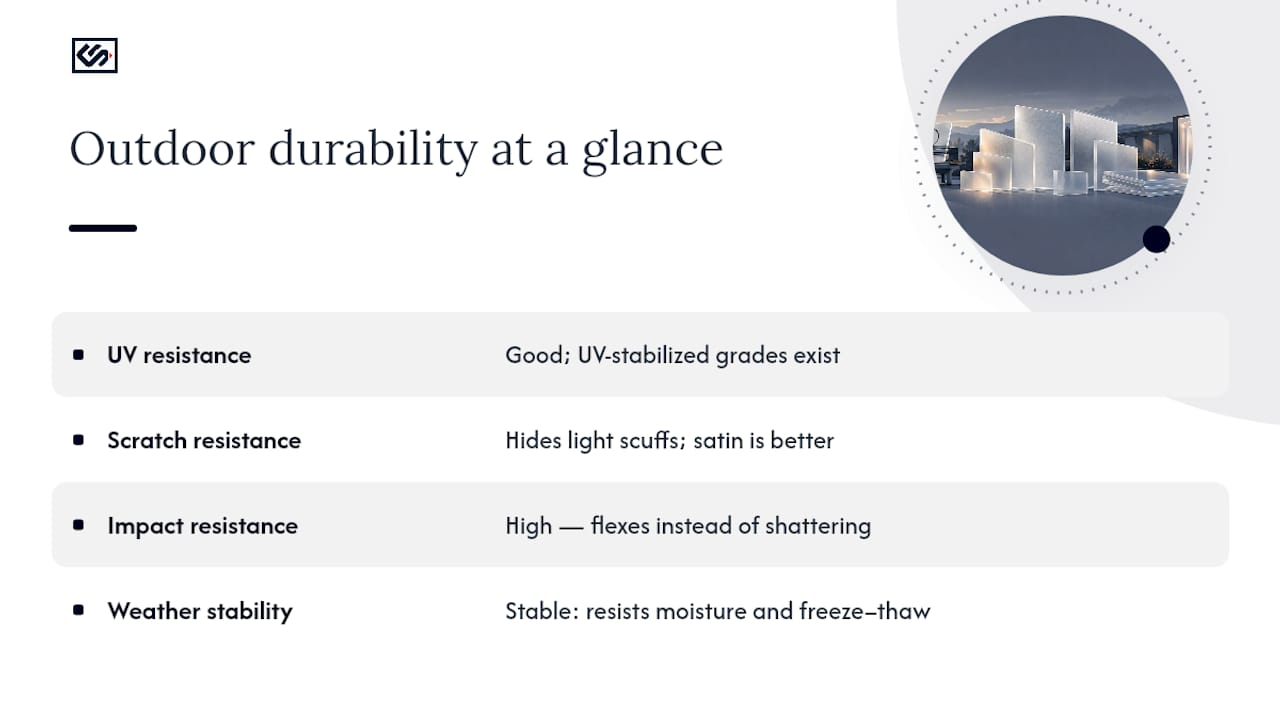
Frosted acrylic holds up well against sun, impact, and everyday scuffing, though performance varies by grade and where you install it. Standard acrylic formulations resist UV degradation far better than many plastics, holding their color and clarity for years of outdoor exposure without yellowing at the rate polycarbonate often does. That said, UV-stabilized grades exist specifically for extended outdoor signage, so ask your supplier whether the sheet you're buying carries UV stabilizers if the panel will sit in direct sun for years.
Scratch resistance depends heavily on finish. A frosted surface actually hides light scuffs and fingerprints better than clear acrylic simply because the matte texture already scatters light, masking minor surface wear. Premium satin grades take this further, engineered specifically to resist fingerprints and abrasion in commercial settings where people touch the panel constantly.
Impact resistance is where acrylic separates itself from glass entirely. A frosted acrylic panel can absorb a direct hit that would shatter tempered glass, flexing instead of fracturing. It's not indestructible. Sharp impacts or stress at drilled holes can crack it, which is why proper pilot holes and support during fabrication matter so much.
Weather resistance beyond UV comes down to temperature swings and moisture. Acrylic doesn't absorb water or warp from humidity, and it handles freeze-thaw cycles without the brittleness some plastics develop in cold climates. For panels facing direct weather rather than sitting under an awning or indoors, ask specifically about UV-rated grades rather than assuming standard stock will perform the same way outdoors as it does inside.
How Do You Clean and Maintain a Frosted Acrylic Panel?
Frosted acrylic needs gentler handling than clear acrylic, mostly because that matte texture holds onto dust and grease differently than a smooth surface. A microfiber cloth and a mild soap-and-water solution handle most routine cleaning without any risk to the finish. Skip anything abrasive: paper towels, rough sponges, and gritty cleaners will burnish the frosted texture unevenly over time, leaving shiny patches where the matte finish has worn down.
Avoid ammonia-based glass cleaners entirely. Ammonia can craze acrylic, creating a network of fine surface cracks that show up as a hazy or clouded patch, and that damage is permanent. Isopropyl alcohol in low concentrations is generally safe for spot cleaning fingerprints on premium satin finishes, but test it on a hidden corner first if you're unsure about a specific grade.
For panels in high-traffic commercial settings, a light dusting with a dry microfiber cloth weekly keeps grime from building up in the textured surface. Deeper cleaning with soap and water once a month is usually enough for most installations. Static also tends to attract dust to acrylic more than glass, so a slightly damp cloth works better than a dry one for a final pass.
Never use solvents like acetone or lacquer thinner near the panel face, even for stubborn adhesive residue left over from installation tape. These will dissolve the surface instantly. If adhesive residue is a problem, a plastic-safe adhesive remover applied sparingly and wiped immediately is the safer route.
Is Frosted Acrylic Recyclable and Fire-Safe?
Acrylic, including frosted grades, is a thermoplastic, which means it can be reprocessed and reformed rather than being a one-time-use material like some composites. Recycling infrastructure for acrylic specifically is less widespread than for common plastics like PET bottles, so check with your local recycling program or the sheet manufacturer about take-back options before assuming curbside pickup will accept it.
Fire rating is where buyers most often get caught off guard. Standard cast or extruded acrylic is combustible and will burn if exposed to open flame, unlike glass. For any installation with fire code requirements, such as commercial partitions in occupied spaces or signage near exits, confirm the specific fire rating classification with your supplier before ordering, since ratings vary by formulation and thickness. Don't assume a frosted finish changes the base material's fire behavior. It doesn't. The frosting additive affects appearance and light diffusion, not combustibility.
If your project falls under a building code that specifies flame spread ratings for interior finishes, this is a question for a code official or your fabricator, not a guess. It's one of the few places in a signage project where getting the spec wrong has real consequences of aesthetics.
Frosted Acrylic vs. Frosted Glass vs. Polycarbonate: Which Should You Buy?
Each of these three materials solves the same basic problem: diffused, private light transmission. They just get there differently, and the right pick depends on what you're prioritizing.
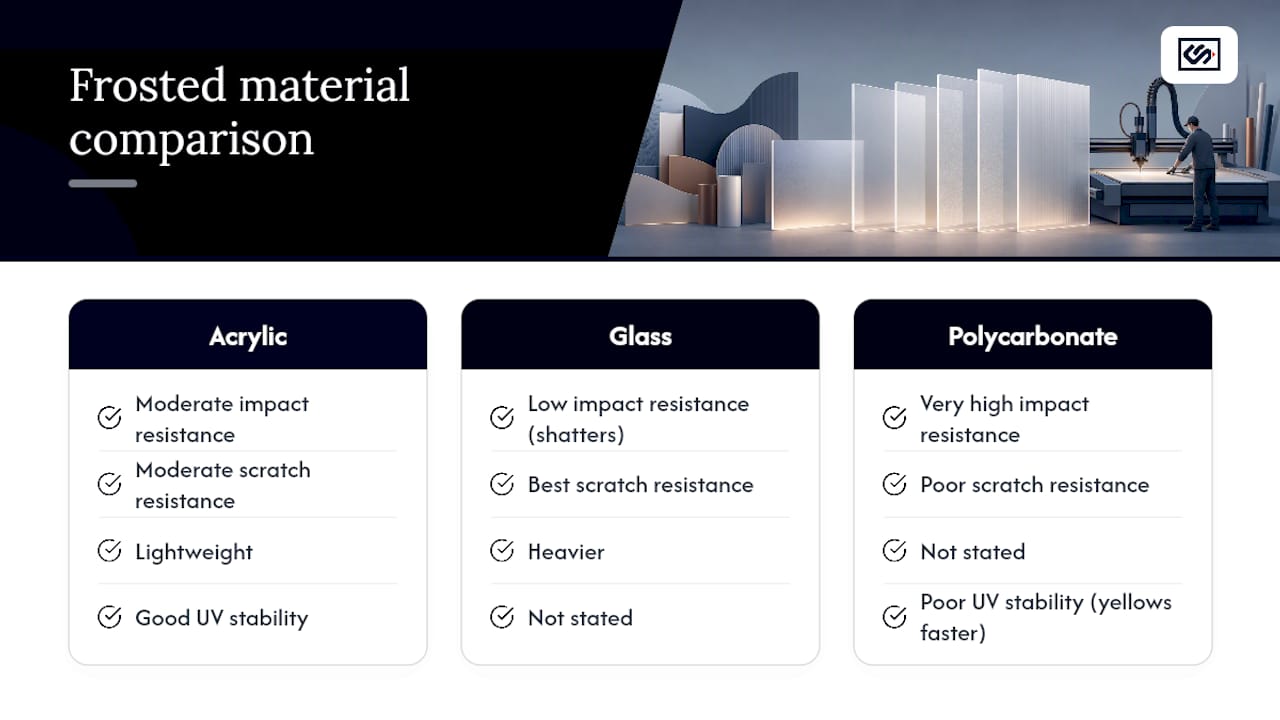
Frosted glass gives you the most premium look and the best long-term scratch resistance of the three, since glass simply doesn't scuff the way plastic does. It's also heavier, more expensive to fabricate into custom shapes, and it shatters under impact where acrylic just flexes. For a fixed installation that will never move once installed, like a bathroom window insert, frosted glass makes sense. For anything shipped, handled, or mounted in a commercial space with foot traffic, the weight and breakage risk usually rule it out.
Polycarbonate wins on raw impact resistance. It's the material building codes often require for high-security or high-vandalism-risk locations because it resists shattering even under direct blows better than acrylic does. The trade off is clarity and finish quality. Polycarbonate tends to yellow faster under UV exposure than UV-stabilized acrylic, and it scratches more easily, which matters more on a frosted diffuser panel where consistent, even light matters.
Frosted acrylic sits in the middle and, for most signage, partition, and diffusion applications, that middle ground is exactly what you want. It's lighter and easier to fabricate than glass, cleaner and more UV-stable than polycarbonate, and available in the continuously processed grades that hold their frosted finish through cutting and forming. Unless your project has an extreme impact-resistance requirement or a fixed, unhandled installation where glass's premium finish justifies the weight, frosted acrylic is the practical default.
How CrispSign Chooses Frosted Acrylic for Storefront Signage
For backlit cabinet faces and illuminated storefront signs, we lean toward continuously processed frost or LED-grade frost almost every time, because the finish has to survive routing, drilling for mounting hardware, and years of daylight exposure without a visible seam or hotspot. For lobby panels and interior partitions that get touched constantly, premium satin finishes earn their higher cost through better fingerprint and abrasion resistance. The right frosted grade depends less on the material itself and more on how much handling and light the panel has to survive.
Get Your Frosted Acrylic Panel Fabricated and Shipped
Once you know the finish, thickness, and size you need, the fastest path to a finished product is skipping the separate steps of buying raw material, finding a fabricator, and coordinating installation yourself. Custom sign fabricators build frosted acrylic panels to your specs, cut them to size, finish the edges, and can coordinate professional installation if you'd rather not handle mounting yourself.
For backlit signage specifically, that means ordering a panel that's already matched to LED hotspot control and fabricated to your cabinet dimensions, rather than guessing at finish and thickness on your own. Multi-location businesses managing signage across several storefronts can order and track everything through the Crisp Corporate portal, which keeps every location's specs consistent without repeating the ordering process from scratch each time. Products ship nationwide, built to customer specifications, with quality checked before shipment. If you know your application and rough dimensions, the next step is simple: request a quote and get a finished panel back instead of a raw sheet you still have to fabricate yourself.
Sources
- Frosted Acrylic Sheet | Custom Cut Frosted Plexiglass | ShapesPlastics
- Frost LED Acrylic Lighting Panel | LED Panel | KASTLITE
- Frosted Acrylic Sheet (PMMA-iFrost) | Satin Finish | SRT Plastics | SRT Plastics®
FAQ
How much does a frosted acrylic sheet cost?
Price depends on thickness, finish, and whether you buy a full sheet or cut-to-size, so a thin 0.080" LED diffuser panel costs far less than a thick, continuously processed sheet cut to custom partition dimensions. Get a direct quote based on your exact size and finish rather than relying on a generic per-sheet price.
How do you get a frosted look on acrylic?
Manufacturers create the frosted look either by treating the surface of a clear sheet or by mixing a frosting additive through the material during production. The second method, called continuous processing, keeps the frosted appearance intact even after the sheet is cut or drilled.
Where can you find frosted acrylic sheets?
You can buy frosted acrylic sheets from retail plastics suppliers for DIY cut-to-size orders, directly from manufacturers for bulk or wholesale pricing, or through a custom sign fabricator like CrispSign if you need the panel built into a finished signage product.
What's cheaper, plexiglass or acrylic?
Plexiglass is simply a brand name for acrylic sheet, so they're the same material and cost the same for equivalent thickness and finish. Price differences you'll see come from the grade, finish, and supplier, not from any real distinction between the two terms.
What's the difference between surface-frosted and continuously processed acrylic?
Surface-frosted sheets have the matte texture applied only to one face, which can thin out or vanish when cut, drilled, or formed. Continuously processed sheets have the frosting additive mixed through the entire thickness, so the finish holds up through fabrication.