Green Advertisements for Small Businesses: Brief Your Sign Vendor

A credible green storefront sign pairs honest, verifiable claims with low-impact materials and production. Color alone won't make your brand sustainable, and it won't protect you from FTC scrutiny either.
Here's what every vendor brief for a green-themed sign needs:
- Measurable claim or certificate: "Made with recycled aluminum" or an FSC/UL ECOLOGO mark, not just "eco-friendly"
- Material spec: recycled content percentage, FSC-certified wood species, or low-VOC acrylic grade
- Production method: water-based or low-VOC inks, LED illumination with efficient drivers
- End-of-life plan: vendor takeback, curbside-recyclable substrate, or documented recycling path
Brands that measure both their claims and their advertising footprint are better protected against enforcement and reputational risk than those that rely on color and slogans alone.
Table of Contents
- What "green advertisements" actually means for your storefront sign
- Design rules that make your sustainability message credible
- Sustainable materials and production options for storefront signs
- What you can and cannot say on a storefront sign
- Typical costs and timelines for sustainable storefront signage
- Your anti-greenwashing checklist before you approve any sign order
- Compliant copy snippets you can use on your storefront signs
- Key Takeaways
- The gap between "green-looking" and genuinely green
- Crispsign helps you produce credible, documented green signage
- Useful sources
- FAQ
What "green advertisements" actually means for your storefront sign
There are two distinct dimensions here, and confusing them is where most SMBs get into trouble.
Visual signaling uses green color, leaf icons, and earth-tone palettes to trigger an environmental association. It works as a peripheral cue. Research shows green color signals sustainability to general audiences, but that effect weakens with savvy consumers who recognize the tactic. A PMC study found that color ads outperform pure-green ads for green products, particularly altruistic ones, because they activate a more balanced self-control response in buyers.
Factual claims are statements about materials, certifications, or processes. These carry legal weight under FTC rules and must be substantiated.
For a storefront sign specifically, you have limited real estate. Use that space for your headline claim and a verification path. Put the detail on a QR code, a plaque, or your website.
- Use green as an accent color, not the entire palette
- Pair any visual cue with at least one specific, verifiable statement
- Reserve vague terms like "eco" or "green" for contexts where you can immediately point to proof
Pro Tip: If your sign says "sustainably made," place a QR code directly on the sign that links to your material spec sheet or supplier certificate. Without that path, the claim is unsubstantiated under FTC guidance.
Design rules that make your sustainability message credible
Good green-themed sign design follows a short set of rules. Break them and you risk both consumer skepticism and regulatory exposure.
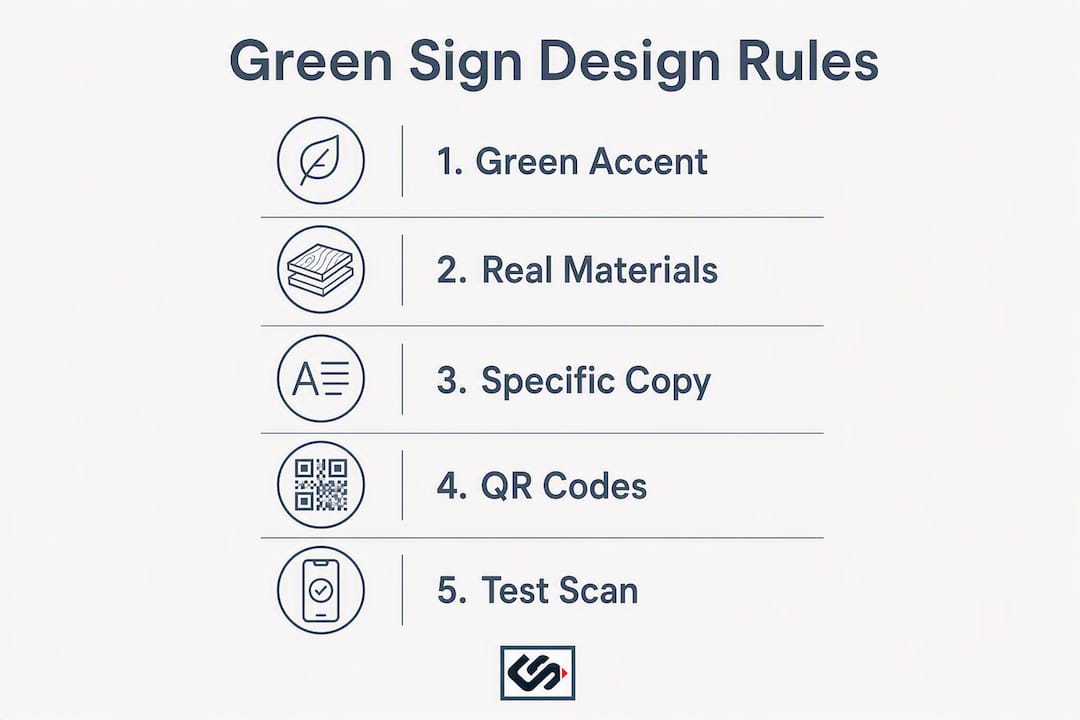
1. Use green as an accent, not a flood. A sign that is entirely green reads as a color choice, not a claim. Use green for borders, icons, or a single headline word. Pair it with neutral tones: warm white, slate, or natural wood grain.
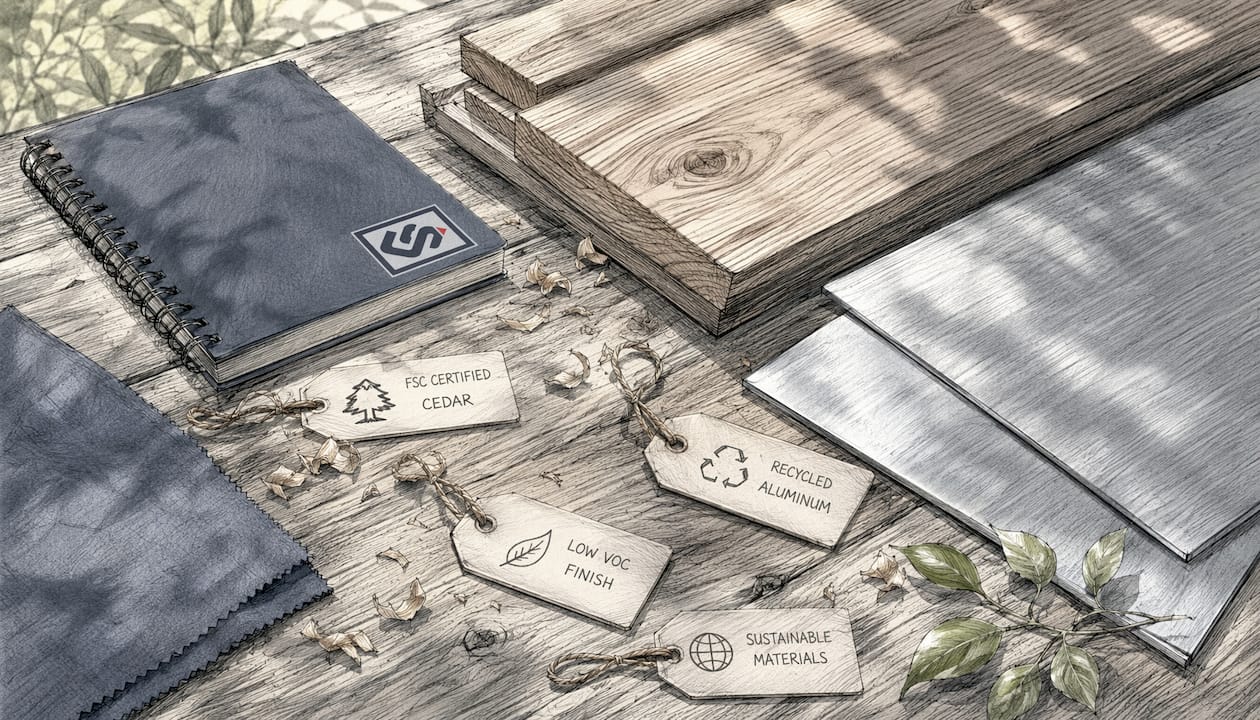
2. Choose imagery tied to real materials. A photo of your actual cedar panel or recycled aluminum channel letters is more credible than a generic leaf badge. If you use an icon, make it a recognized certification mark (FSC, UL ECOLOGO) rather than a custom "eco" badge you designed yourself.
3. Write short, specific copy. "Made with recycled aluminum" beats "eco-friendly sign." Specificity signals honesty. Vague language signals greenwashing risk to both regulators and informed customers.
4. Hierarchy matters. Lead with your strongest verifiable claim. Put the certification mark or QR code in a secondary position where it's visible but not competing with your brand name.
Dos and don'ts at a glance:
- ✅ Name the specific material and its recycled content percentage
- ✅ Display recognized third-party certification marks with their full name
- ✅ Include a QR code linking to documentation
- ❌ Use "green," "eco," or "natural" without a qualifier
- ❌ Create your own sustainability badge without a certifying body behind it
- ❌ Rely on green color alone to communicate environmental responsibility
Pro Tip: Keep your QR code at least 1 inch square on exterior signs and test it at arm's length before approving the proof. A QR code that doesn't scan in sunlight defeats its purpose.
Sustainable materials and production options for storefront signs
The right material choice lets you make truthful claims. Here's what's available and what each option actually delivers.
| Material | Certification/Recycled Content Option | Best Use Case | End-of-Life |
|---|---|---|---|
| Recycled aluminum | High post-industrial recycled content available | Channel letters, cabinet frames | Fully recyclable curbside or scrap |
| FSC-certified cedar/wood | FSC chain-of-custody certification | Carved signs, dimensional letters | Repurpose, compost, or recycle |
| Low-VOC acrylic | Water-based finishes, reduced solvent content | Face panels, lobby signs | Check local recycling; some programs accept |
| Non-PVC vinyl alternatives | PVC-free substrates (e.g., polyolefin-based) | Window graphics, wall vinyl | Reduced toxicity vs. standard PVC |
| LED illumination | Energy-efficient drivers, no mercury | Illuminated cabinets, backlit panels | Lamp recycling programs available |
Pros and cons by material:
- Recycled aluminum: durable, weather-resistant, widely recyclable. Higher upfront cost than standard aluminum; verify recycled-content percentage with mill certificate.
- FSC-certified wood: authentic, warm aesthetic. Requires sealing and periodic maintenance; sourcing lead times can be longer.
- Low-VOC acrylic: reduces indoor air quality impact during fabrication. Not all suppliers stock certified grades; confirm with spec sheet.
- Non-PVC vinyl: better end-of-life profile than standard vinyl. Fewer color options; slightly higher cost per square foot.
- LED with efficient drivers: lower operating energy and longer lamp life. Initial cost higher than fluorescent; verify driver efficiency rating.
Reducing creative variations and extending sign asset life also cuts production waste, a principle the Ad Net Zero sustainable media guide applies to physical as well as digital advertising.
Pro Tip: Ask your vendor for the mill certificate or supplier attestation showing recycled content before you approve the order. A vendor who can't produce that document can't support your claim.
What you can and cannot say on a storefront sign
Only make claims you can substantiate. That's the FTC's baseline rule, and it applies to signage the same way it applies to packaging or digital ads.
The FTC Green Guides set three practical requirements for environmental claims:
- Avoid general claims like "eco-friendly" or "green" without qualification. They imply broad environmental benefit the FTC says you must be able to prove.
- Specify scope. "Made with recycled materials" should clarify whether that applies to the sign substrate, the frame, or the packaging.
- Use verifiable qualifiers. "Made with 60% post-consumer recycled aluminum, verified by [supplier name]" is compliant. "Sustainable sign" is not.
Third-party certifications strengthen your position. The FTC notes that certified seals are useful only when backed by solid standards and transparent disclosures. FSC covers wood and paper-based substrates. UL ECOLOGO covers a range of products including inks and coatings.
Treat every sustainability claim on a sign as receipt-based: if you cannot point to a specific, measurable data point, don't claim it. Require supplier mill certificates or lab reports before the sign goes to production.
Marketing experts at Forbes advise linking claims to concrete, verifiable actions rather than slogans. Greenwashing is the greatest reputational risk in sustainable marketing.
Note: Storefront signage claims are advertising under FTC rules. Keep your documentation on file and update it when materials or suppliers change.
Typical costs and timelines for sustainable storefront signage
Sustainable materials add modest cost and sometimes a few extra days. Here's what to expect.
Cost drivers:
- Material grade (certified vs. standard)
- Certification documentation and supplier attestation fees
- Custom finishes (painted, powder-coated, sealed wood)
- LED illumination and driver efficiency rating
- Installation coordination
Rough price ranges (U.S. market, 2026):
- Vinyl window graphic with recycled substrate: $150–$500
- Routed aluminum channel letters with recycled content: $1,500–$5,000+
- Carved FSC-certified cedar sign: $800–$3,000+
- Illuminated cabinet sign with LED: $2,000–$8,000+
Timeline estimates:
- Vinyl graphic: 5–10 business days; add 2–3 days if waiting for substrate certification documents
- Channel letters: 15–25 business days; recycled-content mill certificates typically arrive within the same window
- Carved wood sign: 10–20 business days; FSC chain-of-custody verification adds 1–3 days
- Illuminated cabinet: 20–30 business days
To shorten your lead time:
- Approve your proof within 24 hours of receipt
- Request material spec sheets and certifications from your vendor at order placement, not after
- Confirm your installation site measurements before production begins
- Provide your brand files in vector format (AI or EPS) to avoid revision rounds
Your anti-greenwashing checklist before you approve any sign order
Use this as your minimum standard before you sign off on artwork or release payment.
Procurement checklist:
- Vendor has provided a mill certificate or supplier attestation confirming recycled content percentage
- Any certification mark on the sign (FSC, UL ECOLOGO) is current and the vendor holds chain-of-custody documentation
- All environmental claims on the sign are qualified with scope and a measurable figure
- Low-VOC or water-based inks are specified in the production order, not just verbally confirmed
- An end-of-life plan is documented: substrate recyclability, vendor takeback option, or local recycling path
- A QR code or plaque is included to link customers to substantiation details
- Maintenance and replacement guidance is provided so the sign's sustainable intent holds over its full lifespan
Sample contract clauses you can paste into your purchase order:
- Substantiation clause: "Vendor shall provide mill certificates or third-party test reports confirming all recycled-content percentages stated in the sign copy prior to production approval. Claims not supported by documentation will be removed from the design."
- End-of-life clause: "Vendor shall provide written guidance on substrate recyclability and, where available, a takeback or recycling program for sign components at end of useful life."
Compliant copy snippets you can use on your storefront signs
Every example below pairs the copy with the evidence it requires. Adapt length to your sign's visibility zone.
Short headline (under 6 words):
- "Made with recycled aluminum" — requires: supplier mill certificate
- "FSC-certified wood. Responsibly sourced." — requires: FSC chain-of-custody cert
- "Printed with low-VOC inks" — requires: ink spec sheet from vendor
Secondary line (8–12 words):
- "Our sign substrate contains post-consumer recycled content. Scan for details." — requires: QR link to spec sheet
- "Fabricated with energy-efficient LED lighting. Details at [URL]." — requires: driver efficiency documentation
Non-quantified visual cue copy (avoids greenwashing when you lack a specific figure):
- "Made with responsibly sourced materials — details inside"
- "Scan here for our material sourcing information"
- "Built to last. Designed to reduce waste."
Pro Tip: "Built to last" is a durability claim, not an environmental one, so it requires no environmental substantiation. It's a safe anchor phrase when you're still gathering your material documentation.
Key Takeaways
Credible green storefront signage requires verifiable claims, certified materials, and documented production methods. Color and slogans alone create liability, not credibility.
| Point | Details |
|---|---|
| Claims must be receipt-based | Every environmental statement needs a mill cert, spec sheet, or third-party certification to back it. |
| Color alone isn't enough | Green visuals help with general audiences but weaken with savvy consumers; pair them with specific claims. |
| FTC Green Guides apply to signs | Storefront signage is advertising; avoid unqualified terms like "eco-friendly" without scope and evidence. |
| Certifications that matter | FSC covers wood substrates; UL ECOLOGO covers inks and coatings; both require chain-of-custody documentation. |
| Crispsign as your next step | Crispsign offers certified-material options, low-VOC production, and documentation support for compliant green signage. |
The gap between "green-looking" and genuinely green
Most SMBs I see ordering green-themed signs focus almost entirely on the visual: the color palette, the leaf icon, the earthy font. That's understandable. It's what you see first. But the FTC doesn't care what your sign looks like. It cares what your sign says and whether you can prove it.
The more interesting problem is that a sign that looks green but can't be substantiated is actually more damaging than no green claim at all. Informed customers notice the gap between a "sustainable" headline and a standard PVC substrate. That gap erodes trust faster than silence would.
What actually works is the opposite of what most people expect: fewer claims, stated more specifically, with a clear path to verification. A sign that says "Made with recycled aluminum, certified by [supplier]" and includes a QR code to the mill certificate will outperform a sign covered in green imagery and vague eco-language every time. The specificity is the signal.
The brands getting this right treat their sign as the front end of a documentation chain, not a standalone marketing asset. The sign makes the claim. The QR code, the website, and the supplier certificates close the loop. That's the standard worth holding yourself to.
Crispsign helps you produce credible, documented green signage
Your sign should make a claim your business can actually stand behind. Crispsign works with SMB owners to specify, verify, and produce sustainable storefront signs that meet FTC standards and hold up to customer scrutiny.
Here's what Crispsign brings to a green signage project:
- Material consultation: guidance on recycled-content aluminum, FSC-certified wood, and low-VOC acrylic options
- Certified-material sourcing: access to substrates with documented recycled content percentages and chain-of-custody records
- Low-VOC production: water-based and low-solvent ink options specified at order placement
- Documentation delivery: mill certificates and spec sheets provided with your order for your compliance file
- Optional installation coordination: flat-fee professional installation arranged through Crispsign's installer network
Ready to order a sign you can actually back up? Browse lobby and ADA signage options at Crispsign and get your custom quote today.
Useful sources
These are the primary references worth bookmarking when you're substantiating claims or briefing a vendor:
- FTC Green Guides — the governing U.S. legal guidance on environmental marketing claims; use it to check every phrase before it goes on a sign
- FTC Consumer Advice on Eco-Friendly Claims — plain-language explanation of when seals and certifications are and aren't sufficient
- Forest Stewardship Council (FSC U.S.) — certification body for wood and paper-based substrates; use to verify chain-of-custody claims
- UL ECOLOGO — third-party certification for inks, coatings, and related products; request the certificate number from your vendor
- Zevero sustainable advertising guide — practical framework for measuring both claim credibility and advertising footprint
- Ad Net Zero sustainable media guide — covers physical and digital asset life extension and waste reduction
FAQ
What makes a storefront sign a credible green advertisement?
A credible green advertisement pairs a specific, measurable environmental claim with documented proof, such as a supplier mill certificate or a third-party certification like FSC or UL ECOLOGO. Color and generic terms like "eco-friendly" are not sufficient under FTC Green Guides.
Can I use "eco-friendly" on my storefront sign?
The FTC advises against unqualified general claims like "eco-friendly" because they imply broad environmental benefit you must be able to prove. Replace it with a specific, scoped statement such as "Made with 60% recycled aluminum."
What certifications should I ask my sign vendor about?
Ask for FSC chain-of-custody certification for wood substrates and UL ECOLOGO for inks and coatings. Both require the vendor to hold current documentation, which you should receive with your order.
How much extra does sustainable signage typically cost?
Sustainable material options add a modest premium. Recycled-content aluminum channel letters typically run $1,500–$5,000+, and FSC-certified carved wood signs range from $800–$3,000+, depending on size and complexity.
Does Crispsign offer certified-material options for green signage?
Yes. Crispsign provides material consultation, certified-material sourcing with documented recycled-content percentages, and low-VOC production options, along with documentation delivery for your compliance file.