Lightbox Shop Guide for Small Businesses: Custom Signs Made Easy
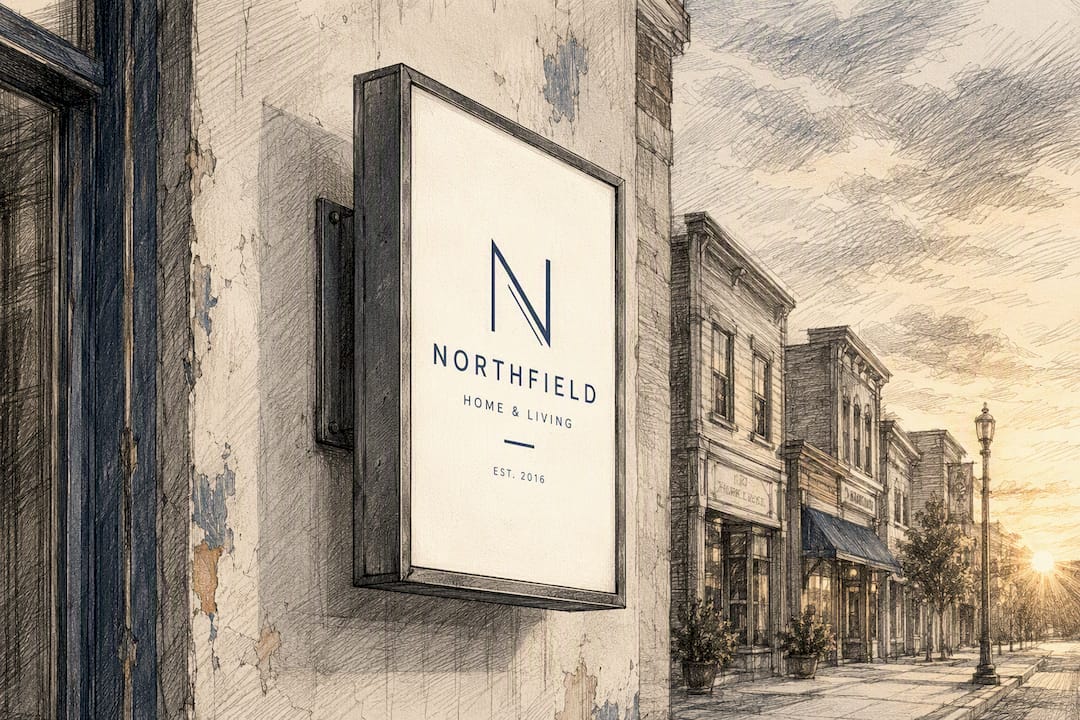
If you're outfitting a storefront, pick a slim wall-mounted LED cabinet or an SEG fabric lightbox first. Those two formats fit the widest range of small business budgets and locations, and both ship as fully custom builds rather than off-the-shelf boxes. If your sign faces weather, upgrade to a double-sided, outdoor-rated cabinet built for awnings and canopies.
From there, the fastest path is simple: request a free mockup from CrispSign and upload your artwork or rough dimensions. You'll get a proof back showing exactly how your logo looks lit up before you commit to production.
Three starting points cover most storefront needs:
- Slim LED cabinet — best for logo signs on flat walls with limited depth.
- SEG fabric lightbox — best for large graphics, trade show walls, or interior feature displays.
- Double-sided outdoor cabinet — best for projecting signs, awnings, and anything exposed to rain or direct sun.
Quick fact: Quality lightbox builds use LED modules rated for tens of thousands of hours, and outdoor units typically carry an IP rating or UL/ETL certification confirming they've been tested for weather and electrical safety.
Key Takeaways
Choosing the right lightbox comes down to matching product family to placement, verifying real construction specs, and requesting a proof before production begins.
| Point | Details |
|---|---|
| Start with placement | Match slim LED cabinets to storefronts and SEG fabric to large trade show or backwall displays. |
| Verify construction specs | Ask for LED spacing, CRI, color temperature, and IP rating before approving any build. |
| Budget for outdoor exposure | Double-sided and IP65-rated outdoor units cost more due to sealing and heavier-duty components. |
| Approve proofs fast | A prompt proof review is the biggest factor buyers control over their own production timeline. |
| Order through CrispSign | CrispSign offers free mockups, custom fabrication, nationwide shipping, and coordinated installation for SMB signage. |
Table of Contents
- What Types of Lightboxes Can You Buy at a Lightbox Shop?
- Why Choose Illuminated Signs Over Standard Signage?
- What Materials Make a Lightbox Durable?
- Where Should You Install a Lightbox Sign?
- How Do You Customize and Order a Lightbox?
- How Much Does a Lightbox Cost and How Long Does It Take?
- How Do You Install and Maintain a Lightbox Sign?
- Why Small Businesses Choose CrispSign for Custom Lightboxes
- What's the Smartest Way to Approach a Lightbox Purchase?
- Get a Free Mockup and Order Your Custom Lightbox
- Further Reading on Lightbox Specs and Examples
- FAQ
What Types of Lightboxes Can You Buy at a Lightbox Shop?
Not every illuminated sign is built the same way, and the differences matter more than most first-time buyers expect. A lightbox shop worth your money will offer at least four or five distinct product families, each suited to a different placement and budget.
Slim/low-profile LED cabinets are the workhorse of storefront signage. They mount flush to a wall or fascia, run just a few inches deep, and work well for logo panels, address numbers, or single-graphic branding. Because the frame is thin, they read as clean and modern rather than bulky.
Edge-lit frames push light in from the sides of an acrylic panel rather than from behind the whole surface. This creates an ultra-thin cabinet, often under an inch deep, which is popular for interior lobby signs or menu boards where wall space is tight.
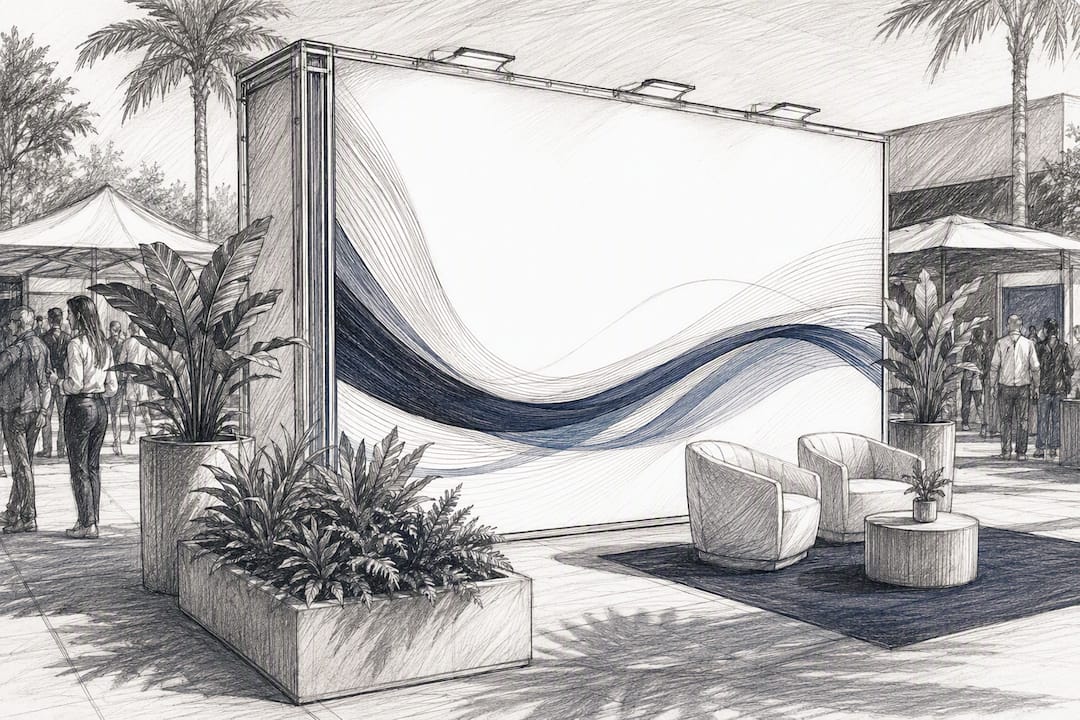
SEG (silicone edge graphic) fabric tension lightboxes stretch a printed fabric skin around an aluminum frame with LEDs built in behind it. The modular aluminum SEG systems available today commonly run a typical slim profile and ship with the frame, LED array, power cable, and custom fabric graphic as a complete kit. These are the go-to choice for large trade show backwalls and oversized retail displays because the fabric produces edge-to-edge, wrinkle-free graphics that look continuous rather than tiled.
Double-sided illuminated cabinets light two graphic faces from one internal LED source, which makes them ideal for projecting blade signs, hanging signs over an entryway, or anything meant to be read from both directions on a street.
Large-format modular backlit walls combine multiple SEG or rigid panels into a single continuous display, often used for retail feature walls or convention booths.
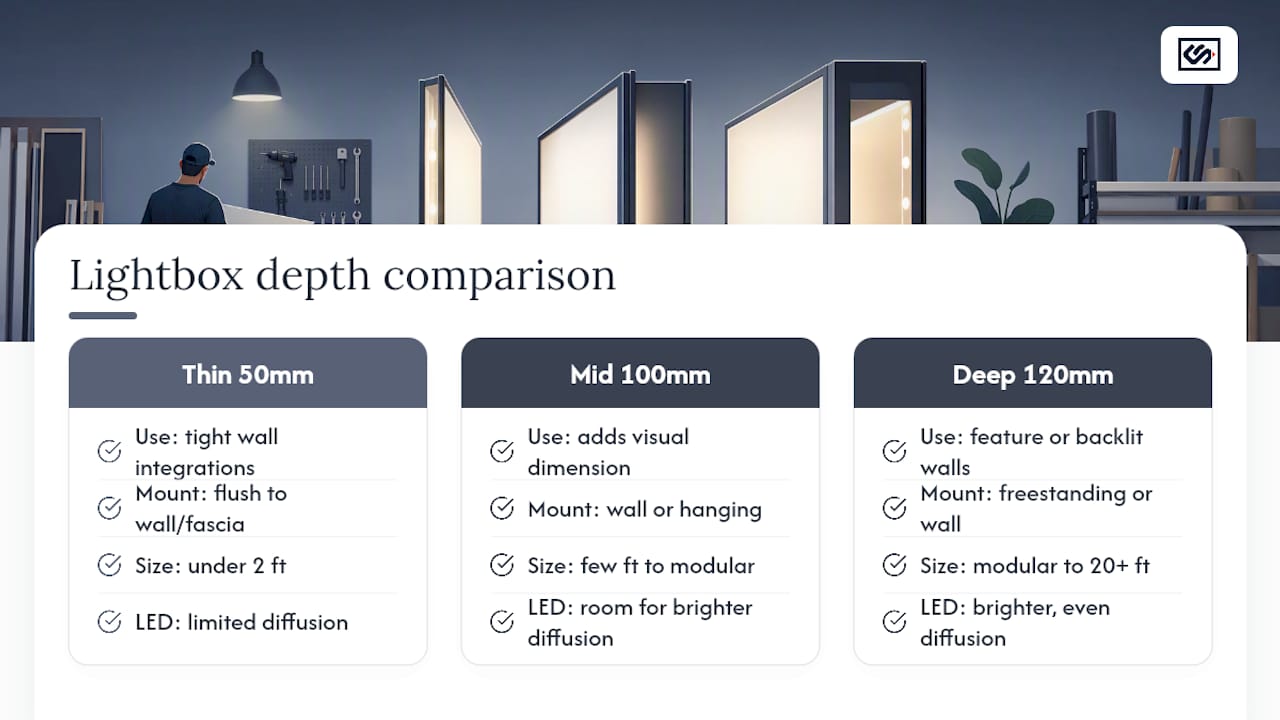
Depth profiles vary by product family. Thinner builds around 50mm suit tight wall integrations, while deeper 100 to 120mm cabinets add visual dimension and room for brighter, more evenly diffused LED arrays. Sizes range from small logo panels under two feet wide up to modular backwalls spanning twenty feet or more. If you're comparing photos on a supplier's site, look closely at the edge of the frame. That close-up reveals whether the LEDs sit flush and evenly spaced or whether you're looking at a budget module prone to hot spots.
Why Choose Illuminated Signs Over Standard Signage?
An unlit sign works fine at noon. It disappears at dusk. That single fact drives most of the ROI case for lightboxes: illuminated signage stays visible and legible for the hours when foot traffic patterns shift and ambient light drops, which is exactly when a storefront needs to stand out most.
Beyond simple visibility, illumination changes how color reads. Backlit graphics tend to render richer, more saturated color than printed vinyl under ambient lighting, which matters if your brand relies on a specific color to be recognized at a glance.
Quick fact: Modern LED lighting systems draw meaningfully less power than the fluorescent tubes lightboxes used a decade ago, and LED modules are commonly rated for tens of thousands of hours of use before any noticeable dimming.
That lifespan advantage compounds. Fewer bulb replacements means fewer service calls and less disruption to your storefront during business hours. Industry product data consistently points to uniform brightness and color fidelity as the two features buyers notice first when they compare an LED lightbox against older signage.
The practical business outcome is attention. A well-lit sign in a window or on a facade catches the eye of someone walking or driving past faster than flat, unlit graphics do, and that split-second of attention is often the difference between a passerby glancing at your storefront and one walking straight past it.
- Better nighttime and low-light visibility than printed or unlit signage.
- Richer color rendering that keeps brand colors consistent.
- Long LED lifespan reduces maintenance calls and replacement costs.
- Even lighting improves legibility from a distance and at an angle.
Pro Tip: Stick with bright white (5000K to 6500K) LEDs for most retail and storefront signs. It reads as clean and modern under daylight and at night. Save warmer tones (3000K) for boutique or hospitality brands going for a cozier feel, and think twice before choosing programmable RGB. Color-changing lightboxes look flashy in a showroom but can undercut brand consistency once installed, since customers expect your logo to look the same every time they see it.
What Materials Make a Lightbox Durable?
The materials inside a lightbox determine whether it looks crisp for a decade or starts yellowing and dimming within a year. Most quality builds share a common architecture: an aluminum extrusion frame for structural rigidity, an acrylic or polycarbonate diffuser to spread light evenly across the face, and either a printed fabric skin or a rigid graphic material depending on the format.
For rigid, snap-frame style lightboxes, the graphic itself is usually printed on Duratrans or a comparable backlit film, chosen for photographic clarity when light passes through it. For SEG fabric units, the graphic is a tension fabric skin, which folds flat for shipping and stretches drum-tight onto the frame without wrinkles. Deep knowledge on backlit materials points to this exact split: rigid film for smaller, static graphics, and SEG fabric for larger or portable displays where wrinkle-free assembly and easy transport matter more than absolute image sharpness.
Before you approve a build, run through this checklist with your supplier:
- LED module type and spacing (tighter spacing reduces hot spots and uneven brightness).
- A diffuser layer that spreads light evenly rather than showing individual LED dots.
- Frame depth appropriate to your mounting location and desired visual effect.
- Clean, reinforced corner joins with accessible wiring for servicing.
- UL, CE, or ETL safety certification marks on the electrical components.
- An IP rating appropriate to the installation environment.
IP ratings matter more than most first-time buyers realize. An IP54 rating means a sign is protected against dust and light splashing water, which is fine for a covered entryway. An IP65 rating means it's sealed against dust entirely and can handle direct water jets, which is what you want for anything mounted outdoors and exposed to rain.
Ask your supplier for the specific numbers behind the marketing language: color temperature in Kelvin, CRI (color rendering index, ideally 80 or higher for accurate brand colors), LED density per meter or watts per square foot, and total power consumption per square foot of sign face. A supplier who hands you those figures without hesitation is one who actually controls their production process.
Where Should You Install a Lightbox Sign?
Placement decides more about your final spec than almost anything else. A sign meant for an interior lobby has completely different requirements than one bolted to a facade facing highway traffic.
Common placements include storefront facades, window poster walls, interior lobby or logo panels, suspended retail features hanging from ceiling grids, and trade show backwalls or pop-up booth walls. Each comes with its own mounting logic:
- Wall-mounted cabinets work for facades, lobbies, and most retail interiors.
- Recessed installs sit flush into a wall cavity for a built-in look.
- Suspended or hanging mounts work for ceiling features and blade signs projecting from a building.
- Freestanding bases suit retail floor displays and event spaces without wall access.
- Pole- or truss-mounted rigs are standard for outdoor events and temporary trade show setups.
Environmental exposure changes the spec fast. A sign facing direct sun needs anti-glare diffusion so customers can actually read it at midday, and anything exposed to wind-driven rain needs a genuine outdoor IP rating rather than an indoor unit pressed into service outside. Architectural-grade fabric lightboxes built for suspended, freestanding, or wall-mounted retail use illustrate how much installation flexibility a well-designed system can offer once the frame and lighting are engineered for it.
One more thing before you order: check your local sign permitting rules. Most municipalities require a permit for any illuminated sign attached to a building facade or projecting over public right-of-way, especially if it involves new electrical work. Interior signs and portable trade show displays generally don't need one. If you're unsure, a quick call to your city's building or planning department before you finalize dimensions can save you a costly redo later.
How Do You Customize and Order a Lightbox?
Ordering a custom lightbox is more straightforward than most business owners expect, provided you follow the sequence in order rather than skipping ahead to production.
- Select your product family — slim cabinet, SEG fabric, double-sided, or modular wall, based on placement and budget.
- Choose materials and finish — frame depth, color temperature, and graphic material (rigid film versus fabric).
- Upload your artwork — logo files, brand colors, and exact copy for the sign face.
- Review and approve a proof — check dimensions, lighting balance, and mounting points before production starts.
- Production — your supplier builds the frame, installs the LED array, and mounts the graphic.
- Shipping and installation — nationwide shipping with optional coordinated professional installation for larger or high-mounted units.
Artwork prep is where most delays happen, so get these specs right the first time:
- Submit files as vector formats (AI, EPS, PDF) when possible; high-resolution PNG or TIFF works for photographic content.
- Build in bleed and keep critical text inside the safe area, away from frame edges.
- Target at least 100 to 150 ppi at final print size for sharp output.
- Outline all fonts or embed them to avoid substitution errors.
- Confirm color mode with your supplier, since backlit graphics often need adjusted color values to look accurate once lit from behind.
A free digital proof, or a physical sample proof for larger orders, is your chance to catch problems before they're baked into an aluminum frame. Confirm the overall dimensions, check that lighting looks even across the face rather than hot in spots, and verify mounting point locations against your actual wall or ceiling structure. Before you place the order, measure your installation site and note power access, wall framing type, available clearance, and the mounting substrate (brick, stucco, drywall, storefront glass). Handing your supplier that information upfront prevents a mismatched bracket or a missing outlet from stalling your install day.
How Much Does a Lightbox Cost and How Long Does It Take?
Cost swings widely based on a handful of factors, and understanding them upfront keeps your budget conversation grounded in reality rather than sticker shock.
Size is the biggest driver, followed closely by whether the sign is single or double-sided (double-sided roughly doubles the LED and wiring cost). Outdoor-rated builds cost more than interior units because of the sealing, gasketing, and higher-spec components needed to hit an IP65 rating. Frame depth and profile affect material cost too, and SEG fabric graphics generally run less per square foot than rigid Duratrans panels at large sizes, since fabric ships flat and needs less packaging.
Quick fact: Modular SEG lightbox systems are commonly sold in stock sizes with the frame, LED array, power cable, and printed fabric bundled as one kit, which keeps per-unit costs more predictable than a fully custom one-off build.
As a rough guide, a small to mid-sized wall-mounted lightbox for a single storefront location typically lands in the low hundreds to low thousands of dollars depending on size and finish, while large modular backwalls and multi-panel displays climb well beyond that range. Treat any number here as a starting point for budgeting conversations, not a quote.
- Standard stock sizes ship faster than fully custom dimensions.
- Quick-ship materials trim days off production compared to specialty finishes.
- Consolidating multiple signs into one order often improves both price and scheduling.
- Approving your proof promptly is the single biggest lever you control over your own timeline.
Lead time generally breaks into three phases: proofing (typically a few days once artwork is submitted), production (longer for custom sizes or double-sided builds than for quick-ship stock units), and shipping plus installation scheduling. If your timeline is tight, ask your supplier directly which sizes qualify for expedited or quick-ship production.
How Do You Install and Maintain a Lightbox Sign?
Installation splits cleanly into two categories. Simple wall-mounted plates on smaller cabinets are genuinely DIY-friendly with basic tools and a stud finder. Anything large, heavy, or mounted above ground level, like a facade sign requiring a lift or crane, calls for a professional installation crew.
A short maintenance routine keeps a lightbox looking sharp for years:
- Wipe diffuser panels with a soft cloth and mild cleaner every few months to prevent dust buildup from dimming output.
- Check LED drivers periodically for flickering or dimming, which often signals a failing driver rather than the LEDs themselves.
- Inspect seals and gaskets on outdoor units annually, since a compromised seal is the fastest way to let moisture ruin an otherwise good sign.
- Schedule a full inspection at least once a year for exterior installations.
Any electrical connection should meet local code, use UL or ETL-listed components, and get installed by a licensed electrician when it involves new wiring or a service panel connection. Before you buy, confirm warranty length, what's covered (LEDs, driver, frame), and whether replacement graphics are available separately if your branding changes down the road.
Why Small Businesses Choose CrispSign for Custom Lightboxes
CrispSign builds custom-designed, high-quality signage to your exact specifications and ships nationwide, with options for coordinated professional installation when you need it. That combination of full customization and a streamlined production workflow is what sets a purpose-built signage supplier apart from a generic sign shop juggling every job the same way.
Every order starts with a free digital mockup, so you see your logo lit up in a real lightbox rendering before a single component gets fabricated. That proof step alone catches sizing and color issues that would otherwise surface only after installation.
What you get working with CrispSign:
- Custom fabrication built to your specifications, not a limited set of preset templates.
- Nationwide shipping with optional coordinated installation for larger or high-mounted signs.
- Free mockups and proofs before production begins.
- A production workflow optimized for faster turnaround without cutting corners on materials.
CrispSign is built specifically for small and medium-sized businesses that need professional-grade signage without the overhead of a traditional custom sign shop. If you're ready to see your storefront lit up, request a free mockup and get your specs moving through proof and production.
What's the Smartest Way to Approach a Lightbox Purchase?
Pick your material and construction quality before you fall in love with a price point. A cheap frame with an uneven diffuser costs you more over three years in replacements and complaints than a properly built cabinet costs upfront, and asking for a proof early is the one habit that consistently separates a smooth order from a frustrating one.
My recommended approach: match the product family to your placement first, standardize on stock sizes where your layout allows to control cost, and get an installation quote immediately if the sign is exterior or mounted above reach. Balancing speed, quality, and budget usually means giving up a little speed for a proof review, never giving up quality for a shorter lead time.
Get a Free Mockup and Order Your Custom Lightbox
CrispSign is the practical alternative to guessing at a generic template or gambling on a low-bid sign shop with no proofing step. You design online, get a free digital mockup showing your exact logo lit up before production starts, and choose nationwide shipping with optional coordinated installation if your sign is large or mounted high.
That means no surprises when the box arrives: what you approved in the proof is what shows up at your loading dock. Whether you need a single slim cabinet for a storefront logo or a full SEG fabric wall for a trade show booth, the process stays the same. Choose your product family, upload your artwork or rough dimensions, and request your free mockup to see exactly how your sign will look before you commit a dollar to production.
Further Reading on Lightbox Specs and Examples
- SEG Systems lightbox displays — SEG fabric benefits and large-format display examples.
- QuickShowDisplay modular SEG lightboxes — stock sizing and component breakdowns.
- ShopperApproved reviews — third-party customer feedback on online lightbox vendors.
- Judgeme customer photo example — real installed lightbox for visual reference.
FAQ
What Is the Best Lightbox to Buy for a Small Storefront?
For most small storefronts, a slim wall-mounted LED cabinet or an SEG fabric lightbox offers the best balance of visibility, cost, and easy mounting; upgrade to a double-sided, outdoor-rated cabinet if the sign faces weather.
Where Can I Find an Affordable Lightbox Shop Online?
Look for a supplier that offers free mockups, transparent stock sizing, and nationwide shipping, since standard sizes and quick-ship materials consistently cost less than fully custom one-off builds. CrispSign offers custom online ordering with free proofs before production.
How Much Does a Lightbox Cost?
Cost depends heavily on size, whether it's single or double-sided, and outdoor IP rating requirements; small to mid-sized wall-mounted signs generally cost far less than large modular backwalls or multi-panel displays.
Are Lightboxes Worth the Investment?
Yes, for most storefronts, because illuminated signs stay visible after dark and render brand colors more accurately than unlit signage, and modern LED modules are rated for tens of thousands of hours before needing replacement.
Do I Need a Permit to Install a Lightbox Sign?
Most municipalities require a permit for illuminated signs attached to a building facade or involving new electrical work, though interior and portable trade show displays typically don't need one; check with your local building department before finalizing your design.