Maximize Sign Placement for Small Businesses: A Playbook
Three moves determine whether your sign earns its keep: put your best sign where curb traffic can actually see it, size the letters for the distance people will read them from, and back that up with a close-range sign that gives them a reason to stop. Get those three right and most storefronts see a real walk-in bump. Get any one wrong, and even a beautiful sign becomes wallpaper.
A storefront sign only has about three seconds to convert someone walking or driving by, so placement isn't decoration. It's math. The US Chamber of Commerce notes that most small-business signage projects run $2,000 to $3,000, and the ADA requires legible, high-contrast lettering for anything mounted permanently. That combination, cost plus compliance, means every placement decision should earn its spot.
- Façade or blade sign: claim the highest-visibility real estate you're allowed to use.
- Letter height: size for your primary viewing distance, not your available wall space.
- Close-range CTA: add a window sign or A-frame with one clear action near the door.
CrispSign builds all three formats to spec, which makes it easier to execute this playbook without juggling three different vendors.
Key Takeaways
Sign placement works when curb visibility, letter size, and a close-range CTA are all aligned to how people actually approach your storefront.
| Point | Details |
|---|---|
| Prioritize curb visibility | Choose a façade or blade sign based on whether your traffic is vehicular or pedestrian. |
| Size for viewing distance | Set letter height using your farthest approach point, not your wall dimensions. |
| Layer in a close-range CTA | Add a window sign or A-frame near the entrance with one clear action. |
| Treat cost as amortized | A $2,000 to $3,000 sign often runs under $30 a month over its lifespan. |
| Test before you commit further | Run a two-week pre/post baseline before expanding any placement or design. |
| Order through a specialized fabricator | CrispSign builds façade, window, and A-frame signs to spec with nationwide shipping and installation coordination. |
Table of Contents
- How to Maximize Sign Placement for Small Businesses Before You Order
- Where to Place Exterior Signs for Maximum Visibility
- Placing Signs Inside Your Store for Better Flow
- Sign Design Rules That Actually Get Read
- Materials, Lighting, and the Real Cost of a Sign
- Permits, Landlord Rules, and Keeping Your Sign Legal
- How to Track Whether Your Signs Are Working
- Choosing a Sign Partner and Your Next Two Steps
- Let CrispSign Build the Sign You Just Planned
- Sources
- FAQ
How to Maximize Sign Placement for Small Businesses Before You Order
Do this groundwork before you spend a dollar on fabrication.
- Walk the sightline audit. Approach your storefront from both directions at normal driving and walking speed, at your actual peak hour, and note every obstruction, tree branch, or glare spot.
- Set your viewing distance target. Measure the farthest point where you want someone to read your name and size letters to that number, not to the blank wall you're staring at.
- Call your landlord or planning office. Ask about sign codes and lease restrictions before you design anything permanent.
- Decide flexible vs. permanent. Flexible signage prints in days; permanent signs need permits and weeks of lead time.
- Rank your placement types. Façade, blade, window, and A-frame each solve a different distance problem.
- Build a measurement plan. Pick one KPI and a two-week baseline before you change anything.
Where to Place Exterior Signs for Maximum Visibility
Not every format belongs in the same spot, and picking the wrong one wastes both budget and wall space.
Your façade sign is your identity marker. It needs to read clearly at mid-to-long range, which means letter height should track your actual approach distance. Cap-height guidance from sign designers ties letter size directly to how far away your primary viewer stands, so measure before you design.
Blade or projecting signs hang perpendicular to your building, which makes them the strongest option on pedestrian-heavy streets where people approach from the side rather than head-on. A flat façade sign is nearly invisible to someone walking the sidewalk toward you; a blade sign catches their eye from a block away.
Window graphics convert the moment someone pauses, whether that's at a crosswalk or while glancing at your display. Use them for hours, promotions, or a short CTA, not your full brand story.
Monument and ground signs earn their cost on corner lots or set-back properties where a façade sign sits too far from the street to matter.
Awnings protect against weather but often sacrifice readability if the fabric folds or shadows the lettering.
- Façade: best identity anchor, moderate permitting.
- Blade: best for foot traffic, moderate cost.
- Window: fast, cheap, great for CTAs.
- Monument: best for corner lots, higher upfront cost.
- Awning: functional but readability varies.
Pro Tip: If your budget only stretches to one format this quarter, choose the one that matches your dominant traffic type: blade for sidewalks, façade for drive-bys, monument for set-back lots.
Placing Signs Inside Your Store for Better Flow
Interior signage does a different job: it moves people through your space and nudges them toward a decision.
- Entry and decompression zone: skip dense signage here. Customers need a few steps to adjust; use this space for a welcome cue or a single directional sign, nothing busier.
- Focal walls and power zones: this is where persuasive point-of-purchase signage belongs, promoting featured items or seasonal offers.
- Checkout: small, focused signs here can lift attach rate on add-on items without slowing the line.
- Match message to zone: "Welcome, browse freely" near the door, "Today's Feature" on a focal wall, "Add this for $3" at checkout.
- Keep interior text legible: larger fonts, strong contrast, and simple wording work at close range just as they do outdoors.
Sign Design Rules That Actually Get Read
Good placement fails if the sign itself is hard to read. Signage guidance across the retail industry keeps circling back to the same rules, because they work.
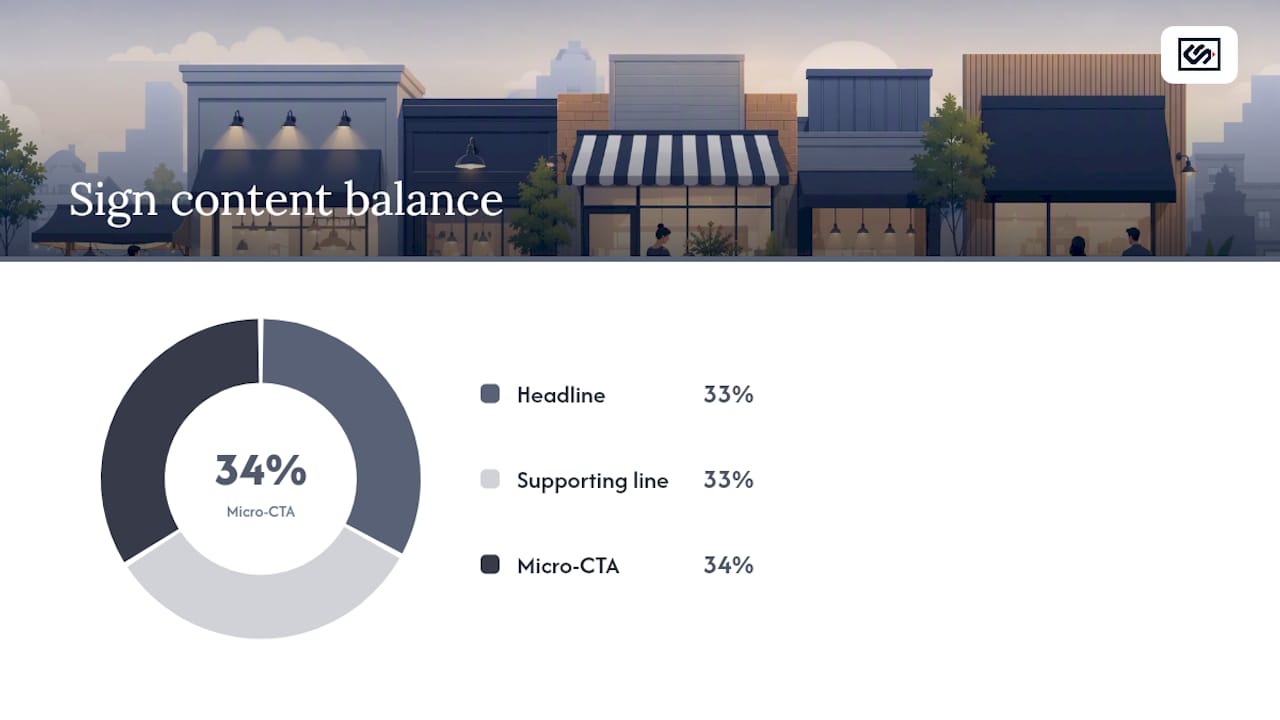
Stick to one idea per sign. A headline, a short supporting line, and a micro-CTA. Keep supporting copy under about 12 words. Signs that try to say everything end up saying nothing to someone glancing at them for three seconds.
Contrast decides legibility more than font choice does. Dark letters on a light background, or the reverse, read far better than mid-tone combinations that blur together in bright sun or dusk light.
Pick clean, wide-stroke fonts for anything meant to be read from a distance. Tight, decorative scripts might look elegant up close and become an illegible smudge from across the parking lot.
Letter height should scale with viewing distance, not the size of your available wall. The same cap-height logic that governs façade signs applies to monument and vehicle signage: bigger distance, bigger letters.
Avoid gradients, thin scripts, and busy backgrounds on any primary exterior sign. They photograph well and read terribly.
- One headline, one supporting line, one CTA.
- High contrast over trendy color pairing.
- Wide, clean fonts for distance readability.
- Letter height matched to viewing distance.
- No decorative fonts on primary signage.
Pro Tip: Print a full-scale paper proof and tape it to the wall or hold it at your target viewing distance before you approve fabrication. It catches sizing mistakes a screen mockup never shows you.
Materials, Lighting, and the Real Cost of a Sign
The material and lighting you choose decide both how long your sign lasts and how much it costs per month of visibility.
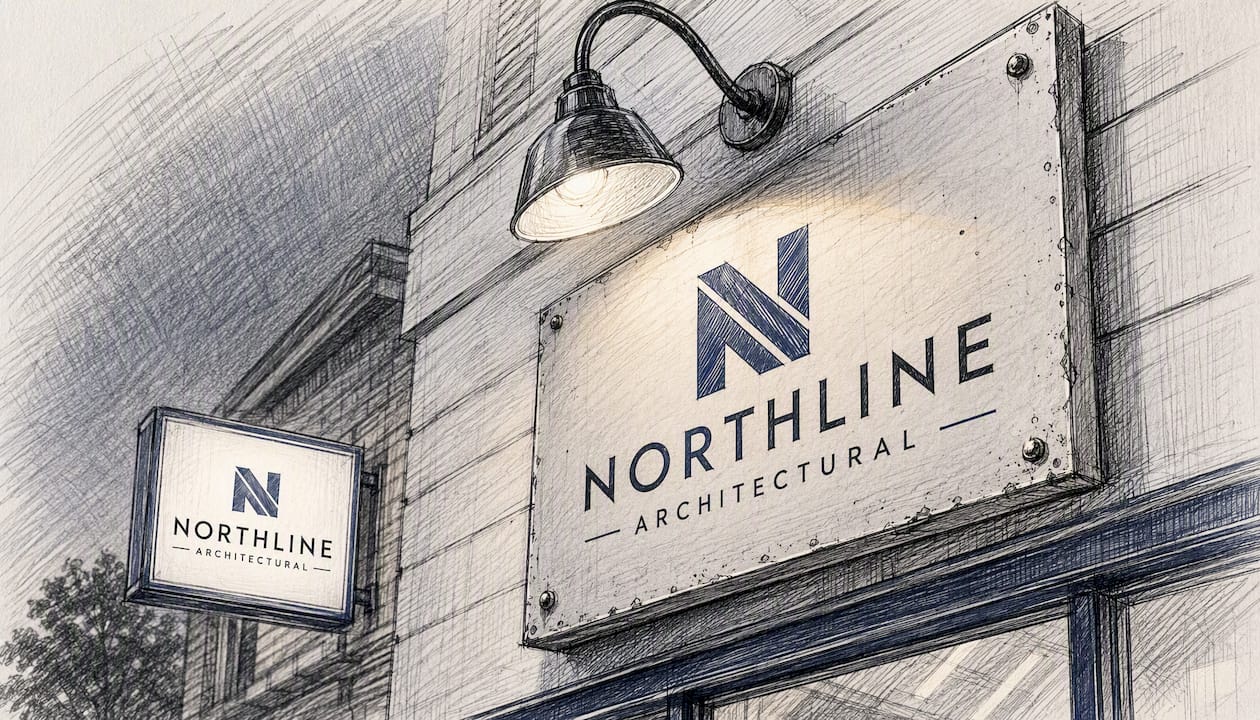
Aluminum composite panels (branded as Dibond in the trade) offer a durable, affordable base for flat signage. Channel letters cost more upfront but read as premium and hold up well outdoors. Lightboxes deliver even illumination for night visibility, while cut vinyl graphics are the cheapest way to brand a window or glass door.
For illumination, front-lit channel letters give crisp visibility after dark, halo-lit (reverse-lit) letters create a softer glow effect that reads as upscale, and lightboxes offer the most even brightness for a lower cost. Gooseneck spotlights work well for façade or monument signs where wiring channel letters isn't practical.
Since signage projects average $2,000 to $3,000, think in terms of cost per month rather than sticker price. A $2,500 sign with a seven-year lifespan runs under $30 a month, cheaper than most local digital ad buys, and it works every hour you're open.
Start with flexible signage (banners, window vinyl, A-frames) while your location proves itself, then layer in permanent fixtures once foot traffic patterns stabilize.
- Dibond/aluminum: affordable, durable, flat applications.
- Channel letters: premium look, higher upfront cost.
- Lightbox: even illumination, moderate cost.
- Vinyl: cheapest, fastest, best for windows.
Permits, Landlord Rules, and Keeping Your Sign Legal
Skipping this step is the fastest way to pay for a sign twice.
- Check your local permit office first. Most require a site plan, sign dimensions, and sometimes an electrical inspection for illuminated signs.
- Ask your landlord or property manager about sign criteria. Shopping centers often restrict size, color, and mounting location in the lease itself.
- Confirm ADA basics. Interior wayfinding and permanent signage should meet accessible height and contrast standards.
- Compare DIY vs. professional installation. DIY works for window vinyl and A-frames; channel letters and monument signs usually need licensed installers for electrical and structural safety.
- Set a maintenance cadence. Check LEDs and lamps monthly, clean surfaces quarterly, and have a rapid-repair plan for cracked panels or burned-out letters.
Pro Tip: Ask any vendor quote to include permit support as a line item. A shop that handles the paperwork saves you weeks of back-and-forth with your local planning office.
How to Track Whether Your Signs Are Working
Signage stops being a guess once you attach numbers to it.
- Pick your KPI by sign type. Exterior signs get measured by foot-traffic lift, POP signage by attach rate, and digital displays by QR scans and landing-page visits.
- Run a pre/post baseline. Track two weeks before a change and two weeks after, using the same days of week for comparison.
- Test locations or copy where possible. If you have a rotatable A-frame or multiple entrances, A/B the placement or message.
- Log every test. Record location, creative, start and end dates, and the KPI delta in a simple spreadsheet.
- Judge results honestly. A modest, repeatable lift across a few weeks means more than one big spike tied to a random sale.
- Avoid testing during holidays or major sales events, since they distort your baseline.
- Give any test at least two full weeks to smooth out day-to-day noise.
Choosing a Sign Partner and Your Next Two Steps
Two steps convert this playbook into an actual order.
- Run your sightline audit and take real measurements. Walk your approach routes, note your target viewing distance, and photograph your façade at that distance.
- Get two or three quotes with scaled proofs. Ask each vendor for a to-scale visual, not just a price sheet.
Before you sign anything, ask vendors about file formats (vector art only), Pantone color matching for brand consistency, production timeline, permit support, and warranty terms on electrical components. A scale proof checked against your actual viewing distance prevents the most common and costly sizing mistake in the industry.
CrispSign fabricates to these specs directly, with nationwide shipping and installation coordination, which makes it a solid option if you'd rather compare one vendor against a clear standard than shop five different local shops.
A Sign Maker's Take on What Actually Moves Sales
The businesses that get this right almost always did three unglamorous things: they walked their own sightlines like a stranger would, taped up a paper proof before ordering, and resisted cramming five messages onto one sign. CrispSign exists because fabrication shouldn't be the bottleneck once you've already done that homework.
Let CrispSign Build the Sign You Just Planned
You've done the hard part: the sightline audit, the letter-height math, the placement priorities. CrispSign turns that plan into fabricated signage without you needing to coordinate a designer, a fabricator, and an installer separately. Custom exterior signs, window graphics, and A-frames are all designed online and built to your exact specs, with optional professional installation coordinated for you.
Before you request a quote, have three things ready: your vector logo file, your primary brand color as a Pantone number, and the target viewing distance from your sightline audit. Those three details let CrispSign scale your design correctly the first time instead of guessing.
Head to the CrispSign site to browse templates, get instant pricing, and start your order based on the placement plan you just built.
Sources
- 9 Business Signage Tips to Attract Customers and Build Your Brand | CO- by US Chamber of Commerce
- Business Signs 101: What Goes Outside, What Goes Inside, and What to Buy First - Custom Ink Blog
- How to Design Signage for a Small Retail Business: 8 Rules That Attract Walk-Ins - The Crazy Pixel
FAQ
What's the fastest way to improve storefront sign visibility?
Start with a sightline audit at your peak traffic hour, then add a blade sign or window graphic since both install faster than permanent façade signage.
How high should storefront letters be?
Size letters to your primary viewing distance using cap-height guidance rather than the available wall space.
How much should a small business budget for signage?
Most projects run $2,000 to $3,000, though costs shift with material, illumination, and permit complexity.
Do I need a permit for a new storefront sign?
Most municipalities require a permit for illuminated or permanent signage, so check with your local planning office and your landlord before fabrication.
How do I know if my sign is actually working?
Track a KPI tied to your sign type, foot-traffic lift for exterior signs or QR scans for digital displays, using a two-week pre/post baseline.
Where can I order custom signage designed to these specs?
CrispSign designs and fabricates façade, window, and A-frame signage online, built to your measurements and shipped nationwide with optional installation coordination.