From $3,000 to $65,000: Monument Sign Ideas Built by Signmakers
The best monument sign approach depends on what your site actually needs. Masonry and stone deliver prestige for corporate campuses and upscale retail. Aluminum cabinet signs balance cost with easy face updates for multi-tenant plazas. Carved HDU brings warmth to restaurants and boutique offices. Illuminated and digital monuments win when nighttime visibility or changeable messaging matters most. The right idea comes from matching one of these categories to your budget, your traffic pattern, and how often your message needs to change.
TL;DR:
- Masonry and natural stone signs provide the highest prestige but require the greatest upfront investment and are less flexible for future updates.
- Illuminated and digital signs offer improved visibility at night and flexibility for changing messages but come with higher costs and regulatory considerations.
- Cost varies widely: post-and-panel signs start around $3,000, masonry signs can exceed $65,000, and digital LED monuments may go beyond $100,000 based on size and technology.
- Proper placement requires ensuring letter height matches traffic speed and distance, with high contrast and minimal copy for optimal readability from a moving vehicle.
- Working with a streamlined, nationwide sign manufacturer like CrispSign can shorten project timelines and ensure consistent branding across multiple locations.
Table of Contents
- Monument Sign Ideas Grouped By Style and Purpose
- Materials and Finishes: Matching Look to Longevity
- Lighting, Illumination, and Digital Display Options
- Cost Ranges and a Budgeting Checklist
- Placement, Sizing, and Legibility Best Practices
- Permits, Site Prep, and Maintenance to Plan For
- The CrispSign Take: Building Monument Signs That Actually Get Ordered
- Ready to Design Your Monument Sign?
- Sources
- FAQ
Monument Sign Ideas Grouped By Style and Purpose
Every strong monument sign starts as a category, then becomes a specific idea once you factor in your site, your brand, and your budget. Here's how the main styles break down, with adaptable concepts inside each one.
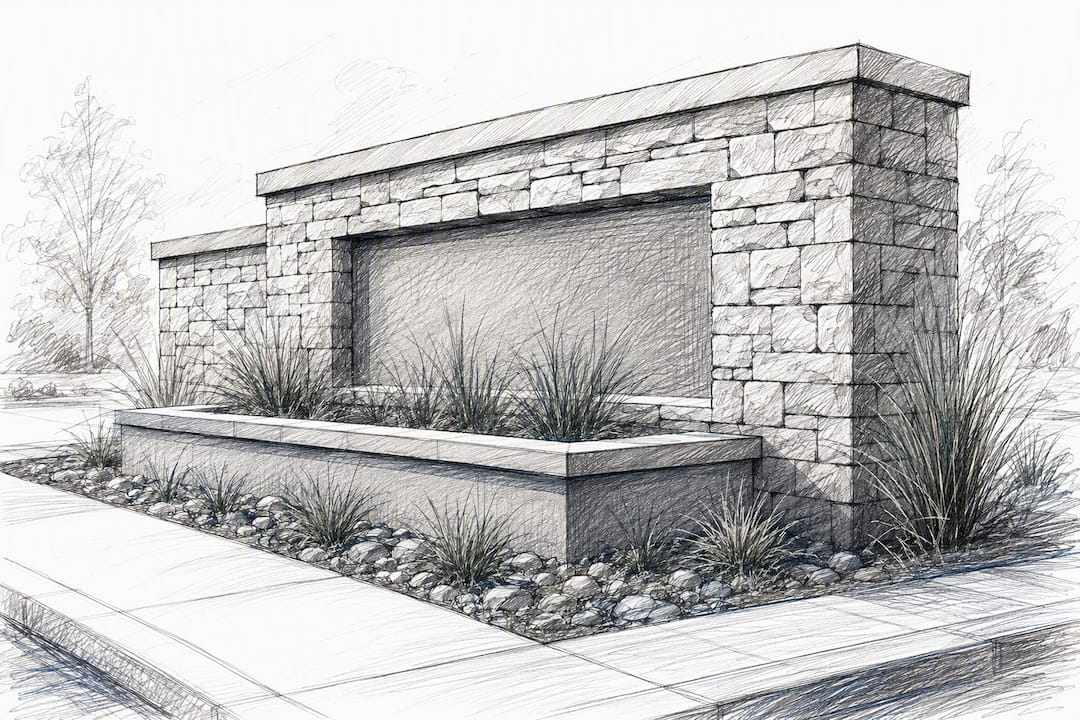
Masonry and natural stone concepts carry the most visual weight per square foot. A monolithic stone slab with a single recessed logo reads as understated luxury, popular with law firms, medical campuses, and country clubs. Stacked stone with a recessed metal or acrylic logo panel softens the look without losing the permanence. Stone columns flanking a center panel, paired with built-in planter benches, turn the sign into a small gathering point rather than just a marker.
Contemporary metal and acrylic treatments suit brands that want to look current rather than traditional. Layered metal panels in staggered depths create shadow lines that shift with the sun. Corten steel accents (that rusted, weathered orange-brown finish) pair surprisingly well with clean white acrylic lettering for a tech or design-forward feel. Backlit acrylic logo panels give a soft glow without the cost of a full illuminated cabinet, and asymmetrical blade forms (angled or off-center panels instead of a symmetrical rectangle) make small signs feel intentional instead of undersized.
Carved and HDU wood-look options bring texture that flat panels can't match. Deep-carved text panels with painted recesses work well for wineries, spas, and boutique hotels. Routed HDU with a faux wood-grain or stone texture gets you the carved look at a fraction of real stone's weight and cost, according to the Monument Sign Cost Guide. Cedar accents around a core panel add a residential warmth that many commercial signs skip entirely, which is exactly why it stands out.
Post-and-panel and aluminum cabinet variants are the workhorses of the category. Painted aluminum panels on a simple post frame cost the least and still look sharp when the typography is clean. Changeable tenant inserts let a shopping center swap a departing business's panel without touching the rest of the sign. Faux-stone wraps around an aluminum or steel frame mimic masonry's look at a lower weight and price point.
Illuminated and digital treatments solve the after-dark visibility problem. Halo-lit letters (a soft glow ringing each raised letter) look premium and use relatively little power. Edge-lit acrylic panels give a thin line of light along the panel's border, great for a modern logo mark. Integrated LED message centers paired with a static brand panel above them let you keep your logo permanent while updating hours, promotions, or event info below.
Site-enhancing add-ons turn a good sign into a memorable one. Integrated planters and small water features soften a hard structure, according to design ideas cataloged by Vervilla. Sculptural elements, wayfinding arrows for campus entrances, and even QR or NFC tags that link to a directory or promotion add a layer of interactivity that a flat panel alone can't offer.
Materials and Finishes: Matching Look to Longevity
Material choice determines both how your sign looks on day one and how much it costs to keep looking that way for the next decade.
- Brick, natural stone, and cast stone deliver the most permanent, prestige look, and they're the right call when the sign needs to signal institutional trust, but they carry the highest upfront investment and the least flexibility for future updates.
- Aluminum cabinets with acrylic faces trade some of that gravitas for real flexibility. Faces can be swapped or repainted as your brand evolves, which matters if you rebrand or lease to tenants who change.
- HDU foam and composite panels mimic carved wood or stone at a fraction of the weight, according to Blink Signs, which also reduces structural and foundation demands.
- Finish treatments matter more than most owners expect: sealers protect stone and masonry from staining, powder coat resists fading on metal, and faux textures need periodic touch-up to keep their illusion convincing.
Pro Tip: If your brand colors or logo might change within five years, avoid painting them directly onto a masonry surface. Use a separate acrylic or aluminum panel you can replace without touching the stonework.
Lighting, Illumination, and Digital Display Options
Lighting decides whether your sign works at 9 AM or actually earns its keep at 9 PM.
- External uplighting washes the sign from below with ground-mounted fixtures. It's affordable to install but needs bulb maintenance and can wash out fine detail.
- Internal cabinet illumination lights the sign from within, giving even, consistent brightness that reads well from a distance.
- Halo and edge lighting create a refined glow around letters or panel edges, using less energy than a fully lit cabinet.
- LED message centers make sense when your message changes often (a school, church, or gas station), but they add real cost and often trigger local rules on brightness and animation limits, per United Signs.
Before finalizing any digital component, check your municipality's sign ordinance for brightness caps and the maximum percentage of the sign that's allowed to be electronic.
Cost Ranges and a Budgeting Checklist
Monument sign pricing swings widely based on material and technology, so knowing where your idea lands helps you plan realistically instead of guessing.
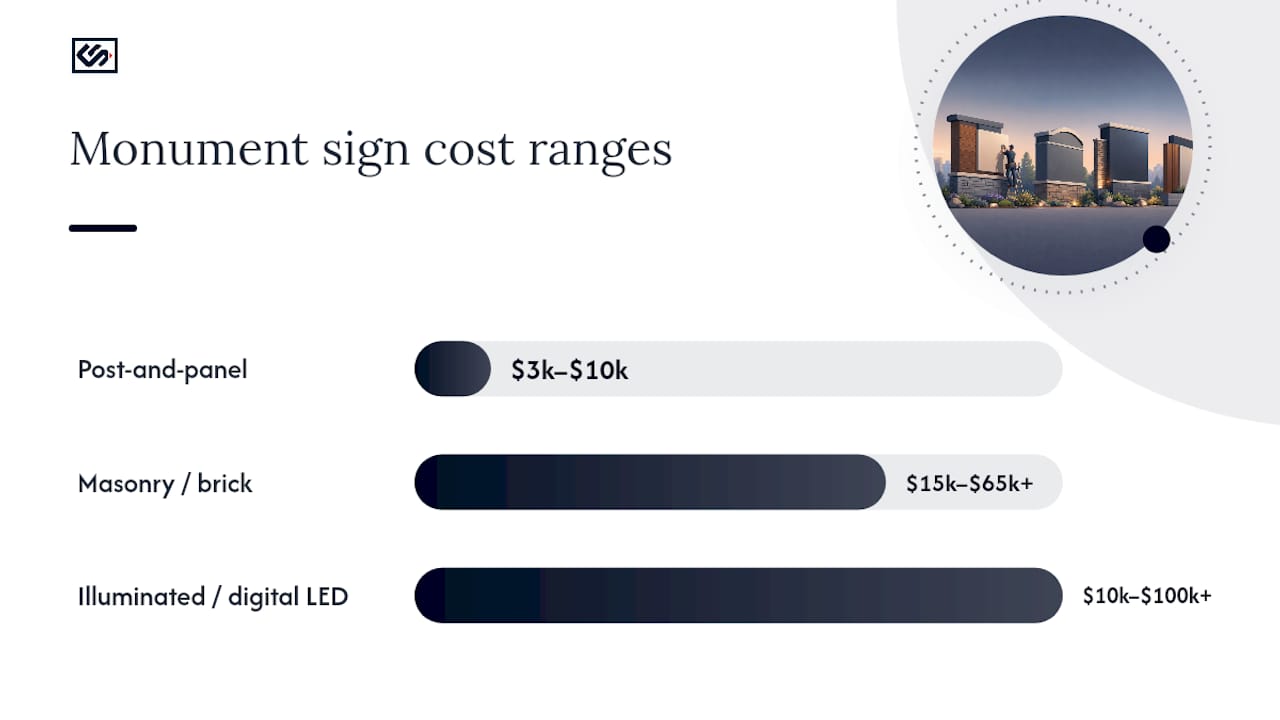
Post-and-panel signs typically run $3,000 to $10,000. Masonry and brick builds climb to $15,000 to $65,000 or more. Illuminated and digital LED monuments span roughly $10,000 to $100,000-plus, according to the Monument Sign Cost Guide, depending on display size and the electrical infrastructure it needs.
The biggest cost drivers are sign size, foundation and site prep, electrical work for illumination, material choice, permitting fees, and whether you need changeable tenant panels. Before requesting quotes, run through this checklist:
- Get a site survey to confirm setback distances and underground utilities.
- Budget a permit allowance, since fees and review timelines vary by jurisdiction.
- Add an electrical contingency if the sign will be illuminated or digital.
- Confirm installation access, especially for masonry signs that need heavy equipment.
Placement, Sizing, and Legibility Best Practices
A beautifully designed sign still fails if drivers can't read it in time. Setback distance and viewing speed should drive letter height, not the other way around. As a rule of thumb, plan roughly one inch of letter height for every 10 feet of intended viewing distance from the road.
- Keep primary business names in high contrast against the background (dark letters on light stone, or vice versa).
- Limit copy to your name, logo, and maybe one line of secondary information. Long lines of text get skipped by drivers.
- Scale your logo to remain identifiable at a glance, not just legible up close.
- Keep landscaping low near the base so shrubs never creep up over the copy line.
Pro Tip: Stand at your property's actual entrance speed and distance, print your proposed copy at true size, and tape it to a stake where the sign will go. If you can't read it comfortably from a moving car, your type is too small.
Permits, Site Prep, and Maintenance to Plan For
Design gets the attention, but permitting and prep are what actually delay projects.
- Check local rules early: illumination limits, electronic messaging restrictions, and setback or sightline requirements vary by municipality and can reshape your design.
- Budget for site work: excavation, an engineered foundation, and conduit for electrical service, with frost-depth engineering required in colder climates, per United Signs.
- Schedule maintenance: sealant checks on stone, periodic LED module servicing, and vegetation control around the base keep the sign performing for years.
The CrispSign Take: Building Monument Signs That Actually Get Ordered
Most monument sign projects stall not because the idea is bad, but because turning an idea into a fabrication-ready design takes too long. A modern sign company might build its process around closing that gap: custom design handled online, production optimized for speed, and nationwide shipping with optional coordinated installation to have local support when needed. Expect a workflow built for clarity, not guesswork, from first sketch to finished sign.
— Nick
Ready to Design Your Monument Sign?
If you're managing signage across more than one property, the idea gallery above only gets you halfway. The harder problem is keeping every location's design consistent while ordering fast enough to hit your opening dates. Some companies handle custom monument sign design, production, and nationwide shipping from one online workflow, with optional installation coordination to help manage installation logistics.
For businesses managing multiple locations, the Crisp Corporate portal lets your team request quotes and manage multi-location signage projects from a single dashboard, so every storefront gets a monument sign that matches your brand without ten separate vendor conversations. If your monument sign will also drive traffic to a QR code or digital landing page, make sure that destination is built for mobile visitors before you finalize the artwork. Start your project through the corporate portal and get a quote based on your actual site, not a generic template.
Sources
- Monument Sign Cost Guide 2026
- Monument Signs & Custom Exterior Entrance Signs
- 20+ Creative Monument Sign Ideas for Your Home - Vervilla
FAQ
Can you provide some examples of monument signs?
Common examples include monolithic stone slabs with a recessed logo, aluminum cabinet signs with changeable tenant panels, carved HDU panels with faux wood texture, and illuminated signs with halo-lit letters or an LED message center.
How much does a monument sign typically cost?
Post-and-panel signs generally run $3,000 to $10,000, masonry builds range from $15,000 to $65,000 or more, and illuminated or digital LED monuments span roughly $10,000 to $100,000-plus depending on size and infrastructure, according to the Monument Sign Cost Guide.
What is the difference between a ground sign and a monument sign?
A monument sign is a specific type of ground sign, low-profile and typically built on or integrated with a solid base rather than mounted on tall poles, distinguishing it from taller pylon or pole signs, per United Signs.
What are some creative ideas for outdoor signs?
Strong creative options include contrasting textures, layered materials, asymmetrical shapes, integrated planters or water features, and interactive elements like QR codes linked to a directory or promotion, as cataloged by Vervilla.
Does CrispSign design and ship monument signs nationwide?
Yes. CrispSign offers custom monument sign design through an online process, with production built for faster turnaround and nationwide shipping, plus optional coordinated installation.