Retail Sign for Store Owners: Pick, Design, and Order
For most U.S. retailers, the best first investment is a high-contrast exterior storefront sign, whether that's illuminated channel letters or a cabinet sign with your brand colors. It's the one asset that works 24/7 to pull foot traffic before a customer ever steps inside. If you already have a solid storefront sign and want to go deeper, request a custom quote at Crispsign and upload your artwork to get a digital proof fast.
Pro Tip: Think of your storefront sign as your best salesperson. It never calls in sick, never misses a shift, and speaks to every person who walks by. Invest there first.
Signage is a strategic brand asset, not decoration. The sections below walk you through every sign type, what each costs, how to order, and how to measure results so you can move from planning to production with confidence.
Table of Contents
- Which retail sign type fits your business goal?
- What are the main types of retail signs and materials?
- What design rules make a retail sign actually work?
- How does the ordering and production process work?
- Do you need a permit for your retail sign?
- What does a retail sign cost?
- How do you know if your sign is working?
- What should you check before placing a sign order?
- Key Takeaways
- Crispsign makes custom retail signage straightforward
- FAQ
Which retail sign type fits your business goal?
The fastest way to shortlist your options is to match your primary goal to the sign type built for it. Here's a quick mapping:
- Guide customers inside the store: — Interior wayfinding signs, department markers, and overhead banners. A multi-room service office benefits from clear directional signs so clients don't wander.
Start with your storefront identity sign. Once that's in place, layer in sidewalk signs or POP displays to support specific campaigns. Sign visibility directly influences whether a business attracts foot traffic or gets overlooked, so the exterior sign is almost always the right first move.
What are the main types of retail signs and materials?
Retail signage breaks into six broad categories. Each serves a different function, uses different materials, and carries different durability expectations.
Exterior and storefront signs
These are the signs mounted to your building's facade, above your entrance, or on a freestanding structure. Common formats include:
- Fascia signs: — Flat panels (aluminum composite, PVC, or acrylic) mounted flush to the building face. Durable, low-maintenance, and easy to brand with vinyl graphics or direct print.
Window and blade signs
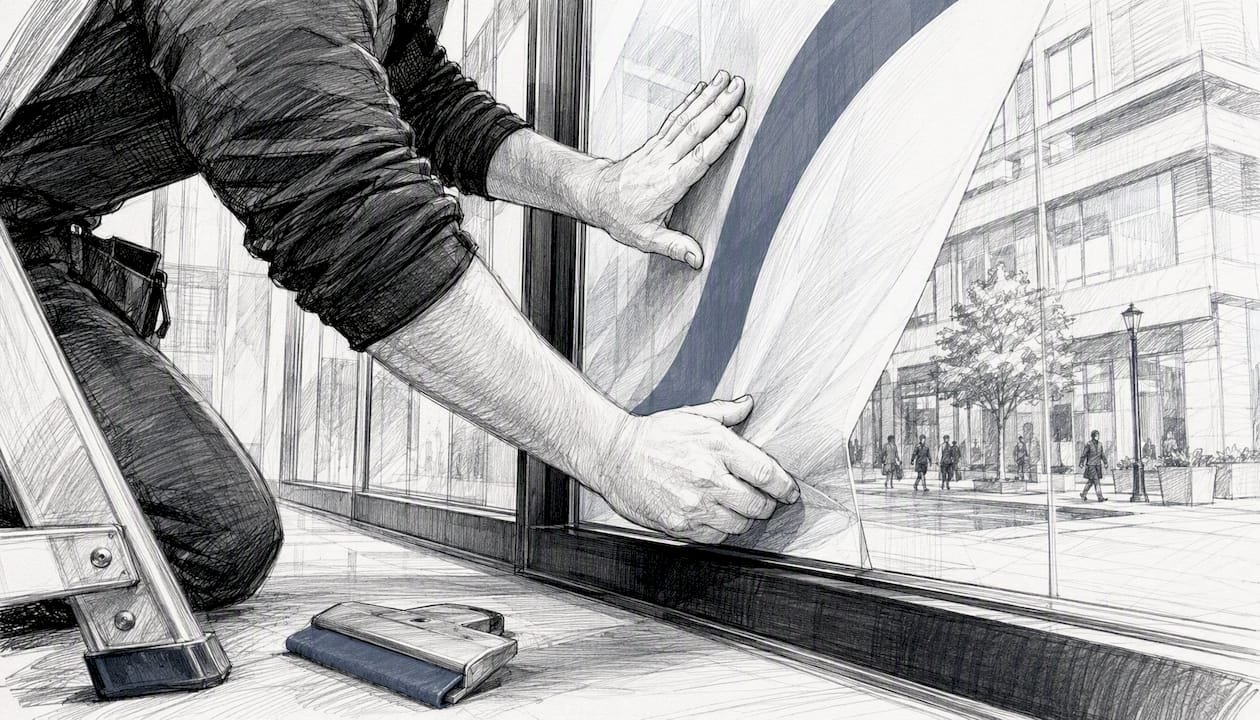
Window graphics use adhesive vinyl applied directly to glass. They can be opaque, perforated (see-through from inside), or frosted. A blade sign projects perpendicular to the building face so pedestrians can read it from down the sidewalk.
A-boards and sidewalk signs
Portable, double-sided frames placed on the sidewalk. Typically aluminum or plastic with a chalkboard, dry-erase, or printed insert surface. Easy to update daily.
Interior wayfinding and lobby signs
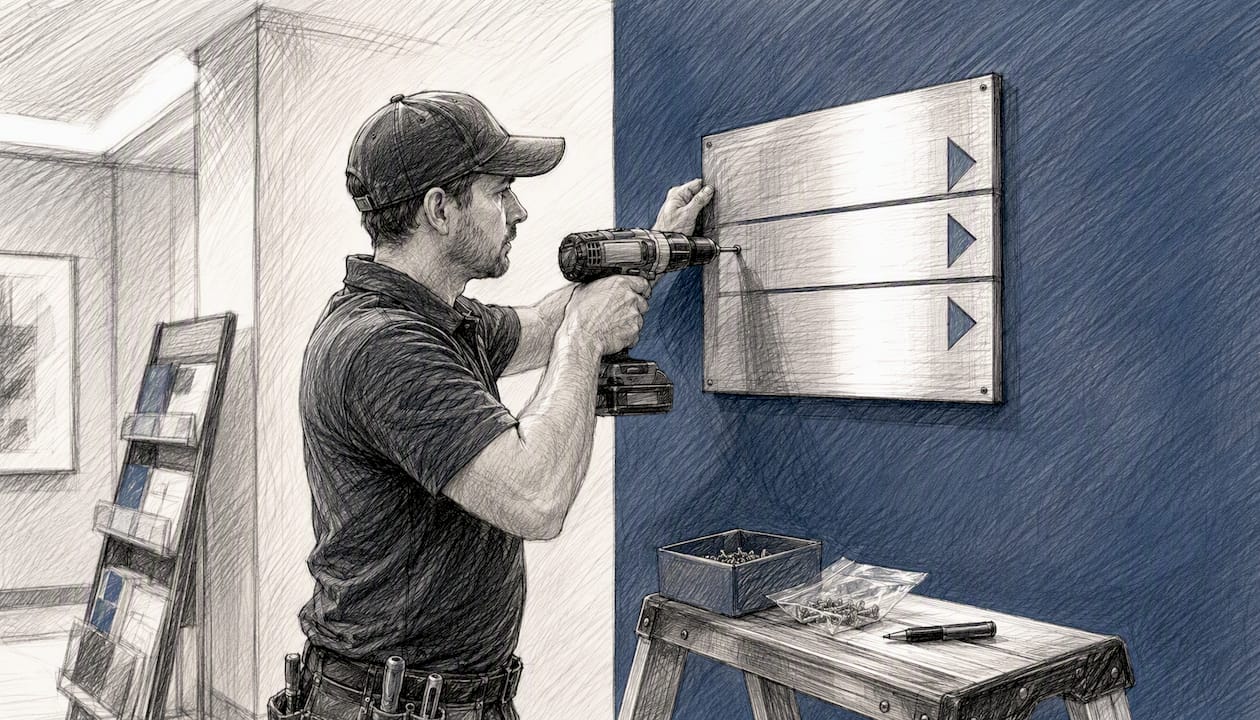
Directional signs, room markers, ADA-compliant plaques, and dimensional lobby logos. Materials range from brushed aluminum and acrylic to PVC foam board for lighter-duty applications.
POP and shelf displays
Point-of-purchase signs live at the shelf, end-cap, or checkout counter. Formats include foam board, corrugated plastic (Coroplast), acrylic holders, and tabletop tents. These are typically short-lived and designed for seasonal refresh.
Digital displays
LED video panels and digital menu boards. A 2025 study referenced by Shopify found that exposure to in-store video ads increased purchase probability by roughly 8.1%. Digital signs carry a higher upfront cost but allow real-time content updates without reprinting.
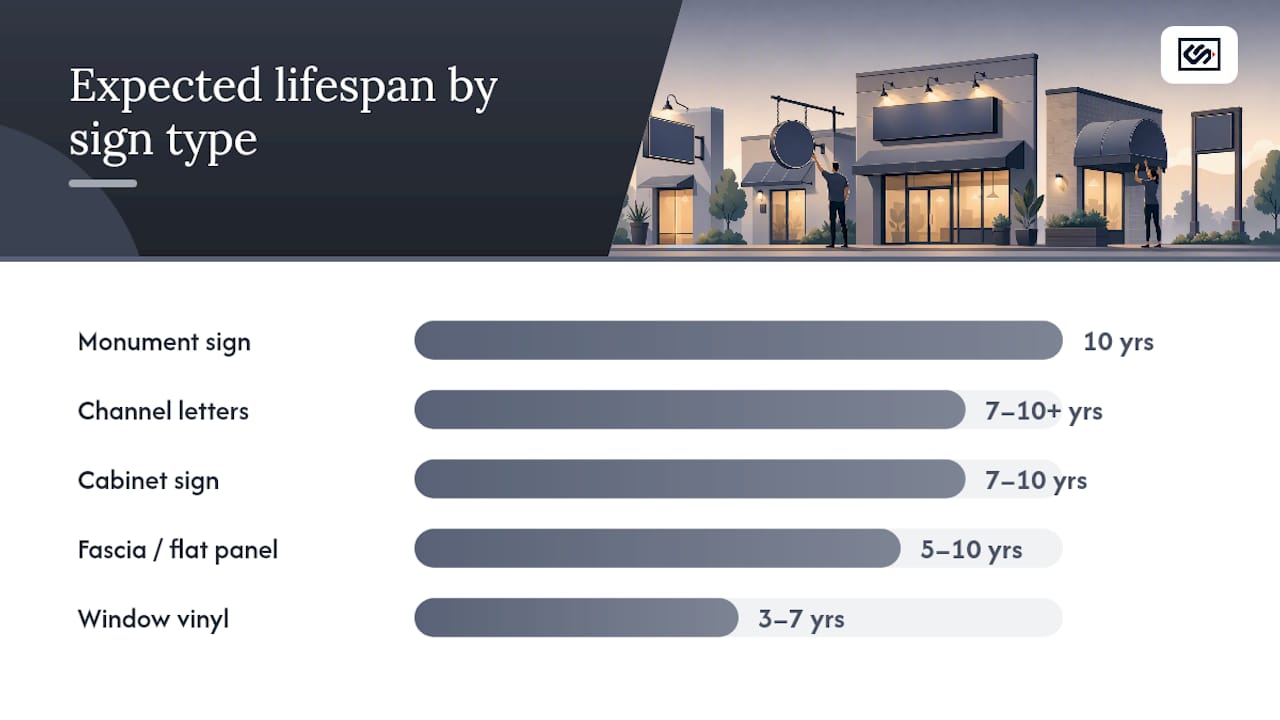
| Sign type | Best for | Material / finish | Expected lifespan | Install complexity |
|---|---|---|---|---|
| Channel letters | High-visibility storefronts | Aluminum + acrylic, LED | 7–10+ years | High (electrical required) |
| Cabinet sign | Franchise / multi-tenant | Steel or aluminum, LED backlit | 7–10 years | Medium |
| Fascia / flat panel | Clean brand identity | Aluminum composite, vinyl | 5–10 years | Low to medium |
| Monument sign | Parking lot / campus entry | Concrete, brick, aluminum | 10 years | High (foundation required) |
| Window vinyl | Promotions, hours, branding | Cast or calendered vinyl | 3–7 years | Low (DIY possible) |
| A-board | Daily specials, sidewalk | Aluminum, plastic | 3–5 years | None |
| Interior wayfinding | Retail, office, medical | Acrylic, aluminum, PVC | 5–10 years | Low to medium |
| POP / shelf talker | Seasonal promotions | Foam board, Coroplast, acrylic | Seasonal to 1 year | None |
| Digital display | Menu boards, video ads | LED panel | 5–10 years | High (electrical, mounting) |
What design rules make a retail sign actually work?
The single most important rule: one idea per sign. A sign that tries to say three things says nothing. Every other design decision flows from that principle.
Message hierarchy
Lead with your brand name or the single action you want the viewer to take. Supporting details (tagline, phone number, hours) go below in smaller type. A viewer should absorb the primary message in under five seconds, which is roughly how long a pedestrian at normal walking speed spends in front of a typical storefront.
The Rule of 10 for letter height
A practical design heuristic used widely in the sign industry: for every 10 feet of viewing distance, your letters should be at least 1 inch tall. A sign read from 50 feet away needs letters at least 5 inches tall. This is a starting point; verify it with a street-level photo mockup before finalizing production files.
Contrast and brand colors
High contrast between the letter color and background is non-negotiable for legibility. Dark text on a light background or light text on a dark background both work. Avoid color combinations that reduce contrast, like yellow text on a white background. Your brand colors should anchor the palette, but legibility wins over brand color fidelity when the two conflict.
Whitespace and copy length
Aim for roughly 60% negative space on the sign face. Crowded signs read as noise. If you're tempted to add a phone number, a tagline, and a list of services to your storefront sign, resist it. Save that information for your window graphics or A-board.
Pro Tip: Test your proof at night if you're ordering an illuminated sign. Glare from a high-gloss finish can wash out lettering after dark. Request a matte or satin acrylic face to keep the sign readable around the clock.
When reviewing proofs, print the design at a small scale, hold it at arm's length, and see if you can read the primary message in five seconds. If you can't, simplify before approving.
How does the ordering and production process work?
Here's the standard flow from first contact to installed sign:
- Fabrication — The sign is built to spec. Channel letters and illuminated signs take longer than flat vinyl or foam board because of the electrical components and metalwork involved.
| Stage | What you receive | Typical timing |
|---|---|---|
| Quote / design intake | Estimate and design brief confirmation | Same day to 2 business days |
| Digital proof | Rendered mockup with dimensions and material specs | 2–5 business days |
| Proof approval | Signed approval triggers production | Your timeline |
| Fabrication | Varies by sign type and complexity | 5–15 business days (simple vinyl to complex illuminated) |
| Shipping | Tracking number and estimated delivery | 3–7 business days depending on destination |
| Installation | Coordinated separately if professional install is needed | Varies by installer availability |
Permit-dependent changes can extend the timeline significantly. If your sign requires a local permit, start that process before you finalize the design so the permit drawings align with the approved proof.
Do you need a permit for your retail sign?
Many exterior and illuminated signs require a local permit before installation. Skipping this step can result in fines, forced removal, or a stop-work order. Check early.
Common permit triggers:
- Installing any new exterior sign on a building facade or freestanding structure
- Increasing the total sign area beyond what your current permit covers
- Adding or changing illumination (LED, neon, or backlit)
- Mounting to a structural element like a parapet, canopy, or pole
- Installing a monument or pylon sign (almost always requires a permit and sometimes a foundation inspection)
Installation options:
- DIY: Window vinyl, A-boards, lightweight foam board interior signs, and small acrylic plaques are typically DIY-friendly. You need basic tools and a clean surface.
- Professional installation: Channel letters, cabinet signs, monument signs, and any sign with an electrical connection require a licensed installer. Crispsign can coordinate professional installation for an added flat fee passed to a third-party installer.
Pro Tip: Call your local building department before you finalize your sign design. Ask specifically about maximum sign area, setback requirements, and illumination restrictions for your zoning district. Getting this information early prevents costly redesigns.
ADA compliance applies to interior signs in public-facing spaces. Tactile characters, Braille, and specific mounting heights are required for restroom, room identification, and directional signs under the Americans with Disabilities Act. Factor this into your interior sign budget.
What does a retail sign cost?
Cost is driven by four variables: size, material, illumination, and installation complexity. A small window decal and a set of illuminated channel letters are both "retail signs," but they sit at opposite ends of the budget spectrum.
| Sign type | Typical fabrication range | What pushes price up |
|---|---|---|
| Window vinyl / decals | $50–$500 | Size, full-color print, specialty finishes |
| A-board / sidewalk sign | — | Material, insert type, custom print |
| Flat panel / fascia sign | $2,000+ | Size, substrate, full-color print |
| Carved cedar sign | $500+ | Size, depth of carve, paint or gilding |
| Acrylic lobby sign | $400+ | Dimensional lettering, backlighting, size |
| Cabinet sign | $1,500+ | Size, LED vs. fluorescent, custom shape |
| Channel letters | $2,000+ | Number of letters, illumination, install |
| Monument sign | $3,000+ | Materials, size, foundation, electrical |
| Digital display | $2,000+ | Screen size, resolution, content management |
Beyond fabrication, budget for these line items:
- Permit fees: — Vary by municipality, typically $50–$500 for most exterior signs, more for large or illuminated structures.
Budgeting approach: Prioritize your storefront identity sign first. Once that's in place, allocate remaining budget to POP displays or interior wayfinding. Modular sign systems, where the frame stays and only the insert changes, lower refresh costs for retailers who update messaging seasonally.
How do you know if your sign is working?
Every sign should have one primary KPI. Tracking it before and after installation gives you a real signal rather than a gut feeling.
- Wayfinding signs: — Track staff time spent redirecting customers, or use a short post-visit survey asking how easy it was to find what they needed.
A simple two-step test works for most small retailers: record your baseline metric for two to four weeks before the sign goes up, then run the same measurement for two to four weeks after. A meaningful lift in foot traffic or sales at the promoted SKU confirms the sign is earning its place. Brand visibility online and offline reinforce each other, so pair your new storefront sign with consistent Google Business Profile photos and updated local listings to amplify the effect.
What should you check before placing a sign order?
Run through this checklist before you commit to a vendor or approve a proof:
Decision checklist:
- Sign type confirmed and matched to your primary goal
- Dimensions verified against your building or space (measure twice)
- Brand files ready: vector logo, brand color codes (Pantone or CMYK), approved fonts
- Budget set, including fabrication, permit, install, and shipping
- Permit requirements checked with your local building department
- Installation method decided (DIY or professional)
Questions to ask any sign vendor:
- What is your standard lead time for this sign type, and what can delay it?
- Do you provide a digital proof before production, and how many revisions are included?
- What warranty do you offer on materials and workmanship?
- What file formats and material specs will you provide for permit applications?
- Do you subcontract electrical work, and are those subcontractors licensed and insured?
- Can you coordinate professional installation, or do I need to source my own installer?
- Are you bonded and insured for commercial sign work?
Red flags to watch for:
- No physical business address or verifiable U.S. production facility
- No proofing process or unwillingness to provide a digital mockup before production
- No written warranty or satisfaction guarantee
- Vague lead times with no commitment ("a few weeks" with no range)
- No clear answer on permit-ready drawings or ADA compliance for interior signs
Key Takeaways
The right retail sign starts with matching your primary business goal to the correct sign type, then budgeting for fabrication, permits, installation, and ongoing measurement.
| Point | Details |
|---|---|
| Start with the storefront | An exterior sign is the highest-ROI first investment for most retailers; prioritize it before POP or interior signs. |
| Match sign type to goal | Use the goal-to-sign mapping: exterior for foot traffic, window vinyl for promotions, A-board for daily specials, POP for SKU lift. |
| Budget all-in | Fabrication is only part of the cost; add permit fees, professional installation, electrical, and shipping to your total. |
| Track one KPI per sign | Foot traffic for exterior signs, sales lift for POP, QR scan rate for digital; measure baseline before install. |
| Crispsign for turnkey ordering | Crispsign offers free design proofing, U.S.-based production, nationwide shipping, and coordinated installation options. |
A note on working with sign vendors
Signage projects go smoothest when the vendor handles proofing, production, and fulfillment under one roof. Crispsign's process is built around that principle: free design proofing, clear production timelines, and a satisfaction guarantee so you're not left guessing at any stage.
Crispsign makes custom retail signage straightforward
Ordering a custom sign shouldn't require three vendors, two phone calls, and a week of back-and-forth. Crispsign handles design, fabrication, and nationwide shipping from a single U.S.-based production workflow, so you get a quality-made sign without the coordination headache.
Here's what you get when you order through Crispsign:
- Free design proofing: — Upload your logo and brand files, and Crispsign's team produces a digital proof before a single piece of material is cut.
The full product range covers exterior channel letters, carved cedar signs, illuminated cabinet signs, monument signs, interior lobby logos, acrylic wall panels, window and wall vinyl graphics, tabletop tents, wayfinding signs, and vehicle graphics including wraps, cut-vinyl decals, and removable magnets.
Get a custom sign quote or upload your artwork today to receive a digital proof and move your project forward.
Useful resources for permits, ADA, and design standards
Before you finalize your sign order, these authoritative sources can help you navigate permits, compliance, and design best practices:
- Retail Signage: Types, Design Tips, and Examples (2026) - Shopify
- Retail Signage: Turning Foot Traffic Into Brand Loyalists
- Driving Visibility: How Effective Signage Can Transform A Brand
- Brand Visibility: How to Increase It in the Era of AI
- Sign Visibility Term Guide | FasterCapital
For permit-ready drawings or ADA-compliant interior sign specifications, contact Crispsign directly. The team can provide the technical documentation most local building departments require for sign permit applications.
FAQ
What is a retail sign?
A retail sign is any visual display a business uses to communicate its brand, location, products, or directions to customers, spanning exterior storefront signs, window graphics, interior wayfinding, and point-of-purchase displays.
What are storefront signs called?
Storefront signs go by several names depending on their format: fascia signs (flat panels on the building face), channel letters (individual 3D letters), cabinet signs (enclosed backlit boxes), and blade signs (projecting perpendicular to the facade). The industry term covering all of them is "exterior retail signage."
What types of retail signage are there?
The main categories are exterior/storefront signs, window graphics, A-boards and sidewalk signs, interior wayfinding signs, point-of-purchase and shelf displays, and digital displays. Each type serves a different function and suits different business goals.
Where can I find free printable signs for my store?
Free printable signs work for temporary, low-visibility applications like back-of-house notices or simple shelf labels. For customer-facing signage, professionally fabricated signs from a vendor like Crispsign deliver the durability and brand quality that printed paper cannot match.
How long does it take to get a custom retail sign made?
Turnaround depends on sign type and complexity. Simple vinyl graphics and flat panel signs typically take 5–10 business days in fabrication; illuminated channel letters and cabinet signs can take 10–15 business days or more, plus shipping time. Permit-dependent projects add additional lead time.