U.S. Businesses: Expect $181–$804 for Basic Sign Installation
Most commercial sign installations in the U.S. run between $181 and $804, averaging around $464 for straightforward jobs, but that figure climbs fast once you add illumination, permits, or a tricky mounting site. Channel letter sets, monument signs, and digital displays often land in the thousands, not hundreds. The real driver isn't the sign itself. It's size, power requirements, and how hard your site makes the crew work. Compare per-type ranges below, then use the checklist further down before you sign a contract.
TL;DR:
- Sign installation costs vary significantly by type, with simple storefront signs averaging around $464, while large, illuminated, or digital signs can cost several thousand dollars.
- Larger signs, added electrical components, and complex mounting sites notably increase total expenses, especially for monument and pylon signs or those near power lines.
- Itemized quotes should break down fabrication, electrical, permits, and delivery costs to enable accurate comparison and ensure no hidden fees.
- Timeline for installation depends heavily on permit review, often taking 2 to 6 weeks, plus 1 to 3 days for actual on-site work, especially if cranes or electrical permits are needed.
- Proper insurance and liability coverage from installers are essential to mitigate legal and financial risks during sign installation, especially for elevated or structural signs.
Table of Contents
- How Much Does Sign Installation Cost by Sign Type?
- What Factors Increase or Reduce Installation Price?
- What's Included in an Itemized Sign Installation Quote?
- How to Budget and Get Accurate Sign Installation Quotes
- How Long Does Sign Installation Take?
- What Do Signs Cost to Maintain After Installation?
- How CrispSign Approaches Pricing and Installation Coordination
- Do You Need Insurance for Sign Installation?
- A Publisher's Take on Avoiding Bad Sign Bids
- Get a Sign Installation Quote Through CrispSign
- Where to Check Permit Rules and Sign Codes
- Sources
- FAQ
How Much Does Sign Installation Cost by Sign Type?
Sign installation pricing swings wildly by category, and lumping them into one "average" number is how business owners end up underbudgeting. A backlit channel letter set behaves nothing like a vinyl window graphic in terms of labor, electrical work, or permit scrutiny.
Channel letters, the individual illuminated letters you see on retail storefronts, typically run $250 to $900 per letter, with full-set installs landing anywhere from $2,000 for a simple non-illuminated set to $20,000 or more for a large, fully lit system. Monument signs, the freestanding ground-level signs common at office parks and shopping centers, involve foundation work and usually cost more upfront because of concrete and structural labor. Pylon signs, the tall pole-mounted signs visible from highways, carry similar structural costs plus crane time for the elevated install.
Digital and LED displays sit at the high end because of the electronics and data connections involved, often running $10 to $300 per square foot depending on resolution and size. Awning signs and window graphics are comparatively gentle on the budget since they skip electrical work entirely in most cases. A-frame sidewalk signs are the cheapest option on this list, often installable in under an hour with no permit required in most municipalities.
Three quick examples show how this plays out. A small café installing a non-illuminated awning sign with basic window graphics might spend a few thousand dollars in total. A retail storefront putting up a mid-size illuminated channel letter set, roughly ten letters, could cost several thousand dollars once electrical and permits are factored in. A shopping center installing a new monument sign with digital messaging might face costs in the mid to high thousands once foundation work, electrical service, and permitting are included.
What Factors Increase or Reduce Installation Price?
Size and letter count set the floor. A five-letter sign costs less to fabricate and mount than a fifteen-letter version of the same design, and every additional letter adds both material and installer time on the wall.
Material choice shifts the number meaningfully too. Aluminum faces and returns are the industry standard for durability at a moderate price point. Acrylic faces cost less but scratch more easily over time. Carved cedar signage, popular for boutique retail and hospitality, costs more per square foot than metal fabrication because of the hand-finishing involved. Concrete monument bases add both material and labor cost compared to a simple pole mount.
Illumination is often the single largest cost factor after size, due to electrical work, LED or neon installation, and potentially separate electrical permitting.
Mounting method and site access matter more than most business owners expect going in:
- Ground-level, wall-mounted signs on accessible facades install fastest and cheapest.
- Second-story or roof-mounted signs typically require a boom lift or scaffolding.
- Signs near power lines or on historic buildings often trigger extra utility coordination and design review.
- Landlord or property management approval can add weeks if your lease requires sign committee sign-off.
Regional labor rates create real spread too. Urban markets often have costs moderately higher than suburban averages, while rural markets can be somewhat lower due to labor and permitting differences. for both fabrication and installation, while rural markets can come in 5 to 15 percent below the national mid-range because of lower labor costs and lighter permitting.
Pro Tip: Ask your installer whether they're quoting a raceway mount or individually mounted letters for channel letter jobs. Raceway mounting bundles the wiring into a single enclosure and cuts on-site labor time, while individually mounted letters look cleaner but mean more wall penetrations and wiring hours.
What's Included in an Itemized Sign Installation Quote?
A quote that lists one lump sum tells you nothing. A properly itemized bid breaks the project into distinct cost centers so you can see exactly where your money goes and compare bids apples to apples.
- Fabrication and materials — the sign itself, priced separately from labor to install it.
- Delivery and rigging — transport and handling for large or heavy pieces, especially monument or pylon signs shipped in sections.
- Installation labor — the crew's time, usually billed per hour or as a flat installation fee based on sign type and site complexity.
- Equipment rental — boom lifts, cranes, scaffolding, or traffic control for street-facing jobs; these can add several hundred dollars on their own for elevated installs.
- Electrical work — wiring, transformers, and connection to power, plus the electrician's own labor charge separate from the sign installer's.
- Structural or foundation work — concrete footings for monument signs or reinforcement for heavy wall-mounted pieces.
- Permits and inspections — filing fees and any required inspection visits, typically $400 to $2,500 depending on your municipality and sign type.
- Contingency — a buffer of roughly 10 to 15 percent for unforeseen site conditions, since older buildings often hide surprises behind the wall.
Skip a line item and you're either underbudgeting or letting a vendor bury costs where you can't compare them against a competing bid.
How to Budget and Get Accurate Sign Installation Quotes
Getting three bids that all mean the same thing requires asking the same questions of every vendor. Start by requesting a fully itemized quote broken into fabrication, installation, electrical, permits, and delivery, exactly as outlined above, rather than a single bottom-line number.
Verify licensing and insurance before you sign anything. Ask for proof of liability coverage and workers' compensation, plus references from at least two recent commercial jobs similar in scope to yours.
- Confirm who handles permit filing and whether that cost is included or billed separately.
- Ask whether post-install cleanup and any punch-list fixes are covered in the price or billed as extras.
- Decide upfront whether you want a single turnkey vendor handling fabrication and installation, or a fabricator plus a separately hired local installer.
- For large structural signs, ask whether an engineering review or additional inspection is required before install day.
Pro Tip: A lowball quote that skips a line item almost always means that cost shows up later as a change order, so ask directly: "What's not included in this number?" before you compare price against a competing bid.
How Long Does Sign Installation Take?
Timelines depend heavily on your municipality's permit review speed, which varies more than most business owners anticipate.
- Permit review: often 2 to 6 weeks depending on the city, longer if design review or a variance is required.
- Fabrication lead time: typically 2 to 4 weeks for standard channel letters or cabinet signs, longer for custom carved or oversized pieces.
- On-site installation: usually 1 to 3 days for most sign types, extending if a crane, boom lift, or electrical panel upgrade is involved.
- Scheduling buffer: build in extra time if you're targeting a grand opening or seasonal event, since permit delays are the most common cause of missed launch dates.
What Do Signs Cost to Maintain After Installation?
Illuminated signs carry a monthly energy cost, usually modest for LED systems but worth budgeting for, especially on larger digital displays that draw more continuous power.
- LED modules typically last 8 to 10 years before needing replacement, while older neon or fluorescent components may need service sooner.
- Routine maintenance, cleaning faces, checking wiring connections, replacing individual bulbs, is usually an annual task for most storefront signs.
- Warranties commonly cover parts and workmanship for one to five years, and it's worth confirming whether labor for warranty repairs is included or billed separately.
- Digital displays need periodic software and hardware checks beyond basic cleaning, since controllers and drivers wear differently than static LED modules.
How CrispSign Approaches Pricing and Installation Coordination
Signs are built to order after online design and fabricated through a production workflow optimized for efficiency and quality. Quotes typically break out fabrication and shipping clearly, so you know what you're paying for before installation ever enters the conversation.
Installation is generally available as an optional add-on, coordinated through third-party installers, allowing for either DIY installation for simpler pieces or professional installation for more complex signage requiring specialized skills.
Do You Need Insurance for Sign Installation?
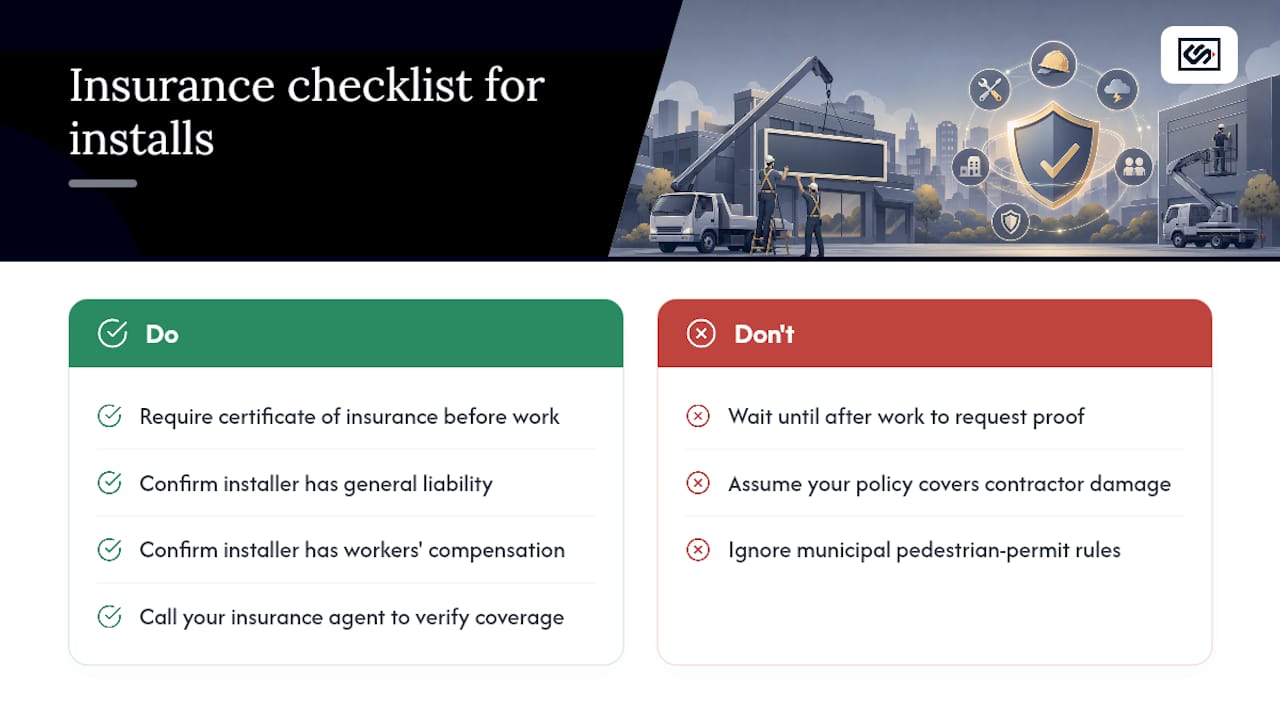
Yes, and this is where a lot of business owners get caught off guard mid-project. Any installer working at height or handling electrical connections should carry general liability insurance and workers' compensation coverage, since a fall or wiring mistake during install can create real liability exposure for both the installer and your business.
Ask for a certificate of insurance before work begins, not after. A legitimate commercial sign contractor will provide one without hesitation, and many landlords or property managers require it as a condition of granting access to the building facade.
Your own business insurance matters here too. Some general liability policies exclude damage caused by third-party contractors on your property, so it's worth a quick call to your insurance agent to confirm whether an installer's work is covered under your existing policy or whether the installer's coverage is the only protection in place. For elevated installs involving boom lifts or scaffolding near public sidewalks, some municipalities also require temporary permits covering pedestrian safety, which is a separate consideration from your standard sign permit.
Structural signs like monument bases or pylon towers carry additional liability weight if they're ever damaged in a storm or vehicle collision, so ask whether the installer's insurance covers the finished structure after handoff or only the installation process itself.
A Publisher's Take on Avoiding Bad Sign Bids
The bids that look cheapest on paper are usually the ones missing a line item, not the ones with better efficiency. If a quote skips permits, electrical, or contingency, assume that cost lands on you later as a change order.
Spend more on materials when the sign faces direct weather exposure or heavy foot traffic; aluminum and quality acrylic pay for themselves over five years. On negotiation, ask about bundling fabrication and installation with one vendor for a combined discount, and always request a payment schedule tied to milestones rather than full payment upfront.
— Nick
Get a Sign Installation Quote Through CrispSign
Some companies offer an integrated process where customers can design signage online, have it fabricated to specification via an optimized production process, and add coordinated professional installation with streamlined contracting options.
Multi-location businesses managing signage across several storefronts can request quotes through the Crisp Corporate portal, built specifically for brands ordering and coordinating installation across multiple sites from one place. Request an itemized quote today, specify whether you need installer coordination, and get a real number back before you commit to a launch date.
Where to Check Permit Rules and Sign Codes
For local permit requirements, contact your city's planning or building department directly, since rules vary by municipality and zoning district. For general industry standards and permit navigation help, the International Sign Association offers guidance on working with permit consultants for complex projects.
Sources
- How Much Does Commercial Sign Installation Cost? 2026 Data | Angi
- How Much Does Commercial Sign Installation Cost? | HomeAdvisor
- Channel letter signs cost: Pricing guide for U.S. buyers
- Signs
FAQ
How Much Does It Cost to Install a Sign?
Most commercial sign installations cost between $181 and $804, averaging around $464, though illuminated or custom signs like channel letters can run into the thousands depending on size and electrical needs.
How Much Should I Charge for a Sign?
Pricing depends on whether you're fabricating, installing, or both. Fabrication and installation are typically billed as separate line items, with installation labor priced by job complexity, site access, and whether electrical or structural work is involved.
How Long Does It Take to Install a Sign?
On-site installation itself usually takes 1 to 3 days for most sign types, but the full process from permit approval to fabrication to install day commonly spans 4 to 10 weeks depending on your municipality's permit review speed.
How Much Does a Sign on a Building Cost?
Building-mounted signs like channel letters typically cost $2,500 to $25,000 per sign depending on size and letter count, with per-letter pricing running $250 to $900 based on materials and illumination.