Sign Shop Jobs: Your SMB Guide to Custom Signage
"Sign shop jobs" means full-service custom signage projects: design, fabrication, permitting, and installation handled by a professional sign company on your behalf. Your immediate next step is to pick your sign type (storefront, vehicle, or interior), gather a few site photos, and request a quote. Crispsign handles the entire workflow turnkey, from your first design concept through permit coordination and professional installation, backed by a documented portfolio and a satisfaction warranty.
Key Takeaways
Custom signage projects cover design, fabrication, permitting, and installation as a single managed job, and choosing the right sign type and vendor upfront prevents the rework that inflates final cost.
| Point | Details |
|---|---|
| Match sign type to goal | Exterior channel letters for brand identity, vinyl for promotions, wraps for fleet visibility. |
| Confirm permits before fabrication | Code checks and landlord approval must happen before materials are cut to avoid rework. |
| Budget realistically by tier | Entry signs run $150–$800; mid-range $1,500–$5,000; premium $5,000–$20,000+. |
| Track one KPI per sign | Foot traffic for exterior, redemption codes for POP, call tracking for vehicle wraps. |
| Crispsign for turnkey projects | Crispsign handles design, permit coordination, fabrication, and optional installation nationwide. |
Table of Contents
- What sign shop jobs actually cover for your business
- Which sign type fits your business right now?
- How does the sign production process work, step by step?
- What does custom signage actually cost, and how long does it take?
- How do you pick the right sign shop for your project?
- How do you measure whether your signage is working?
- What permits and accessibility rules apply before you install?
- How do you maintain signage and what warranty should you expect?
- Why turnkey signage makes more sense than piecing it together yourself
- Ready to get your sign built? Here's how to start with Crispsign
- Sources
- FAQ
What sign shop jobs actually cover for your business
Think of a sign shop job as a single managed project, not a product purchase. You hand off your brand assets and location details; the shop returns a fabricated, installed sign that meets local code. The four functional categories that retail signage covers are exterior/storefront, interior/wayfinding, promotional/point-of-purchase, and digital, each tied to measurable outcomes like foot traffic, dwell time, and sales lift.
Before you call anyone, confirm you have:
- A clear project goal (new location opening, rebrand, fleet update, wayfinding refresh)
- Your preferred sign type and approximate size
- At least two site photos: one close-up of the mounting surface, one from the street at normal viewing distance
- A budget band (entry, mid, or premium)
- Your target install date and whether you want coordinated installation or DIY delivery
- Your logo in vector format (AI, EPS, or SVG) and your brand color codes
Pro Tip: Snap a photo from across the street at the angle a passing driver or pedestrian would see your storefront. That single shot lets a sign shop size your lettering correctly and flag any visibility obstacles before design starts.
Which sign type fits your business right now?
Matching sign type to material is the fastest way to control cost and lifespan. Use the table below to narrow your choice before requesting a quote.
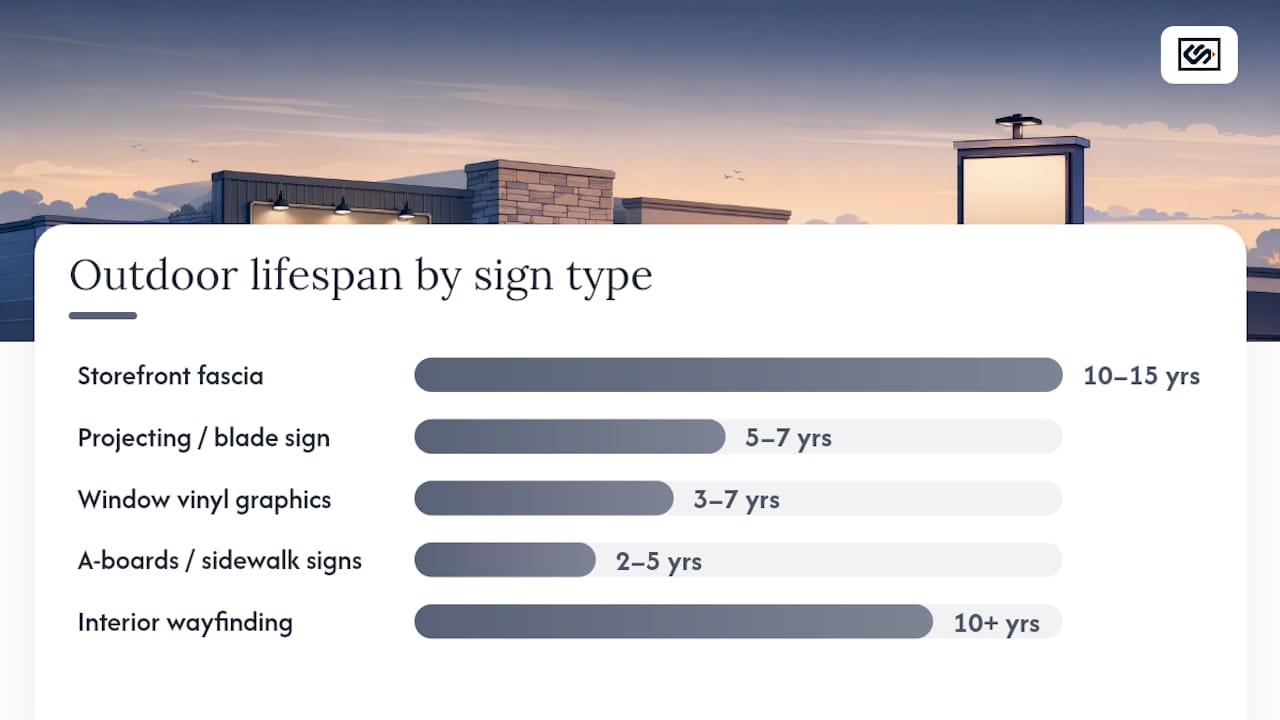
| Sign Type | Best Materials | Outdoor Lifespan | Primary Use |
|---|---|---|---|
| Storefront fascia / channel letters | Aluminum, acrylic, LED | 10 to 15 years | Brand identity, street visibility |
| Projecting / blade sign | Aluminum, HDU foam, acrylic | 5 to 7 years | Pedestrian foot traffic, corner locations |
| Window vinyl graphics | Cast or calendered vinyl | 3–7 years | Promotions, hours, brand messaging |
| A-boards / sidewalk signs | Aluminum, coroplast | 2–5 years | Daily specials, directional |
| Interior wayfinding | Acrylic, aluminum, ADA-compliant substrates | ten-plus years | Navigation, compliance |
| POP / digital displays | Tempered glass, metal housing | 5–8 years (hardware) | Promotions, upsell, engagement |
| Vehicle wraps / cut vinyl | Cast vinyl, removable magnets | 3–7 years (wraps) | Fleet branding, mobile advertising |
Carved cedar signs and illuminated cabinet signs sit between fascia and blade categories: cedar suits heritage or craft-brand aesthetics, while cabinet signs work well for strip-mall tenants with landlord-mandated uniform sign bands. Cast vinyl on vehicles outlasts calendered vinyl by two to three years in direct sun, so fleet operators should always specify cast.
How does the sign production process work, step by step?
Pre-fabrication planning is where most project delays originate. Skipping a code check or landlord review before fabrication starts is the single most common cause of rework. Here is the full sequence:
- Initial brief and site survey. You provide logo files, brand colors, site photos, and mounting details. The shop confirms dimensions and structural requirements.
- Code and landlord check. Municipal sign ordinances, historic-district rules, and your lease's signage manual are reviewed before any design work begins.
- Design concepts and revisions. You receive rendered proofs showing the sign in context. Confirm font, color, size, and placement before approving.
- Proofing and written approval. Sign off on a formal proof. Check: spelling, logo version, color codes, dimensions, and mounting method.
- Fabrication. Materials are cut, routed, painted, or printed to spec. LED drivers and electrical components are wired and tested.
- Installation scheduling. The installer confirms site access, power availability, and lift or ladder requirements. Permits are pulled if not already in hand.
- Final sign-off. You inspect the installed sign against the approved proof and confirm completion.
What to hand over at step 1: vector logo file, Pantone or hex color codes, two site photos (close and street-level), landlord contact for sign approval, and your target completion date.
What does custom signage actually cost, and how long does it take?
Cost is driven by five factors: sign size, substrate and finish materials, lighting type, structural or electrical engineering, and installation complexity. Permits add both cost and time, typically one to four weeks depending on the municipality.
Budget bands by sign type:
- Entry level: Window vinyl, A-boards, and cut-vinyl decals typically run $150–$800 installed, with lead times of five to ten business days.
- Mid-range: Illuminated cabinet signs, non-illuminated channel letters, and partial vehicle wraps generally fall in the $1,500–$5,000 range, with two to four weeks from approved proof to installation.
- Premium: Full illuminated channel letters, monument signs, full vehicle wraps, and large-format carved cedar signs commonly run $5,000–$20,000+, with four to eight weeks for fabrication and permit processing.
Effective storefront signage has a documented impact on walk-in decisions and brand perception, which makes the per-year cost of a well-built sign far lower than it appears at the point of purchase.
Pro Tip: Order seasonal promotional signs six to eight weeks before the campaign launch date. Permit delays and fabrication queues compress fast in Q4. Missing your window by two weeks can cost you the entire season.
How do you pick the right sign shop for your project?
Portfolio depth is the fastest filter. A shop that can show before-and-after photos across multiple sign types, with real business names and locations, has proven production range. Ask these questions before committing:
- Can you show three completed projects similar to mine in size and sign type?
- Do you handle permit applications, or is that my responsibility?
- Who installs the signs, and are they licensed and insured?
- What does your warranty cover, and for how long?
- How many revision rounds are included in the proof stage?
- What is your current production lead time for my sign type?
- What are your payment terms and cancellation policy?
Trust signals to look for: a documented portfolio with photos, written customer testimonials or case studies, clear warranty terms in writing, permit and installation coordination offered as a service, and visible production lead times on their website.
Red flags: vague answers about permits ("we'll figure it out"), no portfolio photos, a quote that is 40% below competitors with no spec sheet, and no formal proofing step before fabrication.
Pro Tip: Ask specifically whether the shop uses its own installers or subcontracts. Subcontracted installation is not a problem, but you want confirmation that the installer carries liability insurance and that the shop stands behind the installation quality.
How do you measure whether your signage is working?
Track one primary KPI per sign type. Exterior signs: weekly foot traffic count or door-counter data before and after installation. Wayfinding: staff reports of misdirected customers or navigation complaints. POP and promotional signs: offer redemption rates or promo-code scans tied to the sign's placement period. Vehicle wraps: call-tracking numbers or landing-page URLs printed on the wrap.
For A/B testing, rotate two sign variants between zones or weeks, hold all other variables constant, and log results to a simple spreadsheet. Shopify recommends tracking outcomes to a signage dashboard so you can identify what drives consistent lift across locations.
A 2025 analysis of 237 campaigns found that in-store video ads increased purchase probability for featured products by an average of 8.1%. Use that figure as a baseline when estimating the ROI potential of a digital display investment.
Pro Tip: Print a unique promo code on each sign variant during a test period. Code redemptions at the register give you a clean, low-cost attribution signal without any tech setup.
What permits and accessibility rules apply before you install?
Most municipalities require a sign permit for any exterior sign attached to a building or placed in the right-of-way. Key items to check:
- Maximum sign area (square footage relative to building frontage)
- Illumination restrictions (brightness limits, hours of operation for lit signs)
- Historic-district or design-review board approval requirements
- Landlord signage manual (common in shopping centers; specifies font, color, and mounting zones)
- Electrical permit for any illuminated sign
For interior permanent tactile signs, the U.S. Access Board guidance cited by Shopify's signage primer recommends a mounting range of 48 to 60 inches above the finished floor. Consult a certified ADA consultant or your local building department for compliance confirmation specific to your space.
Installation-day checklist: confirm power access for illuminated signs, clear the mounting surface of obstructions, have a building contact on-site for access, and request a written completion confirmation from the installer.
Pro Tip: Pull your municipality's sign ordinance PDF before you finalize your sign design. Size and placement rules can change your design significantly, and discovering them after fabrication means starting over.
How do you maintain signage and what warranty should you expect?
Maintenance by material:
- Vinyl graphics: Clean monthly with mild soap and water. Inspect edges for lifting every six months. Replace window vinyl every three to five years in direct sun.
- Acrylic panels and faces: Wipe with a non-abrasive cleaner. Avoid ammonia-based products. Expect a ten-plus-year lifespan with no structural maintenance.
- Painted aluminum: Inspect annually for chips or corrosion. Touch up with matching paint. Lifespan of ten to fifteen years with basic upkeep.
- LED drivers: Most quality drivers carry a three-to-five-year warranty. Plan a driver inspection at year three for illuminated signs.
- Vehicle wraps: Hand-wash only; avoid high-pressure washes on edges. Wraps in direct sun typically need replacement at five to seven years.
Warranty checklist: request written coverage for:
- Fade and color shift (minimum three years for outdoor vinyl)
- Material failure or delamination
- Workmanship defects in fabrication and installation
- LED component failure (separate from the sign body warranty)
Standard industry warranties run one to three years on fabrication and workmanship, with material warranties following the substrate manufacturer's terms.
Why turnkey signage makes more sense than piecing it together yourself
The conventional wisdom among first-time sign buyers is to save money by sourcing design, fabrication, and installation separately. In practice, that approach almost always costs more. Coordination gaps between a freelance designer and a fabricator who has never seen the site produce proofing errors. An uninsured installer voids a landlord's approval. A permit pulled after fabrication forces a redesign.
A turnkey provider handles all three phases under one roof and one warranty. The design is built to fabrication tolerances from day one. The permit check happens before a dollar of material is cut. The installer knows the sign because the shop built it.
The real question is not whether turnkey costs more upfront. It is whether the risk of a $3,000 rework on a $2,000 sign is worth the savings on a separate design quote.
Ready to get your sign built? Here's how to start with Crispsign
Crispsign takes SMB sign projects from concept to installed sign without requiring you to manage multiple vendors.
Here is what to do right now:
- Gather your logo file (vector preferred), brand colors, and two site photos
- Choose your sign type from the options above (storefront, vehicle, interior, or wayfinding)
- Visit Crispsign to request a quote or site check
After you submit, Crispsign's team reviews your design, flags any permit requirements, and sends a proof for your approval before fabrication begins. Nationwide shipping and optional coordinated installation mean you get a finished, warranted sign without leaving your desk to manage the logistics.
Sources
- Retail Signage: Types, Design Tips, and Examples (2026) - Shopify
- What is High Quality Custom Storefront Signs Service and How Can It Benefit Your Business? - XLD Signs
FAQ
What does a sign shop job include from start to finish?
A full sign shop job covers design, material selection, fabrication, permit coordination, and installation. The buyer provides brand assets and site details; the shop delivers an installed, warranted sign.
How long does a custom sign project typically take?
Simple vinyl graphics take five to ten business days. Illuminated channel letters and cabinet signs typically need two to four weeks. Monument signs and full vehicle wraps can run four to eight weeks, including permit processing time.
What files do I need to provide to get a quote?
A vector logo file (AI, EPS, or SVG), your brand color codes (Pantone or hex), and two site photos: one close-up of the mounting surface and one from normal street-viewing distance.
Does Crispsign handle permits and installation?
Yes. Crispsign coordinates permit checks and offers optional professional installation as part of its turnkey service, with nationwide shipping for businesses that prefer to handle installation locally.
What is the ADA mounting requirement for interior signs?
The U.S. Access Board recommends mounting permanent tactile interior signs 48 to 60 inches above the finished floor. Confirm the specific requirement for your space with your local building department or a certified ADA consultant.