Verify UL Listed Signs in 30 Seconds: US Buyer Checklist
A UL Listed sign means the entire finished sign assembly, not just the parts inside it, has passed UL evaluation and stays under a manufacturer's ongoing production controls. That distinction is what building inspectors check for, and it's the difference between a smooth permit review and a sign that gets rejected at final inspection. The standards behind it are specific: UL 48 governs electric signs, and NEC Article 600 requires signs to be listed and installed exactly as that listing specifies.
TL;DR:
- UL listing applies only when the entire sign assembly is evaluated and maintained under UL’s ongoing surveillance, not just individual components recognized separately.
- Most illuminated signs like channel letters, cabinet signs, and digital message displays require UL 48 listing, with location ratings matching actual outdoor or indoor use.
- Verifying UL listing involves checking for the UL mark, a control number, accurate product description, and confirming active certification via UL's Product iQ database.
- A UL listed sign does not replace local permits or inspections, which still require submission of sign specifications, electrical load details, and correct installation procedures.
- Common mistakes include trusting vendor claims of UL components without verifying the actual assembly listing or neglecting location ratings, risking inspection rejection.
Table of Contents
- What Does "UL Listed" Actually Mean for a Sign?
- Which Sign Types Usually Need a UL Listing?
- The Standards That Govern Sign Compliance in the US
- How to Verify a Sign Is Actually UL Listed
- Buyer Checklist: What to Request From Your Sign Manufacturer
- Permits, Your AHJ, and Installation: What UL Listing Doesn't Cover
- How Sign Fabricators Build UL-Ready Signage
- Common Mistakes Property Managers Make With UL Claims
- Some specialized sign companies provide an alternative to hunting down a local fabricator by including, with illuminated orders, documentation suitable for AHJ review, factory-applied labels, installation instructions, and clear UL claims, helping to avoid scrambling for control numbers after installation.
- Sources
- FAQ
What Does "UL Listed" Actually Mean for a Sign?
UL runs two distinct evaluation types, and mixing them up is the single most common mistake in sign procurement. Listed means UL has evaluated the complete, finished assembly, and the manufacturer's production line stays under UL's ongoing surveillance. Recognized components (covered under UL 879 and UL 879A) are individual parts, like a transformer or LED module, that passed testing on their own but haven't been verified as part of a finished product.
A sign built entirely from recognized components isn't automatically a listed sign. It only earns full listing when the finished assembly itself goes through UL's certification program.
- Listed assembly: the whole sign, evaluated as a unit
- Recognized components: parts approved individually, not as a finished product
- General Coverage: UL Solutions' program that lets manufacturers certify custom channel letters, cabinet signs, and other standard sign types under one umbrella listing
Custom fabricators typically operate under General Coverage, which is why the manufacturer's file number matters more than any single part inside the cabinet.
Which Sign Types Usually Need a UL Listing?
Most illuminated and electrically powered signs fall under UL's scope, and local codes generally treat them the same way regardless of size or lighting method.
- Channel letters, whether front-lit, halo-lit, or reverse-lit
- Illuminated cabinet or box signs
- Changing-message signs, including digital and LED message centers
- Neon and LED-lit signage of any configuration
- Awning signs with integrated lighting
- Portable, electrically powered signs, including trailer-mounted units
Location rating matters as much as the sign type. A sign certified for dry locations only isn't automatically safe outdoors. UL's General Coverage program issues listings specifically for dry, damp, or wet locations, and an outdoor storefront sign needs the wet or damp rating to match its actual exposure. Oversized signs, multi-section installations, or unusual architectural mounts sometimes fall outside a manufacturer's standard coverage entirely. In those cases, UL Solutions offers preliminary investigations and on-site evaluations as a separate certification path, and buyers should flag that need before fabrication starts, not after.
The Standards That Govern Sign Compliance in the US
Three references to do most of the work when an inspector reviews a sign application. UL 48, the Standard for Electric Signs, covers electric signs regardless of illumination method, whether incandescent, neon, fluorescent, LED, or electroluminescent, and it dictates marking and installation requirements that carry into the field.
UL 879 and UL 879A apply to individual sign components and retrofit kits, like LED replacement modules for existing neon signs. These standards matter most when a business is upgrading an older sign rather than buying new, since a retrofit kit needs its own recognition to keep the host sign's listing intact.
NEC Article 600 is the electrical code section that actually enforces all of this. It requires signs to be listed and, critically, installed in conformance with the terms of that listing. An inspector citing a rejection almost always points back to Article 600.
One more layer applies in some jurisdictions: California's Title 24 energy code sets efficiency requirements for illuminated signage that run alongside, not instead of, UL safety requirements. Businesses in California should confirm both apply before finalizing a design.
How to Verify a Sign Is Actually UL Listed
Reading the label correctly takes about thirty seconds, and it's the single most useful skill in this entire process.
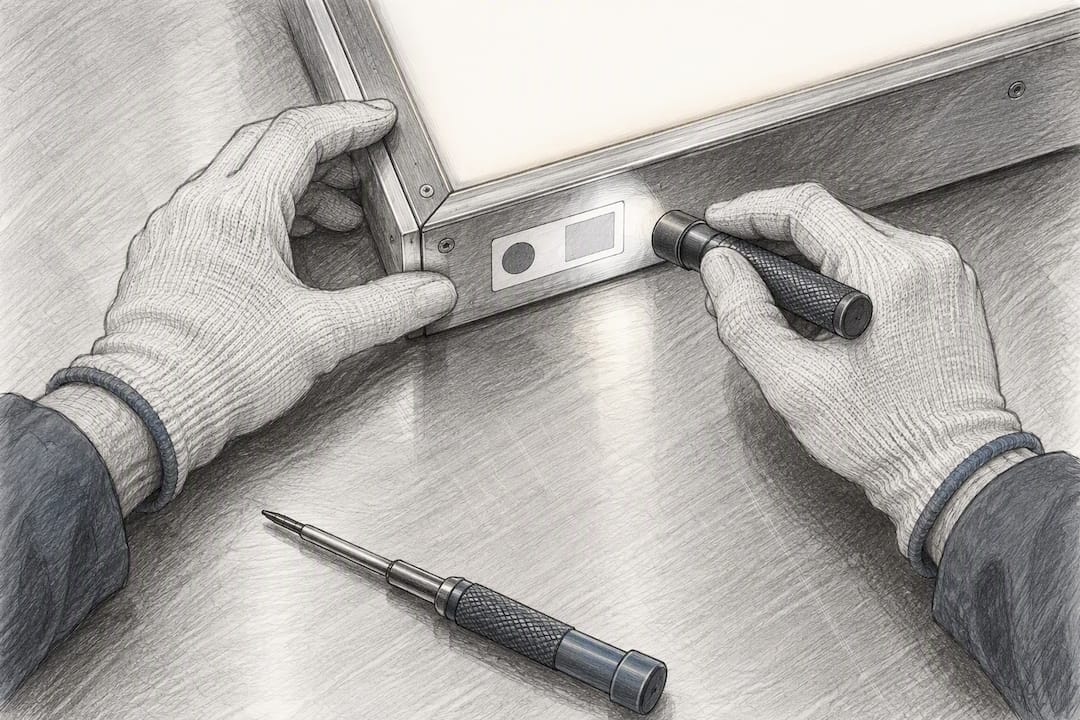
- Look for the UL mark itself, plus the word "LISTED" printed directly on the label, not just referenced in a spec sheet.
- Find the control number or file number. Every legitimate listing has one, and it's traceable back to a specific manufacturer and product line.
- Check the product description. A genuine label reads something like "Electric Sign" or "Electric Sign Section," matched to what you actually ordered.
- Confirm the issue number and location rating printed alongside it.
- Verify the control number using UL's Product iQ database, which pulls the manufacturer's Individual Certificate of Compliance (iCoC) and any conditions of acceptability tied to that listing.
Pro Tip: UL iQ's sign components search tool lets you search by category, model, or file number in under a minute. Bookmark it. You'll use it every time a vendor sends a "certificate of compliance" that you can't immediately verify against UL's own records.
Genuine UL labels are applied at the factory, not stuck on afterward. A loose sticker, a label with no legible control number, or a seller who describes their product only as built from "UL components" without ever naming an assembly listing are all warning signs worth stopping over.
Buyer Checklist: What to Request From Your Sign Manufacturer
Send this list before you sign a purchase order, not after fabrication begins.
- The exact UL claim in writing, naming the applicable standard (for example, "UL 48 General Coverage")
- The UL file or control number tied to that specific product line
- The environmental rating: dry, damp, or wet location
- Full installation instructions and wiring diagrams
- Confirmation that labels are factory-applied, not added by a third-party installer
- A written plan for field evaluation if your sign's size or configuration falls outside standard coverage
Pro Tip: Ask for the control number before you approve final artwork, not after the sign ships. Chasing down a missing certificate on a sign that's already installed is a far harder conversation with your building inspector than catching the gap during procurement.
Permits, Your AHJ, and Installation: What UL Listing Doesn't Cover
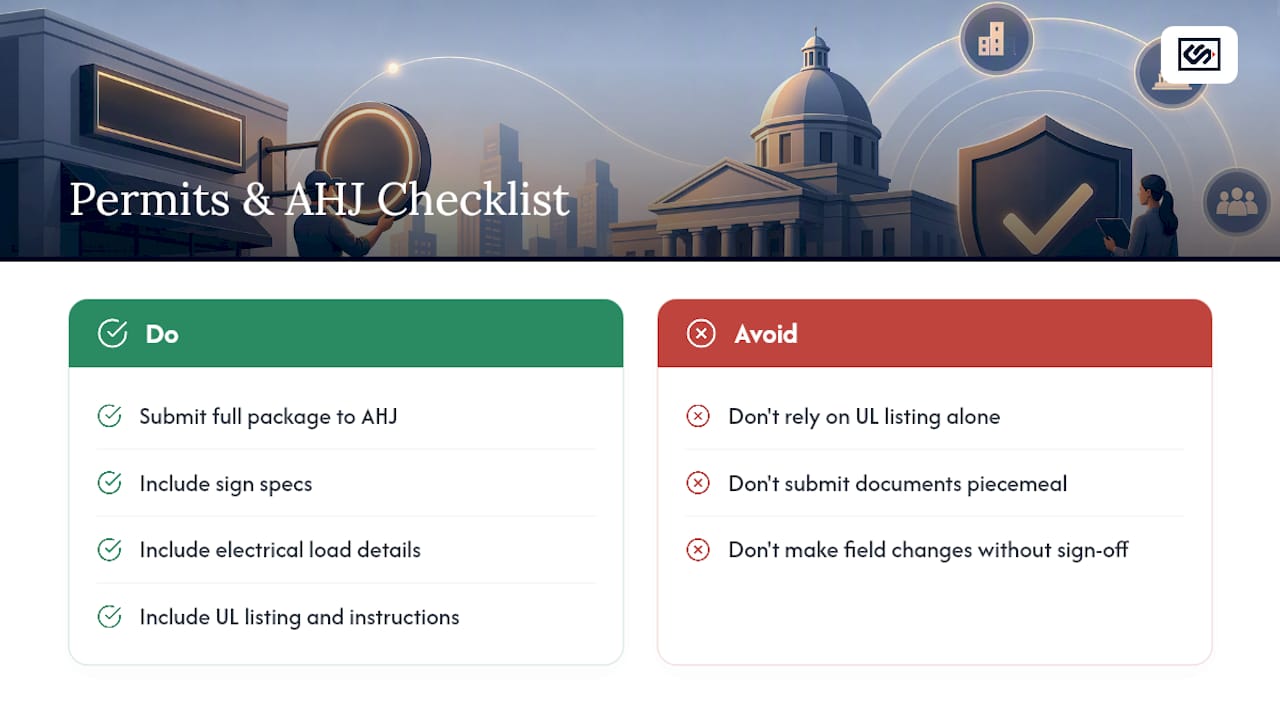
A UL Listed sign is necessary, but it isn't sufficient on its own. It doesn't replace your local sign permit, zoning approval, structural review, or electrical inspection, and every one of those steps still runs through your authority having jurisdiction (AHJ).
The smartest move is handing your AHJ the full package early: sign specifications, electrical load details, the UL listing information, and installation instructions, all submitted together rather than piecemeal. Reviewers who get a complete file up front tend to approve faster than ones who have to chase down missing documentation mid-review.
Field changes create the biggest risk after installation. Swapping a power supply, splicing wiring differently than specified, or combining sign sections in the field can void the original listing entirely. Any retrofit needs sign-off from the fabricator or a qualified electrical professional before work proceeds, never after, so consider hiring through expert Electrician SEO Services to ensure compliance and quality.
How Sign Fabricators Build UL-Ready Signage
Some sign fabricators structure their production workflow around the documentation buyers actually need, not just the sign itself. This can include factory-applied labeling and consistent paperwork accompanying illuminated orders to simplify tracking control numbers for property managers and AHJs.
Relevant product lines may include illuminated channel letters and cabinet signs built to specification with documentation, carved and dimensional signage combining illuminated and non-illuminated elements, and coordinated installation options that help maintain listing compliance during mounting.
Business owners working through their own compliance packages should confirm current certification details directly with their chosen sign fabricator for their specific order.
Common Mistakes Property Managers Make With UL Claims
The recurring error is trusting a vendor's verbal claim of "UL components" as if it were an assembly listing. It isn't, and inspectors know the difference immediately. A close second: installing a dry-location sign outdoors because nobody checked the rating against the actual mounting site.
Fix both by pulling the control number yourself through Product iQ before signing off, and loop in a licensed electrician and your AHJ before any field retrofit. Five minutes of verification beats a failed inspection every time.
— Nick
Some specialized sign companies provide an alternative to hunting down a local fabricator by including, with illuminated orders, documentation suitable for AHJ review, factory-applied labels, installation instructions, and clear UL claims, helping to avoid scrambling for control numbers after installation.
If your storefront needs illuminated channel letters or a carved dimensional sign, the BeaconLetters and BeaconCarved product lines are built to order online, with instant estimates before you commit to anything. Multi-location businesses managing interior wayfinding alongside exterior signage can also route lobby logos and panels through the CrispLobby hub from the same account. Upload your artwork or start a design now at Crispsign to get a quote moving before your next permit deadline.
Sources
Keep these bookmarked for your next permit submission or vendor conversation:
- Electric Sign Certification and Sign Component Solutions | UL Solutions
- UL iQ™
- UL 48 Standard For Electric Signs
FAQ
Is UL Approval Required in the US?
There's no single federal law mandating UL listing everywhere, but NEC Article 600 requires electric signs to be listed and installed per that listing, and most local jurisdictions enforce this through their electrical and building codes. In practice, an unlisted illuminated sign will almost always fail inspection.
How Can I Tell if a Product Is UL Listed?
Check the label for the UL mark, the word "LISTED," a control number, and a matching product description. Then verify that control number through UL's Product iQ database to confirm it's active and matches the manufacturer.
What Are the 10 Safety Signs?
That's not a UL or NEC standard; it's typically a workplace safety term (referring to categories like prohibition, warning, and mandatory signage) that's unrelated to electric sign certification. For storefront and illuminated signage, the relevant frameworks are UL 48 and NEC Article 600, not workplace safety sign categories.
Is There a Difference Between UL Certified and UL Listed?
Yes. "UL Listed" specifically refers to a finished product evaluated as a complete assembly under UL's Listing program. "UL Certified" is broader language sometimes used loosely by vendors, so always ask which specific UL mark and control number applies to your product.
What Does Crispsign Include With a UL-Ready Sign Order?
Crispsign structures its illuminated sign production around factory-applied labeling and complete documentation delivered with the order. For current certification details on a specific product, confirm directly through the BeaconLetters product hub when requesting your quote.