What Is Bar Signage? A Buyer's Guide for Venue Owners
Bar signage is the set of exterior and interior signs a drinking establishment uses to attract customers, communicate its brand, and guide people through the space. That covers everything from the channel letters over your front door to the menu board behind your bartender. The single best next step: pick your primary goal (visibility, branding, or wayfinding), test a few placement options on-site, then request a professional proof before you commit to production.
Bar signage typically does three jobs at once:
- Pulls foot traffic off the street and turns walk-bys into walk-ins
- Signals who you are before a customer reads a single menu item
- Directs guests to the bathroom, the patio, or tonight's happy hour
Key Takeaways
Effective bar signage combines exterior visibility, interior wayfinding, and durable materials matched to your venue's lighting and foot traffic.
| Point | Details |
|---|---|
| Define your primary goal | Decide whether visibility, branding, or wayfinding matters most before choosing sign types. |
| Combine sign types | Pair channel letters with a blade sign or window graphic to solve both distance and walk-by visibility. |
| Match materials to durability needs | Choose acrylic for color, metal for premium durability, or wood for warmth based on your venue style. |
| Test placement on-site | Mock up signs at proposed size and photograph them from real street angles and distances before installing. |
| Order through a streamlined producer | Crispsign handles specification, proofing, and production for custom bar signage with optional coordinated installation. |
Table of Contents
- What Is Bar Signage? The Main Types Explained
- Why Bar Signage Matters for Your Bottom Line
- Materials and Lighting: What Actually Holds Up
- Testing Placement Before You Commit to Installation
- Ordering Custom Bar Signage: What to Prepare
- What Bar Signage Costs and What Drives the Price Up
- What Bar Owners Get Wrong About Signage
- Get a Professional Proof From Crispsign
- Sources
- FAQ
What Is Bar Signage? The Main Types Explained
Bar signage splits into exterior and interior categories, and most successful venues use several types together rather than relying on one sign to do everything.
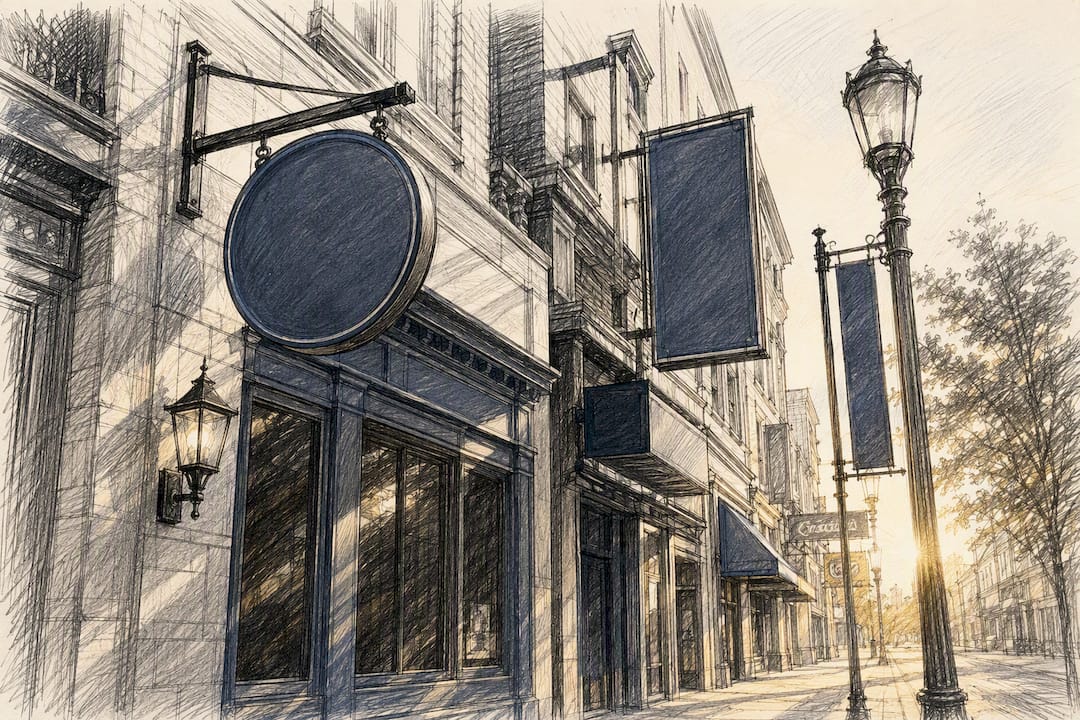
Exterior signage starts with channel letters, the illuminated, dimensional letters mounted directly on your façade. They're the workhorse for name recognition from a distance. Cabinet signs (a backlit box with your logo) work well for tenant spaces sharing a building front. Blade or projecting signs stick out perpendicular to your building, which matters enormously on pedestrian-heavy streets where a flat façade sign gets lost in the sightline. Add window vinyl graphics for hours, specials, or brand marks visible at eye level, and an A-frame or sandwich board for daily specials or one-off events you don't want baked into permanent signage.
Interior signage covers menu boards (printed or digital), LED and neon-style accents for ambiance and bar-back branding, wayfinding signs for restrooms and exits, and tabletop tents for promotions.
- Late-night, low-light venues benefit most from channel letters and cabinet signs with strong illumination.
- Narrow storefronts on busy sidewalks need a blade sign to catch attention outside the direct sightline.
- Multi-room venues rely on wayfinding signage to keep guest flow moving without staff intervention.
A combination of façade channel letters plus a projecting blade or window graphic solves both the distance-visibility problem and the walk-by-visibility problem, according to guidance from Storefront Sign Advisors.
Why Bar Signage Matters for Your Bottom Line
Signage functions as brand shorthand. A customer forms an impression of your bar before they touch the door handle, and that impression is built almost entirely from what they see outside.
The business case breaks into three practical outcomes:
- Visibility that turns passersby into walk-ins and makes your open/closed status unmistakable from the sidewalk
- Operational relief from wayfinding signs that answer "where's the bathroom" so your staff doesn't have to
- Promotion reach, since a well-placed window graphic or A-frame communicates a happy hour or event without a single social post
Statistic Callout: Worn-out or poorly lit signage measurably damages customer perception, while a cohesive signage and branding strategy has been shown to lift revenue, according to ZZC Signage. If your signage looks tired, customers assume the bar behind it is too.
Track foot traffic changes after a sign upgrade, promotion redemption rates tied to window or A-frame messaging, and how often staff get interrupted with wayfinding questions. Those three numbers tell you whether your signage is pulling its weight.
Materials and Lighting: What Actually Holds Up
Material choice drives both the look of your sign and how much maintenance it demands years down the road.
- Acrylic delivers vibrant color and crisp logo reproduction at a relatively accessible price, and it's easy to fabricate into custom shapes, per BSign.
- Metal (stainless steel especially) signals a premium, durable impression and holds up better to impact and weather over a long lifespan.
- Wood brings warmth that suits a craft cocktail bar or neighborhood pub, though it needs more upkeep against moisture.
- Vinyl is the low-cost option for window messaging, seasonal promotions, and hours signage you'll update often.
On lighting, LED backlighting and neon-style LED alternatives now dominate illuminated signage because they're energy-efficient and hold up longer than traditional neon tubing. Illuminated signs make a measurable difference for late-night bar service, since your sign is often the only branding visible after dark, a point echoed in SplitFlapTV's signage guide.
Pro Tip: Ask your sign producer about UV-resistant inks and sealed edges before you finalize a material choice. A sign that fades or delaminates in year two costs you more than paying for weather resistance up front.
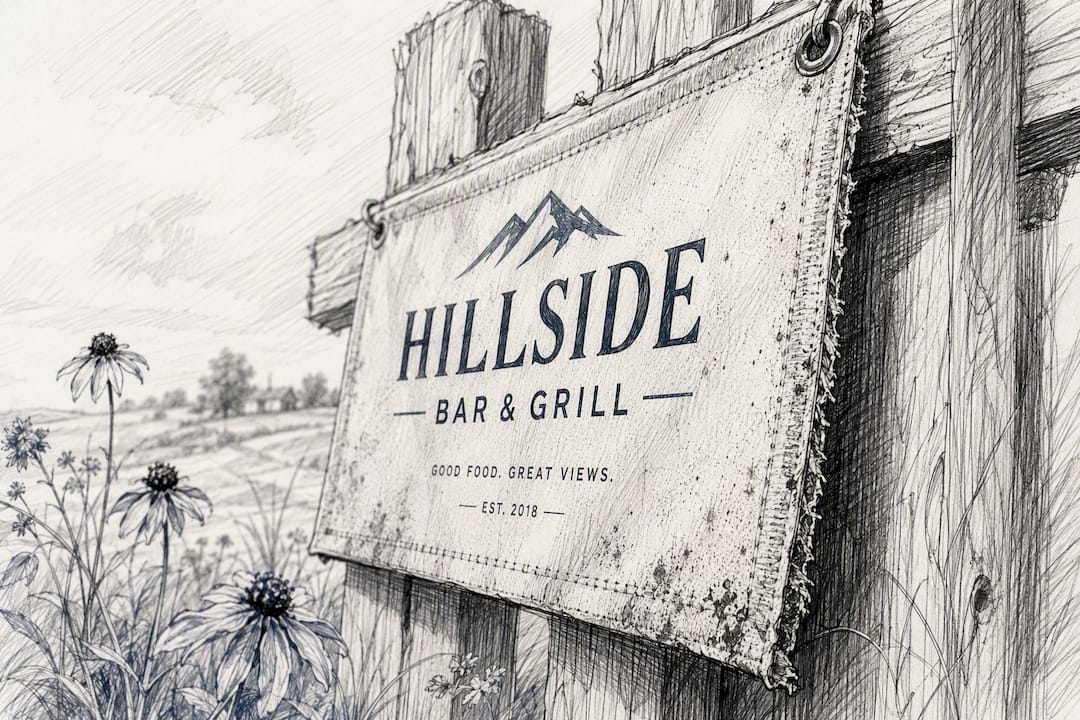
Testing Placement Before You Commit to Installation
Sightlines make or break a sign's effectiveness, and you can catch most placement mistakes before installation with a few deliberate tests.
- Size for the distance. A sign meant to be read from a car doing 30 mph needs far larger lettering than one aimed at pedestrians on the sidewalk.
- Mount for the right eye level. Driver sightlines sit higher and farther out; pedestrian sightlines are closer and lower.
- Check contrast and font size. High contrast between letter color and background reads faster at a glance, which matters when you have two seconds of a driver's attention.
- Run an on-site mockup. Tape up a printed template at the proposed size and photograph it from multiple angles and distances.
Testing readability from actual street angles and distances, then making small iterative adjustments, reveals blind spots that never show up in a digital rendering.
Pro Tip: Walk your block at the time of day your bar is busiest. Afternoon glare and nighttime shadows change what's readable, and a mockup that looks great at noon can vanish at 9 p.m.
Ordering Custom Bar Signage: What to Prepare
A clean order starts with a specification checklist your sign producer can work from immediately, which shortens the back-and-forth considerably.
Gather your measured dimensions, a vector version of your logo (EPS, AI, or PDF, never a low-resolution JPEG), your exact Pantone or hex color values, and notes on mounting surface and nearby electrical access if the sign will be illuminated. Check local zoning and sign permit requirements early, since permit timelines can run longer than the fabrication itself and catch owners off guard late in the process.
Expect at least one proof round before production. Review the proof for scale accuracy, finish (matte versus gloss), and how it will look illuminated at night, not just in daylight renderings. Digital menu boards deserve extra scrutiny here since they cost more upfront but typically pay back the difference after four to six menu changes by eliminating reprint costs, according to SplitFlapTV.
Once approved, most custom signs move into production on a defined timeline, and you can choose DIY installation for simpler pieces like window vinyl or coordinate a professional install for anything electrical or structurally mounted.
What Bar Signage Costs and What Drives the Price Up
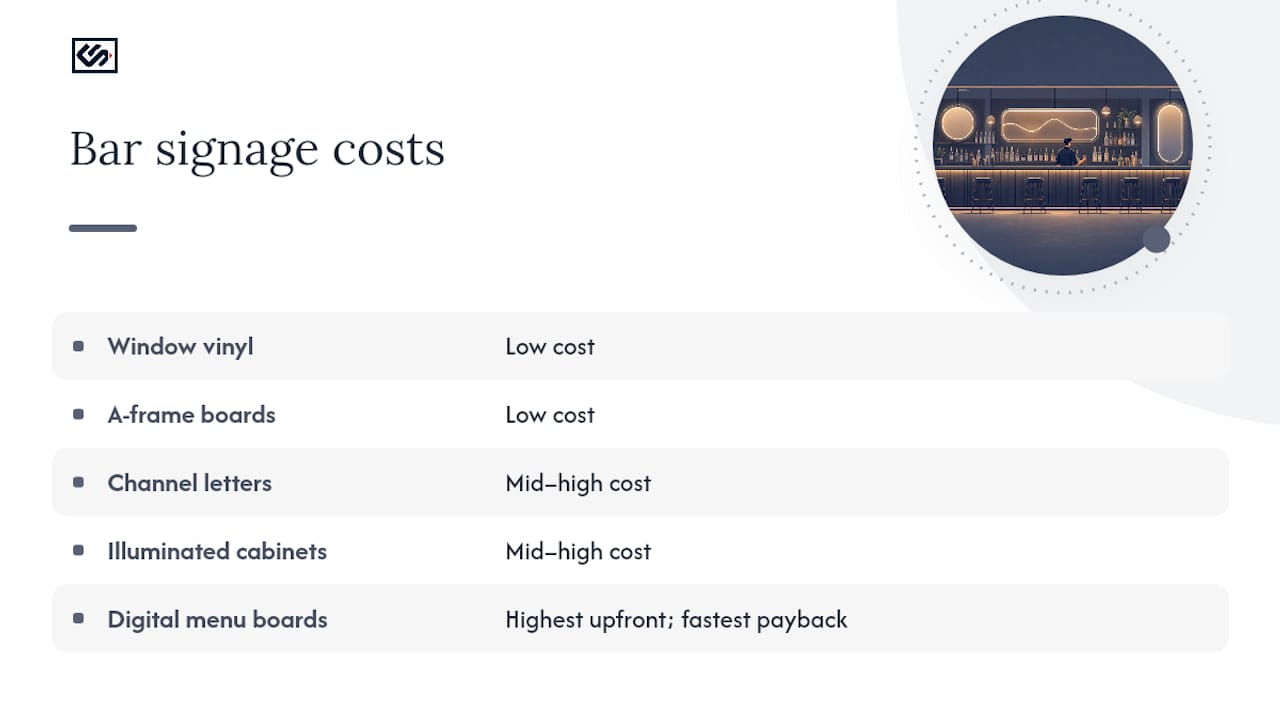
Window vinyl and A-frame boards sit at the low end of the budget, usually the first purchase for a new bar because they're fast to produce and easy to update.
Channel letters and illuminated cabinet signs land in the mid-to-high range, driven up by electrical work and structural mounting. Digital menu boards carry the highest upfront cost of the group but earn that back over time through avoided reprinting.
- Size is the biggest single driver. Larger letters and panels mean more material and more labor.
- Lighting and electrical work add cost fast, especially if you need an electrician to run new power to a mounting point.
- Custom fabrication complexity, like a shaped logo cabinet versus a standard rectangle, adds fabrication hours.
- Permits and installation access (tall façades, scaffolding, tight urban lots) push labor costs up independent of the sign itself.
To save money, stick to standard sizes where possible, use vinyl graphics for anything seasonal, and phase your upgrades instead of replacing every sign in one order.
What Bar Owners Get Wrong About Signage
Most bar owners treat signage as decoration they'll get to once the bar itself is finished. That's backward. Your sign is doing sales work every hour you're closed, which is more hours in a week than most bars are actually open.
The conventional advice tells owners to "pick something that matches your brand" and stop there. That undersells the problem. A sign that matches your brand but can't be read from 40 feet at night is failing at its actual job, which is visibility first and aesthetics second. I'd rank the priorities in this order: legibility from your real street distance, illumination that holds up after dark, then style and material choice. Reverse that order and you end up with a beautiful sign nobody notices.
The other mistake is treating signage as a one-time purchase. Menus change, hours shift, and a happy hour promotion you ran last spring probably deserves a permanent window graphic if it worked. Signage should evolve with your bar's actual traffic patterns, not sit frozen from opening day.
Test your placement before you finalize anything. It's the cheapest insurance in the entire process.
Get a Professional Proof From Crispsign
Crispsign specializes in custom storefront signage built for exactly the decisions this guide walks through, from channel letters and illuminated cabinet signs to window vinyl and wayfinding pieces for your interior.
Ordering starts the same way described above: you submit your measured dimensions, vector logo files, and color values online, and Crispsign's production workflow moves your order through proofing faster than traditional sign shops, without cutting corners on fabrication quality. You'll review a proof that shows scale and finish before anything goes into production, and you can choose to install it yourself or coordinate professional installation for an added flat fee. That means less back-and-forth and a clearer path from decision to a sign hanging on your building. If you're ready to move past planning, start your custom sign order and get a proof in hand.
Sources
- Effective Signage for Restaurant: Attract Customers and Boost Sales
- Restaurant Storefront Signs | Attract Walk-In Traffic in 2026
- Choosing the right materials for restaurant and cafe signage design
FAQ
What Is Bar Signage Explained Simply?
Bar signage is any exterior or interior sign a bar uses for visibility, branding, or guest wayfinding, including channel letters, menu boards, and window graphics.
What Sign Types Work Best for Late-Night Bars?
Illuminated channel letters and backlit cabinet signs perform best after dark, since lighting often becomes your only visible branding once the sun sets.
How Much Does Custom Bar Signage Cost?
Costs range from low-cost window vinyl and A-frame boards to mid-to-high channel letters and illuminated cabinets, with digital menu boards carrying the highest upfront price but the fastest payback through avoided reprinting.
Do I Need a Permit for Exterior Bar Signage?
Most municipalities require a sign permit for illuminated or structurally mounted exterior signs, so check local zoning rules early in your ordering process.
Can Crispsign Handle Both Design and Installation?
Yes. Crispsign manages the specification and production process online and offers optional coordinated professional installation for an added flat fee.