What Is Business Launch Signage? A 2026 Guide

Business launch signage is the collection of visual displays you deploy to announce your opening, attract customers, and establish your brand presence from day one. Think of it as your business's first salesperson: working around the clock before you've served a single customer. Appealing signage alone strongly influences consumers to enter unfamiliar stores, and on-premise signs can drive up to 50% of daily foot traffic during launch periods. Getting your signage right isn't a finishing touch. It's a launch strategy.
Table of Contents
- What is business launch signage and why does it matter?
- What types of signage work best for a business launch?
- How do you keep branding consistent across all launch signage?
- How do you plan and install launch signage effectively?
- What does research say about signage impact and design?
- Key Takeaways
- FAQ
What is business launch signage and why does it matter?
Business launch signage covers every sign, banner, flag, and graphic you use during your opening phase, whether temporary for the first few weeks or permanent from day one. These assets serve three core functions:
- Generate awareness: Pull in drivers and pedestrians who have never heard of you.
- Guide customers: Direct foot traffic from the street to your door and through your space.
- Build brand identity: Communicate who you are visually before anyone walks inside.
75% of consumers have recommended a business to someone else based on its signage alone. That makes your launch signs one of the highest-return marketing investments you can make as a new business owner.
What types of signage work best for a business launch?
A strong launch uses multiple sign types together, each handling a different job in the customer journey from awareness to entry.
- Vinyl banners: Your primary announcement tool. Custom vinyl banners of a large size communicate your grand opening message to passing vehicles and distant pedestrians. UV-resistant, weather-proof materials keep them looking sharp through wind and rain.
- Feather flags: Movement catches the eye when static signs don't. Deploy several feather flags at parking lot entrances and property corners to create a visual corridor leading straight to your door.
- A-frame signs: These portable, double-sided displays work within 30 feet of your entrance, converting foot traffic with specific offers, hours, and urgency messaging. The changeable panels let you test promotions in real time.
- Window graphics: Perforated vinyl turns blank storefront glass into a brand showcase. Window graphics display your logo, hours, and promotions to pedestrians up to 30 feet away while maintaining clear sightlines from inside.
- Storefront signs: Your permanent identity anchor. Channel letters, illuminated cabinet signs, and dimensional wall signs tell customers exactly where they are and what you offer, day or night.
- Flexible portable signs: Vinyl banners, yard signs, and vehicle magnets print quickly, require no permits, and can be updated frequently during the launch period. They complement your permanent signage without replacing it.
Pro Tip: Cover a significant portion of your window space with graphics to balance opportunity and visibility. Too little and you miss the opportunity; too much and you block natural light and sightlines inside.
How do you keep branding consistent across all launch signage?
Consistent branding across every sign you put up builds customer trust faster than any single great-looking display. When your colors, fonts, and logo treatment match from your feather flags to your window graphics, customers recognize you instantly, even before they read a word.
These are the brand elements that must stay uniform across all your launch signs:
- Color palette: Use exact brand hex codes or Pantone values. Slight color shifts between sign types erode recognition.
- Typography: Stick to your brand fonts. Mixing typefaces across sign types looks unplanned.
- Logo placement and sizing: Keep proportions and clear space consistent on every format.
- Tone and messaging: Your tagline and promotional copy should sound like the same voice, whether on a banner or an A-frame.
- Visual style: Photography, illustration style, and graphic elements should feel like they belong to the same family.
Signage is often treated as a last-minute task, but it is actually your business's first physical brand touchpoint. Customers form impressions from your signs before they ever speak to your staff or visit your website. Consistent signage that aligns with your brand guidelines builds long-term recall and signals professionalism from the start.
Pro Tip: Before sending any sign to production, hold your design files side by side with your brand style guide. Check hex codes, font names, and logo versions against the guide, not just your memory.

How do you plan and install launch signage effectively?
Good planning prevents the two most common launch-day failures: signs that arrive late and signs placed where no one can see them. Work through this checklist before you order anything.
Planning steps:
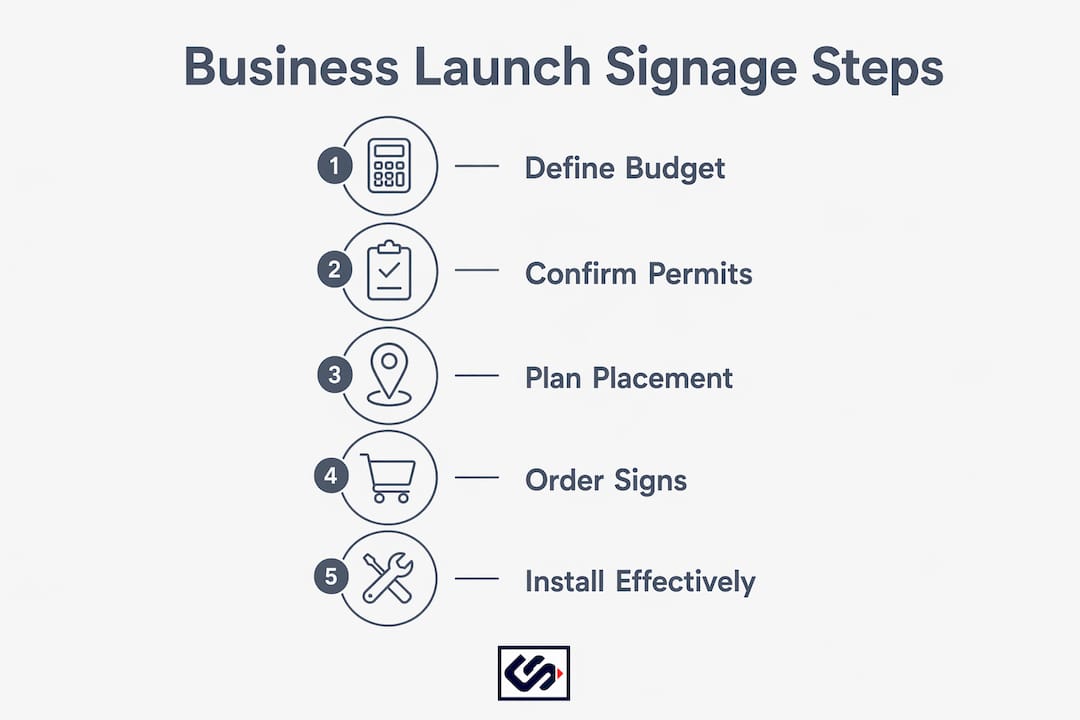
- Define your budget early. A starter package including a large banner, several feather flags, A-frame signs, and basic window graphics typically covers the full awareness-to-entry customer journey for a single storefront and is available at an affordable price range.
- Check local permit requirements. Permanent signs almost always require a building permit. Temporary banners and flags often do too, depending on your city or county. Confirm with your local zoning office before installation.
- Map your sign placement. Walk your property from the street and from the parking lot. Identify where drivers first see your location, where pedestrians pass closest, and where your entrance is least visible.
- Set your installation timeline. Order permanent signs well in advance before opening. Flexible signage like banners and flags can be ordered with much shorter lead times, but don't leave it to the final week.
- Choose materials for your climate. UV-resistant inks and weather-proof substrates matter if your launch runs through rain or direct sun. Proper planning prevents delays and protects your investment.
Placement tips:
- Mount banners above entrances and perpendicular to street traffic for maximum visibility.
- Position feather flags where they catch wind, not tucked against a wall.
- Place A-frames directly in the pedestrian path, not off to the side.
- For signs meant to grab attention at 300 feet, limit text to three words maximum, such as "Grand Opening" or "Now Open," and use high-contrast colors like red, yellow, and black.
Good commercial lighting design also plays a role here. Signs that are unlit after dark lose half their working hours, especially during winter launches when foot traffic peaks in the evening.
What does research say about signage impact and design?
The data on signage effectiveness is hard to ignore. Signage drives word-of-mouth and creates lasting first impressions, with 75% of consumers recommending businesses based on their signs. That kind of organic reach is difficult to replicate with paid advertising at the same cost.
Signage ROI also varies by business type, which affects where you should put your budget. Retail and restaurant businesses depend heavily on exterior visibility, making feather flags and A-frames their highest-return investments. Service businesses that travel to clients get more value from mobile signage like vehicle magnets, which deliver a low cost-per-impression across a wide geographic area. Matching your sign type to your business model is as important as the design itself.
For interior spaces, professional wayfinding signage keeps customers moving confidently through your space from the moment they enter. Crispsign's wayfinding and lobby signage solutions are built specifically for this purpose, with ADA-compliant options that meet both legal requirements and brand standards.
Key Takeaways
Business launch signage is your most cost-effective marketing channel at opening, combining exterior visibility, brand consistency, and customer guidance into a single coordinated system.
| Point | Details |
|---|---|
| Signage drives foot traffic | On-premise signs significantly boost daily foot traffic during launch periods. |
| Multiple sign types work together | Banners, feather flags, A-frames, and window graphics each handle a different stage of the customer journey. |
| Branding consistency builds trust | Uniform colors, fonts, and logo treatment across all signs accelerates customer recognition and recall. |
| Plan permits and timing early | Permanent signs require building permits and 6–8 weeks lead time; flexible signs can move faster. |
| Match sign type to business model | Retail and restaurant businesses prioritize exterior signs; service businesses maximize ROI with mobile signage. |
FAQ
What does business launch signage mean?
Business launch signage is the set of visual displays, including banners, flags, window graphics, and storefront signs, used to announce a new business opening, attract customers, and communicate brand identity.
What are the two main types of business signage?
Permanent signage covers fixed, architectural signs like channel letters and monument signs built to last 10–20 years. Flexible signage covers portable, temporary displays like vinyl banners, feather flags, and yard signs that can be updated quickly and require no installation permits.
How much should a new business spend on launch signage?
A starter package covering a large banner, four feather flags, two A-frame signs, and basic window graphics typically runs $300–$500 and provides solid visibility for a single storefront location.
What are the key steps to launching a business with signage?
Define your budget, confirm local permit requirements, map sign placement for maximum visibility, order permanent signs 6–8 weeks out, and coordinate flexible signage to go up on opening day.