
What Is Flagship Store Signage? A Guide for Business Owners

Flagship store signage is your store's spatial identity campaign — a coordinated system of architectural signs, sculptural features, high-brightness digital displays, and custom millwork that tells your brand story at scale. Unlike a standard retail sign, which identifies a location, flagship signage is the experience. It shapes how customers feel before they step inside.
The principal elements include:
- Architectural exterior signs — oversized, built-into-the-facade lettering or illuminated panels
- Sculptural entry features — dramatic portals, branded columns, or kinetic installations
- High-brightness digital displays — commercial-grade screens rated for continuous operation
- Custom millwork and interior branded environments — integrated cabinetry, wall graphics, and wayfinding
Flagship vs. standard retail signage at a glance:
| Dimension | Standard Retail Sign | Flagship Signage |
|---|---|---|
| Purpose | Identify location | Tell the brand story |
| Materials | Vinyl, foam board, basic metal | Stone, brushed metal, acrylic, veneer |
| Durability | 1–3 years | 5–10 years |
| Experiential role | Functional | Theatrical, photo-ready |
Table of Contents
- Why does flagship signage matter for your business?
- What materials and components define a flagship installation?
- How should digital signage work as an integrated ecosystem?
- What design principles make flagship signage photo-ready?
- What technical and permitting requirements should U.S. owners plan for?
- What does a flagship signage project cost and how long does it take?
- How do you commission a flagship signage project?
- How Crispsign approaches flagship signage projects
- Key Takeaways
- What owners usually get wrong about flagship signage
- Crispsign makes flagship signage straightforward
- FAQ
Why does flagship signage matter for your business?
On-premise signage is one of the highest-ROI investments a physical retailer can make. Research from the Signage Foundation confirms that adding or modifying building signage — including pole and multi-tenant signs — measurably increases site sales revenue, with even small directional signs producing noticeable lifts. A FedEx-cited study found that signage strongly influences consumers' decision to enter stores.
For flagship locations, the stakes are higher. Your flagship is a PR asset, a social media backdrop, and a brand benchmark all at once. Photogenic, well-executed signage generates earned media when customers share it. It increases dwell time because people linger in spaces that feel considered. And it sets the quality expectation that carries through every purchase.
Stat to know: One in six purchases is influenced by in-store point-of-purchase signage, and 16% of all unplanned purchases are driven by a sign or display a shopper saw while browsing.
Pro Tip: Before your flagship opens, establish baseline metrics: weekly footfall, conversion rate, average order value, and social mentions. Measure again at 30, 60, and 90 days post-install. That data becomes your ROI story.
What materials and components define a flagship installation?
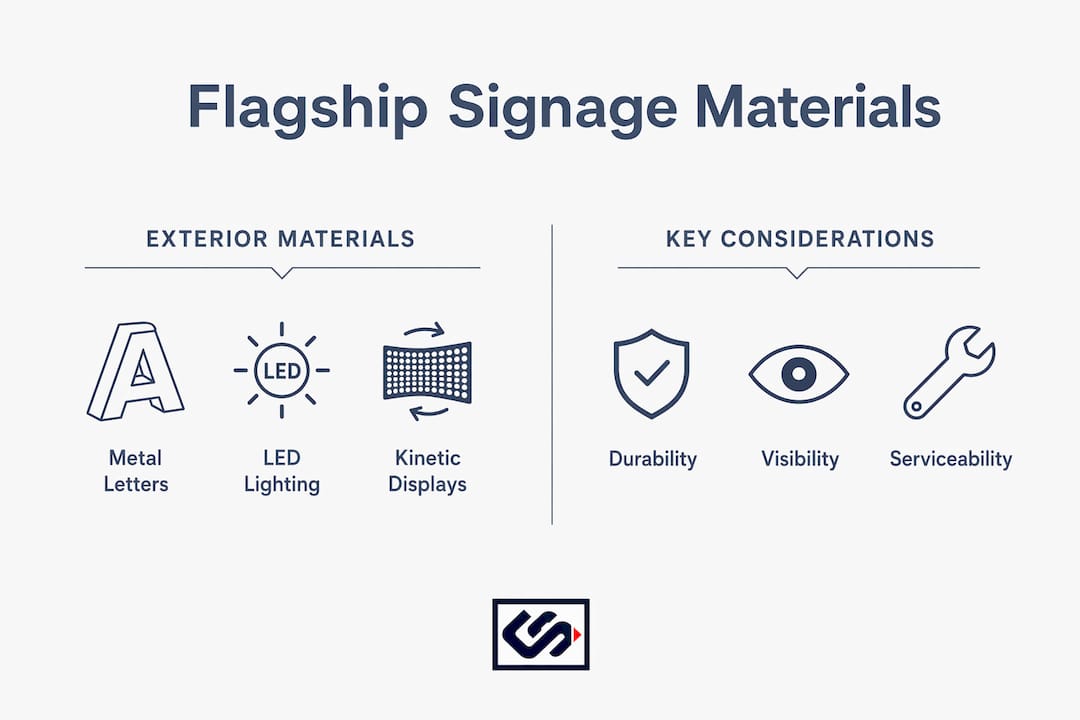
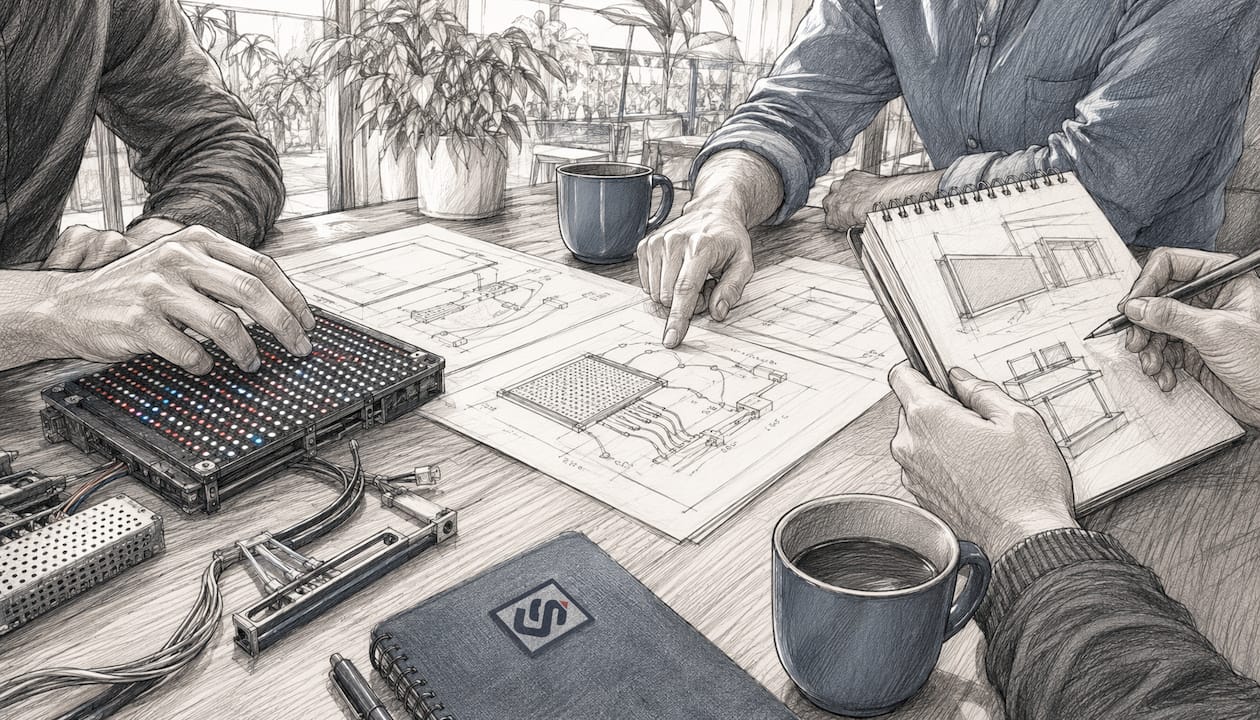
Custom fabrication is what separates flagship-grade signage from anything mass-produced. Oversized signage, dramatic entry portals, and sculptural features create photo-ready moments that off-the-shelf fixtures simply cannot replicate.
| Material / Component | Best Use | Key Consideration |
|---|---|---|
| Brushed or polished metal | Exterior letters, logo plaques | Corrosion-resistant; requires engineered anchoring |
| Stone or concrete veneer | Entry surrounds, feature walls | Heavy load; structural review required |
| Acrylic with LED backlight | Illuminated channel letters | UV-stable grades prevent yellowing |
| Powder-coated aluminum | Frames, cabinets, mounting systems | Lightweight, weather-resistant |
| Commercial-grade displays | Digital feature walls, window panels | Rated for continuous operation |
Lighting deserves its own planning track. Layered architectural lighting — combining LED modules, accent spots, and perimeter illumination — lets the sign read differently at noon versus midnight. Neon and fiber optics still appear in luxury retail for their warm, analog quality, but LED modules dominate for energy efficiency and serviceability. Replaceable panel systems matter: a flagship sign that requires full removal for a single burned module is a maintenance liability.
Kinetic analog displays are worth considering, too. A split-flap installation can be legible from up to 100 feet, scaled to over 1,500 characters, and engineered for ADA legibility — delivering sound, motion, and tactile interest that screens alone rarely match.
How should digital signage work as an integrated ecosystem?
A single screen is not a digital signage strategy. The most effective flagship digital environments treat every display as a node in a connected system, with a content management system (CMS) that allows per-screen scheduling, remote health monitoring, and real-time updates.
The LeSportsac SoHo flagship is a useful reference point: the project combined Samsung OM55B high-brightness window panels with a Samsung QM98C 98-inch 4K interior statement display, all framed in custom millwork so the screens felt built into the architecture rather than mounted on top of it. The CMS tied hardware and content into a single manageable environment.
What to request in any digital ecosystem proposal: Ask for the screen brightness spec in nits (window-facing panels typically need high brightness levels for daylight readability), the CMS platform name, the SLA for fault response, the warranty period, and a content handoff plan that includes staff training. A vendor who cannot answer all five is not ready for a flagship project.
QR integration and interactive catalogs extend the physical visit into your digital channels. A well-placed QR at a product display can link to inventory, loyalty sign-up, or an e-commerce page — turning foot traffic into trackable digital engagement. For flagship digital strategy, prioritize screen placement at entrance, checkout, and key product zones before adding complexity.
What design principles make flagship signage photo-ready?
Flagship visual merchandising functions like theatrical storytelling. The sign is not just readable — it is emotionally resonant, brand-faithful, and built to photograph well under every light condition.
Start with message hierarchy: one dominant element (your logo or brand name), one secondary element (a tagline or seasonal message), and nothing else competing for attention at the exterior. Typography should be legible at 20–100 feet. High-contrast combinations — light letterforms on dark backgrounds, or vice versa — outperform mid-tone pairings in both daylight and low light.
For social-ready design, think about framing. Where will a customer stand to photograph your storefront? That sightline should have a clean background, a focal point at roughly eye level, and a material finish that photographs well (matte metals, polished stone, and backlit acrylic all read beautifully on a phone camera).
Pro Tip: Run a camera test during prototyping. Photograph the mockup at 20 feet, 50 feet, and 100 feet under daylight, overcast, and nighttime conditions. If the brand color shifts or the text blurs, fix it before fabrication.
Design QA checklist before approving final artwork:
- Confirm brand color fidelity under warm, cool, and natural light
- Test legibility at minimum viewing distance and maximum distance
- Verify logo proportions match brand guidelines at full scale
- Check that all typefaces are licensed for large-format output
- Photograph the physical mockup, not just the digital render
What technical and permitting requirements should U.S. owners plan for?
Permitting is where flagship projects stall. Most U.S. municipalities require a sign permit before installation, and historic districts add a second review layer that can add weeks. Electrical permits are separate from sign permits. Hire a licensed contractor who pulls permits as part of their scope — never accept a vendor who asks you to handle permitting yourself.
ADA requirements apply to interior signage: mounting height (typically 48–60 inches to the centerline), tactile characters for room and suite identification, and minimum font sizing for legibility. Crispsign's ADA-compliant signage line covers these requirements for interior environments.
Key documents your vendor must supply at project close:
- Engineered structural drawings (stamped by a licensed PE)
- UL listing for all electrical components
- Permit closeout documentation
- Warranty covering both fabrication and installation
- Maintenance plan with service contact and response time
For retail staff managing installation windows, coordinating after-hours schedules is standard practice. Flagship installs almost always happen overnight or on dark days to avoid disrupting sales.
What does a flagship signage project cost and how long does it take?
| Phase | Typical Duration | Estimated Cost Range |
|---|---|---|
| Concept and design | 2–4 weeks | $3,000–$15,000 |
| Permitting and approvals | 3–8 weeks | $500–$5,000 |
| Fabrication | 4–9 weeks | $20,000–$150,000 |
| Digital hardware and CMS | Included in fabrication | $5,000–$50,000 |
| Installation | 1–5 days | $5,000–$30,000 |
| Content creation and commissioning | 1–2 weeks | $2,000–$20,000 |
Total project timelines typically run 12–24 weeks from signed contract to commissioning. Scale, structural complexity, high-brightness display specs, and custom engineering are the primary cost drivers. A single-facade exterior sign with LED illumination sits at the lower end; a multi-zone digital ecosystem with structural millwork and interactive features pushes well past $100,000.
Cost reality check: Permitting delays are the most common budget risk. Build a 4-week buffer into your timeline and a 15% contingency into your budget before you sign a fabrication contract.
How do you commission a flagship signage project?
Follow this sequence to avoid the most common mistakes:
- Issue an RFP with your brand guidelines, site dimensions, and a clear scope (exterior only, full interior, digital ecosystem, or all three).
- Validate scope with at least two vendors during a paid or complimentary site survey.
- Request itemized quotes that separate design, fabrication, hardware, installation, and content.
- Review physical mockups or prototypes before approving fabrication.
- Confirm engineered drawings are included and stamped before signing off.
- Schedule the installation window — after hours, with a clear commissioning checklist.
Vendor checklist questions to ask before signing:
- Do you fabricate in-house or subcontract?
- Who manages permitting, and is it included in your fee?
- What is your SLA for display faults after installation?
- Can you provide references from comparable flagship projects?
- What does content handoff and staff training look like?
Require an acceptance criteria document in the contract: defined uptime expectations for displays, a punch-list process for defects, and a warranty that covers both parts and labor.
How Crispsign approaches flagship signage projects
Crispsign delivers custom, production-ready flagship signage from concept through installation — fabricated to spec, engineered for your site, and built to perform from day one. The production workflow is designed for speed without cutting corners: each project moves through design validation, material sourcing, fabrication, and quality review on a clear timeline so you always know where your project stands.
Portfolio examples, production workflow details, and ADA-compliant interior options are available directly through Crispsign's team.
Key Takeaways
Flagship store signage is a spatial identity campaign that combines architecture, materials, digital systems, and design to turn your store into a destination and a measurable revenue driver.
| Point | Details |
|---|---|
| Signage drives foot traffic | Signage strongly influences consumers' decision to enter stores. |
| Materials define durability | Choose commercial-grade metals, UV-stable acrylics, and rated displays for 5–10 year performance. |
| Digital needs a CMS | Plan per-screen control, scheduling, and a content handoff plan before selecting hardware. |
| Budget for permitting delays | Build a 4-week buffer and 15% cost contingency into every flagship project timeline. |
| Crispsign delivers end-to-end | Crispsign handles fabrication, engineering, installation, and permit support for custom flagship signage. |
What owners usually get wrong about flagship signage
Most business owners treat flagship signage as a procurement decision — pick a vendor, approve a render, wait for install. The projects that disappoint almost always skipped one of three things: a physical prototype review, a permitting timeline buffer, or a content strategy for the digital components.
The prototype step is the one I'd argue hardest for. A render on a screen cannot tell you how your brand color reads under the sodium-vapor streetlights outside your door at 9 PM. A physical mockup, photographed on-site, catches those problems before steel gets cut.
Serviceability is the other underrated factor. A flagship sign that looks extraordinary on opening day but requires a full scaffold to change a bulb two years later is a liability. Ask every vendor: "How do we service this in year three?" The answer tells you more about their engineering than any portfolio photo.
Crispsign makes flagship signage straightforward
Flagship signage projects are complex, but working with the right fabrication partner makes them manageable. Crispsign specializes in custom storefront and interior signage built to your exact specifications — from oversized exterior letters to ADA-compliant interior systems. Every project includes engineered drawings, permit coordination support, and a clear production timeline so you stay informed at every stage.
Ready to see what your flagship could look like? Request a quote from Crispsign and get a production-ready plan for your storefront.
FAQ
What is flagship store signage, exactly?
Flagship store signage is a coordinated system of architectural signs, digital displays, and branded environmental elements designed to express a brand's identity at scale — not just identify a location.
How much does flagship signage cost in the U.S.?
A single-facade exterior sign with LED illumination sits at the lower end; a multi-zone digital ecosystem with structural millwork and interactive features pushes well past $100,000.
How long does a flagship signage project take?
Most projects run 12–24 weeks from signed contract to commissioning, with permitting often accounting for 3–8 weeks of that timeline.
What permits do I need for a flagship sign?
Most U.S. municipalities require a sign permit and a separate electrical permit; historic districts add a design review layer. A licensed contractor should pull all permits as part of their project scope.
Can Crispsign handle both exterior and interior flagship signage?
Yes. Crispsign fabricates custom exterior and interior signage, including ADA-compliant interior systems, with engineered drawings and permit support included in the project scope.