
Visual Merchandising Signage: Your 2026 Retail Guide

Visual merchandising signage covers every graphic display inside and outside your store that guides, informs, and attracts customers. It bridges brand identity with everyday store operations, working silently on your behalf from the moment a shopper spots your storefront to the second they reach the checkout. The four core categories are:
- Exterior signage: Storefront logos, window vinyl, pole signs, and A-boards
- Interior wayfinding: Aisle markers, category headers, and directional graphics
- Point-of-purchase signage: Shelf talkers, promotional end caps, and floor decals
- Digital displays: Video walls, menu boards, and QR-enabled screens
What is visual merchandising signage, and what types matter most?
Retail signage spans four distinct categories, each serving a different moment in the customer journey.
- Exterior signage is your first impression. Storefront logos, window vinyl, and pole signs pull foot traffic before anyone steps inside.
- Interior wayfinding keeps shoppers moving confidently. Aisle markers and directional signs reduce frustration and help customers find products without asking for help.
- Point-of-purchase signage does the persuading. Shelf talkers call out a price or benefit right at the moment of decision. End caps spotlight promotions where traffic is highest.
- Digital signage adds flexibility. Video walls and QR-enabled displays let you update messaging in real time, no reprinting needed.
Each type solves a specific problem. Exterior signs create awareness, wayfinding reduces friction, point-of-purchase signs convert browsers, and digital displays keep content fresh.
How effective signage directly lifts your sales
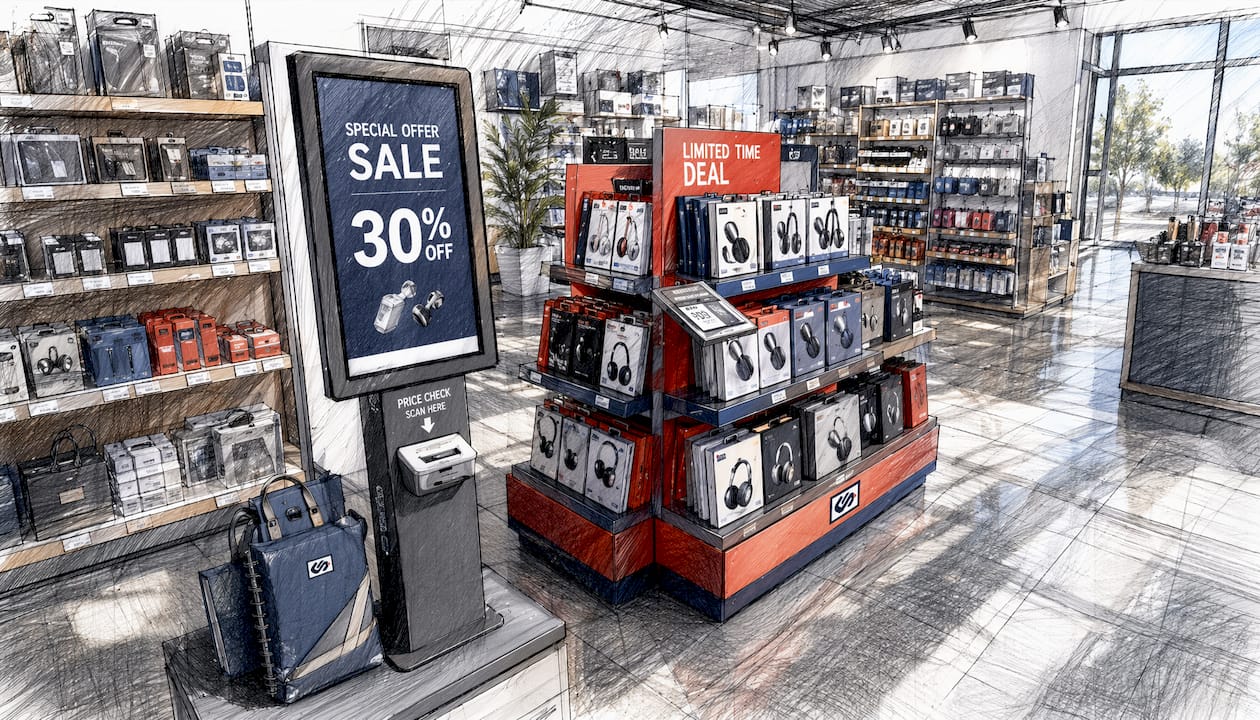
The sales impact of well-placed signage is not theoretical. A field experiment conducted in several retail stores found that moving products to special displays with clear signage produced a significant increase in sales, varying substantially by category and placement. That range reflects how much category and placement matter, but the floor is still 80%.
Navigation is the other lever. Optimized wayfinding signs reduced aisle-finding time by 40% in eye-tracking studies, meaning less frustration and more time spent actually shopping. Shoppers who navigate easily stay longer, discover more products, and buy more on impulse.
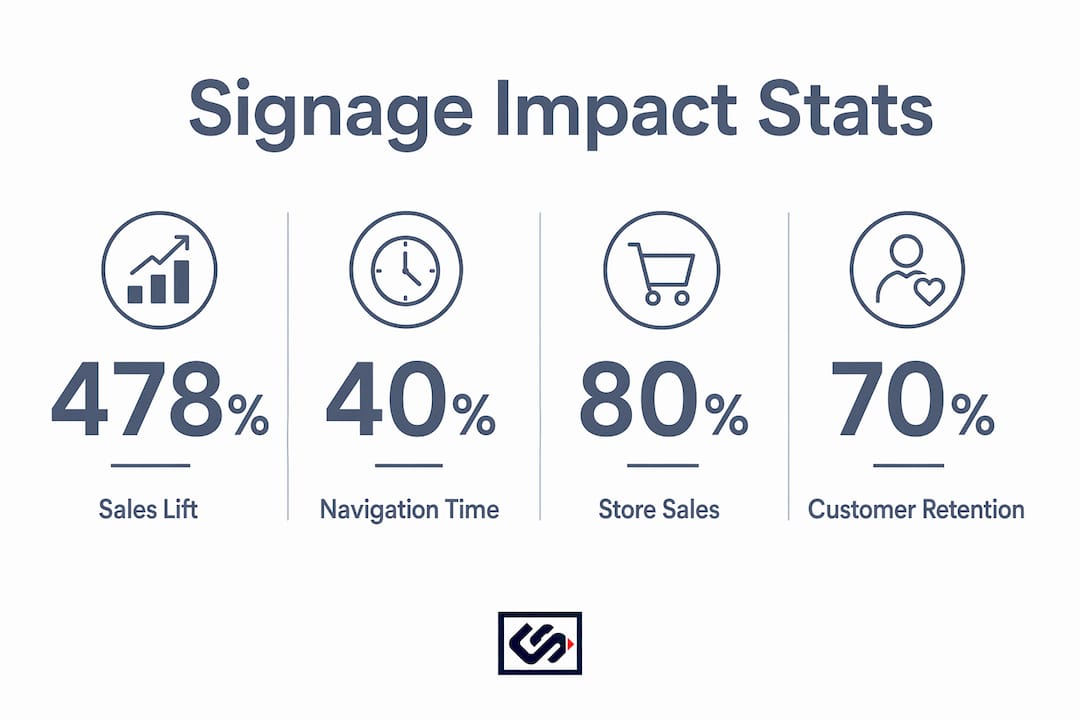
Well-designed signage also builds dwell time and long-term loyalty by turning a routine trip into a smooth, satisfying experience. The dual payoff, more sales today and more return visits tomorrow, is what makes signage one of the highest-return investments in your store.
Design best practices that make your signage work harder
Great signage does not happen by accident. A few principles separate signs that get noticed from signs that get ignored.
- Brand consistency: Use your exact brand colors, fonts, and logo on every sign. Consistency builds recognition and trust across every touchpoint.
- High-resolution visuals: Blurry images undercut credibility instantly. Use print-ready files and quality materials.
- Concise copy: Shoppers do not stop to read paragraphs. Keep messages to a headline and one supporting line at most.
- Strategic placement: Position signs near entrances, at eye level, and on high-traffic endcaps for maximum visibility.
- Universal icons: Pair text with recognized symbols to communicate faster, especially in multilingual markets.
Pro Tip: Before finalizing a sign design, test it with a visual salience tool. Research using mobile eye-tracking and the NeuroVision algorithm found that some signs failed to attract automatic attention until redesigned for higher visual contrast. A sign that does not pop in a salience test will not pop in your store either.
Why signage is your store's most strategic communication tool
Think of your signage system as your store's central nervous system. It controls customer flow, communicates brand value, and shapes every impression before your staff says a word. That is not decoration. It is infrastructure.
The most effective retailers treat signage as part of a continuous customer journey, from the exterior sign that earns the first glance, through interior wayfinding that builds confidence, to point-of-purchase messaging that closes the sale. Each touchpoint reinforces the last.
Data-driven retailers are now using heat-mapping, digital twins, and real-time digital signage updates to make that environment adaptive, not static. The shift from gut-feel display decisions to measurable, technology-backed visual merchandising strategies is the defining trend of 2026 retail.
Regulatory and accessibility standards you need to know
Signage compliance is not optional in the United States. The Americans with Disabilities Act (ADA) sets specific requirements for permanent interior signs, including room identification signs for spaces like restrooms and exits. ADA-compliant signs must include Grade 2 Braille, raised characters, non-glare finishes, and mounted at heights suitable for accessibility, generally within a specified range from the floor.
Beyond ADA, local building codes often govern exterior sign dimensions, illumination levels, and placement relative to property lines. Cities and municipalities vary widely, so always verify local ordinances before fabricating exterior signage. Accessible design is also good retail practice. Clear contrast ratios, legible fonts, and unobstructed placement benefit every shopper, not just those with disabilities.
Crispsign produces ADA-compliant lobby signage fabricated to spec, so your interior signs meet both legal requirements and brand standards without compromise.
Key Takeaways
Visual merchandising signage is the most direct, measurable tool you have for guiding customers, communicating brand value, and driving sales at every point in the store.
| Point | Details |
|---|---|
| Sales impact is proven | Field research across 214 stores showed an 80%–478% sales lift from displays with clear signage. |
| Navigation drives revenue | Optimized wayfinding signs reduced aisle-finding time by 40% in eye-tracking studies. |
| Design consistency matters | Brand-aligned colors, fonts, and placement build trust and automatic shopper attention. |
| Compliance is mandatory | ADA standards require Braille, raised characters, and specific mounting heights for interior signs. |
| Signage is a system | Exterior, wayfinding, point-of-purchase, and digital signs work together across the full customer journey. |
FAQ
What is visual merchandising signage in simple terms?
Visual merchandising signage is any graphic display, inside or outside a store, that guides, informs, or attracts customers. It covers everything from storefront logos to shelf talkers and digital screens.
How much can signage actually increase sales?
A field experiment across 214 retail stores found that products moved to special displays with clear signage saw sales increases of 80%–478%, depending on category and placement.
What are the ADA requirements for retail signage?
ADA-compliant interior signs must include Grade 2 Braille, raised characters, a non-glare finish, and mounting heights suitable for accessibility, generally within a specified range from the floor.
Where should you place signs for the best results?
Place signs near store entrances, at eye level along main aisles, and on promotional endcaps. These zones capture the most natural shopper attention with the least effort.
What is the difference between wayfinding and point-of-purchase signage?
Wayfinding signs help shoppers navigate the store efficiently. Point-of-purchase signs persuade at the moment of decision, highlighting prices, promotions, or product benefits right at the shelf.