Why a Consistent Wayfinding System Matters for Facilities
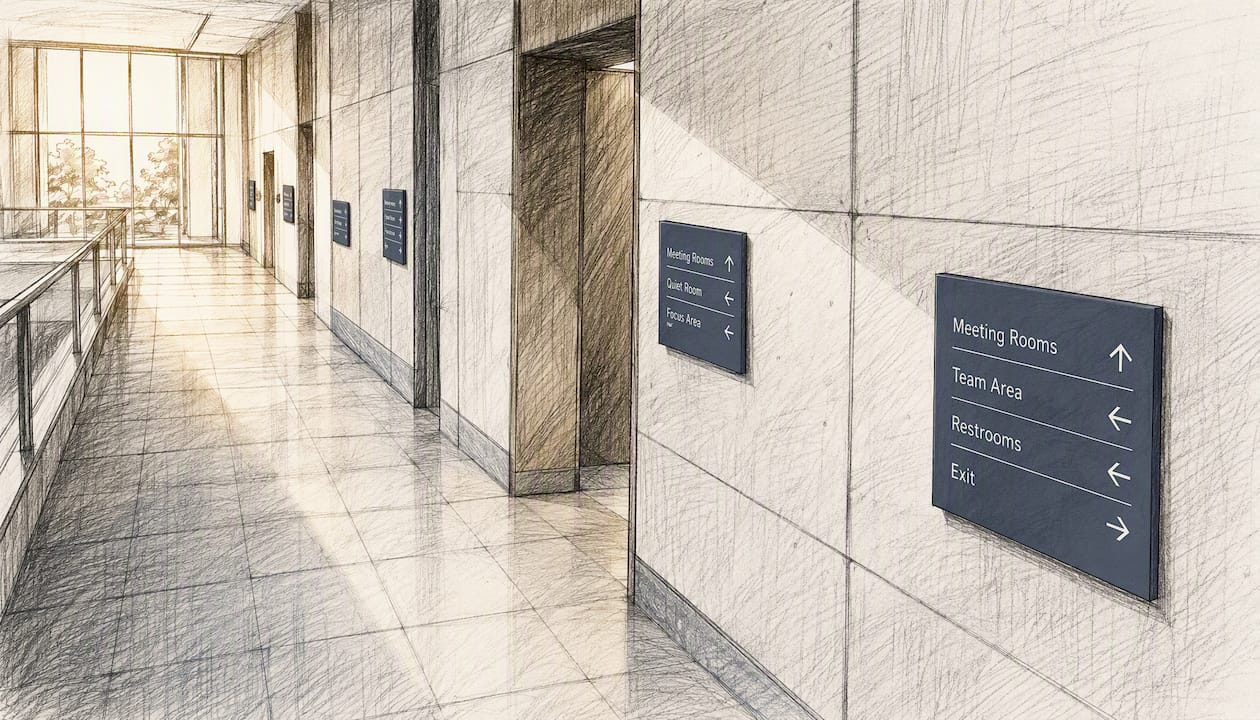
A consistent wayfinding system reduces staff time spent giving directions, cuts missed appointments, clarifies emergency routes, and keeps your facility compliant with ADA 2010 Standards. The Access Board's sign guidance and SEGD's practitioner evidence both confirm that consistency is the single design variable with the clearest operational payoff.
- Staff time saved: Fewer directional questions free front-desk and security staff for higher-value tasks.
- Fewer missed appointments and delays: Predictable signage gets visitors to the right place on time.
- Clearer emergency routing: Consistent exit and evacuation signage reduces confusion when seconds matter.
- Accessibility compliance: Standardized mounting heights, tactile text, and contrast meet federal requirements.
- Brand and trust: Uniform messaging signals professionalism and reduces visitor anxiety from the moment they arrive.
Table of Contents
- 1. What consistency actually delivers for your facility
- 2. The key components every consistent system must lock down
- 3. The evidence: what the numbers say about wayfinding ROI
- 4. A phased implementation checklist for facility teams
- 5. Common pitfalls that break consistency over time
- 7. How to engage stakeholders during wayfinding development
- 8. Measuring user satisfaction after implementation
- Key Takeaways
- The case for treating wayfinding as infrastructure
- Crispsign can help you build it right from the start
- Useful sources
- FAQ
1. What consistency actually delivers for your facility
Consistency converts design choices into operational outcomes. When every sign in your building uses the same terminology, the same arrow logic, and the same placement at decision points, visitors build a mental model fast. CannonDesign's research on human variables frames wayfinding as an act of care: systems must account for perception, memory, stress, behavior, and individual differences. When those variables are managed through consistent design, cognitive load drops and navigation errors follow.
The operational math is straightforward. Fewer navigation errors mean fewer staff interruptions. Fewer interruptions mean more time for patient care, student advising, or customer service. At a busy hospital reception desk, that difference can add up to dozens of redirected conversations per shift. A systematic literature review in Frontiers in Psychology confirms the link between layout complexity and wayfinding errors, which means a well-structured, consistent system is also a measurable error-reduction tool.
Safety is the non-negotiable layer. OSHA regulation 1910.37 requires exit routes and signs to be clearly marked, and inconsistent signage is one of the fastest ways to fail that standard during an inspection or, worse, during an actual evacuation. Consistent color coding and placement of emergency signage removes the guesswork when it matters most.
Brand clarity is the quieter benefit. Kevin Lynch's foundational work in The Image of the City established that legibility and recognizable landmarks make environments feel trustworthy. A campus or retail center with coherent signage reads as professionally managed. One with mismatched fonts, conflicting arrows, and hand-lettered additions reads as neglected, regardless of how well the underlying facility is maintained.
2. The key components every consistent system must lock down
A wayfinding system is only as consistent as its weakest component. Here are the elements to standardize before anything goes to fabrication:
- Mounting heights: The Access Board specifies that tactile signs must be mounted with the centerline at 60 inches above the floor. Consistent mounting across all rooms and corridors is both a compliance requirement and a usability standard.
- Tactile and accessible formats: Braille, raised characters, and high-contrast finishes are required for permanent room identification signs under the ADA 2010 Standards. These are not optional add-ons.
Pro Tip: Create a single sign schedule document — a master spreadsheet listing every sign, its location, its content, its material spec, and its last inspection date. This one document prevents the drift that turns a coherent system into a patchwork over time.
3. The evidence: what the numbers say about wayfinding ROI
The business case for consistent wayfinding is well-documented. SEGD's ROI analysis includes an estimate that one hospital lost more than $400,000 per year from wayfinding failures, including staff time spent giving directions, missed appointments, and late patient arrivals. That figure, calculated in 2021 dollars, is the most-cited benchmark in facility management conversations about wayfinding budgets.
$400,000+ estimated annual cost of wayfinding failures at a single hospital, per SEGD's practitioner analysis.
Digital tools add another data point. QRCodeMaps reports that QR-based wayfinding deployments commonly achieve significant reductions in directional questions within a few months of launch. That reduction translates directly into staff-hour savings you can price at your facility's average labor cost.
Plotstuff's ROI framework recommends tracking four KPIs before and after any wayfinding improvement:
| KPI | What it measures | Why it matters |
|---|---|---|
| Directional enquiries per shift | Staff time diverted to navigation help | Most direct measure of wayfinding load |
| Missed appointments / no-shows | Visitor navigation failures | Revenue and scheduling impact |
| Visitor satisfaction scores | Perceived ease of navigation | Proxy for brand and UX quality |
| Tenant or patient retention | Long-term loyalty linked to experience | Strategic ROI for multi-tenant facilities |
Baseline these numbers before you change anything. Without a pre-implementation benchmark, you cannot make the ROI case to leadership after the fact.
4. A phased implementation checklist for facility teams
Getting to a consistent system requires a structured rollout. Here is a five-phase approach that design firms and facility managers use in practice:
- Create your standards kit — Document typefaces, sizes, colors, mounting heights, icon library, and ADA accommodations in a single spec document. This is your source of truth. No sign gets ordered without matching it.
Pro Tip: Stage the rollout by zone rather than by sign type. Replacing all directional signs in Zone A before moving to Zone B keeps each area coherent during the transition and avoids the confusing mixed-system period that frustrates visitors and staff alike.
5. Common pitfalls that break consistency over time
Most wayfinding systems start coherent and drift into chaos. The causes are predictable.
Fragmented procurement is the most common failure mode. When individual departments order their own signs from different vendors, you get mixed materials, mismatched fonts, and conflicting arrow styles within months. The fix is a centralized procurement policy that routes all sign orders through a single approved vendor list and spec review.
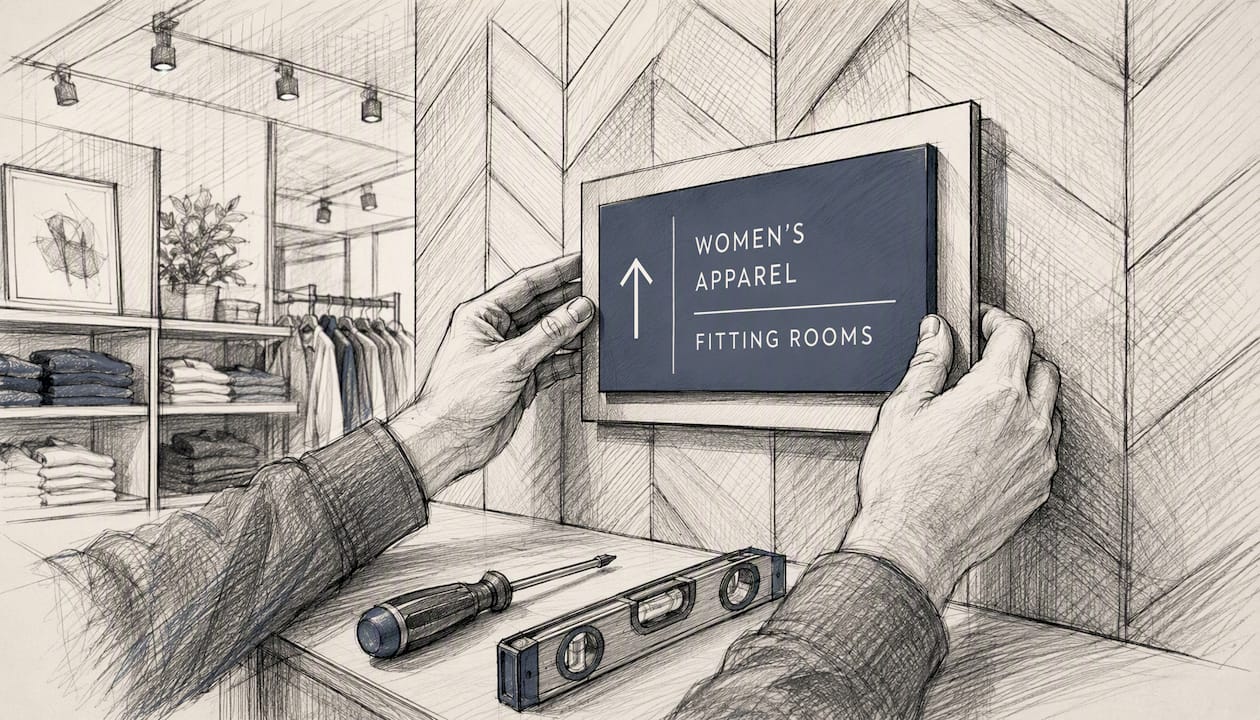
Ad-hoc temporary signage is the second-fastest path to system breakdown. A hand-lettered paper sign taped to a wall is a symptom of a gap in the permanent system, not a solution. Every temporary sign that stays up longer than a week becomes part of the visual environment and undermines the system's credibility.
Siloed branding changes create another common problem. When marketing updates brand colors or typography without notifying facilities, new signs ordered after the rebrand clash with existing ones. A simple approval workflow that requires facilities sign-off on any signage-adjacent brand change prevents this.
Watch for these red flags during audits: mixed typefaces on the same corridor, arrows pointing in directions that contradict each other, mounting heights that vary by floor, and signs with outdated department names. Each one is a governance failure, not a design failure.
7. How to engage stakeholders during wayfinding development
A wayfinding system touches more departments than most facility managers expect. Facilities, marketing, IT, security, HR, and clinical or academic leadership all have a stake in the outcome. Getting them aligned early prevents the rework that happens when a finished system conflicts with a department's naming conventions or a brand team's color palette.
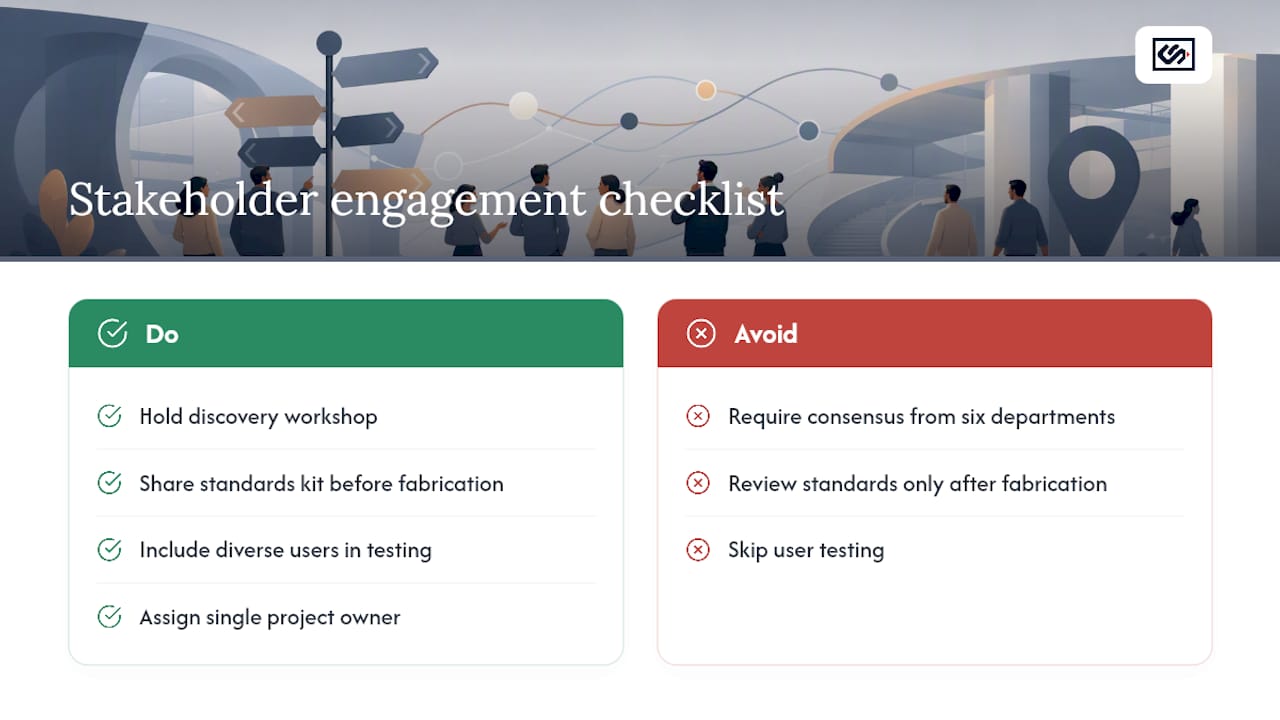
Start with a discovery workshop that maps who owns what. Facilities owns installation and maintenance. Marketing owns brand standards. IT owns digital directories and CMS access. Security owns emergency signage placement. Each stakeholder group should review the standards kit before fabrication begins, not after.
User representation matters too. Include first-time visitors, people with mobility limitations, and non-English speakers in your user-testing phase. Their navigation patterns reveal gaps that internal stakeholders, who know the building well, will never notice. This is where the CannonDesign human-variables framework is most useful: stress, perception, and individual differences are real variables, and they show up in testing before they show up as complaints.
Assign a single project owner with authority to make final calls. Wayfinding projects stall when decisions require consensus from six departments. One owner, with a clear escalation path, keeps the timeline moving.
8. Measuring user satisfaction after implementation
Post-implementation measurement is where most facilities leave value on the table. The KPIs from the evidence section (directional enquiries, missed appointments, visitor satisfaction scores) need a collection mechanism, not just a spreadsheet.
For directional enquiries, a simple tally sheet at reception desks gives you weekly data with no technology investment. For visitor satisfaction, a short three-question survey at exit points or via QR code captures perception data in real time. For missed appointments, your scheduling system already has the data; you just need to tag the reason code.
Digital wayfinding tools add passive measurement. QR scan rates by location tell you which signs are being used and which are being ignored, which is often a signal that placement or content needs adjustment. A sign that nobody scans in a high-traffic area is either redundant or invisible.
Review the data quarterly for the first year. Wayfinding systems need tuning after real-world use, and the first 90 days of data usually reveal two or three placement or terminology issues that user testing missed. Build that review into the governance cycle, not as a special project.
Key Takeaways
A consistent wayfinding system is an operational control that reduces staff load, improves safety compliance, and delivers measurable cost savings across every complex facility type.
| Point | Details |
|---|---|
| Consistency reduces operational cost | SEGD estimates one hospital lost more than $400,000 annually from wayfinding failures alone. |
| Digital tools accelerate ROI | QR-based wayfinding can reduce directional questions by 60–80% within three months of deployment. |
| Standardize nine core components | Lock down placement, terminology, typography, color, icons, mounting heights, tactile formats, maps, and digital integration. |
| Audit first, then build standards | Baseline directional enquiries and missed appointments before any changes so you can prove ROI afterward. |
| Crispsign supports custom production | Crispsign fabricates custom wayfinding signage to spec, ships nationwide, and coordinates optional installation. |
The case for treating wayfinding as infrastructure
The conventional wisdom treats wayfinding as a design project: you hire a firm, install signs, and move on. That framing is why so many systems degrade within three years. The facilities that maintain coherent wayfinding over time treat it the way they treat HVAC or fire suppression: as infrastructure with a maintenance budget, a responsible owner, and a scheduled review cycle.
What gets underestimated is the distributed cost of poor wayfinding. The $400,000 hospital figure from SEGD is striking, but the real insight is that those costs are invisible in most budgets. Staff time spent giving directions shows up in payroll, not in a "wayfinding failure" line item. Missed appointments show up in scheduling reports. Visitor complaints show up in satisfaction surveys. No single budget owner sees the full picture, which is exactly why the problem persists.
The ROI case is strongest when you connect those distributed costs to a single governance decision: appoint an owner, create a sign schedule, and set a maintenance budget. That is not a design recommendation. It is an operations recommendation. And it is the one that actually sticks.
Crispsign can help you build it right from the start
When your standards kit is ready and your sign schedule is locked, the next step is fabrication that matches your spec exactly. Crispsign produces custom wayfinding signage built to your design specifications, using durable materials suited for high-traffic interior and exterior environments. Every order ships nationwide, and optional installation coordination is available for facilities that need a managed deployment rather than a DIY rollout.
For facility managers who need a reliable production partner, Crispsign offers design spec support, material selection guidance, and a straightforward online ordering process. Whether you are replacing a fragmented legacy system or fabricating a new program from scratch, you get quality-made signs that hold up to daily use and match your standards document sign for sign. Get your custom wayfinding quote and see turnaround times before you commit.
Useful sources
- ada.gov
- access-board.gov
- frontiersin.org
- Wayfinding’s Return on Investment: Five Facts - SEGD - Designers of Experiences
- Five human variables that shape wayfinding in buildings | CannonDesign
- mitpress.mit.edu
- Wayfinding ROI: How Indoor Navigation Reduces Costs and Improves Visitor Experience — QRCodeMaps
- The ROI of Wayfinding: How Better Navigation Reduces Costs | Plotstuff
Key figure: SEGD's analysis puts the annual cost of wayfinding failures at one hospital above $400,000, a figure that makes the ROI case for a properly governed system in a single line item.
FAQ
Why does wayfinding consistency matter more than good individual signs?
Individual signs solve local problems; consistency solves the system problem. A visitor who encounters conflicting terminology or arrow logic between two otherwise well-designed signs loses trust in the entire system and defaults to asking staff for help.
What does ADA compliance require for wayfinding signage?
The ADA 2010 Standards require tactile characters, Braille, and high contrast on permanent room identification signs, with mounting centerlines at 60 inches above the floor per Access Board guidance. These requirements apply to all U.S. facilities open to the public.
How quickly can digital wayfinding show measurable results?
QR-based wayfinding deployments commonly report a 60–80% reduction in directional questions within three months, according to QRCodeMaps, making it one of the fastest-payback investments in facility operations.
What is the first step to improving wayfinding consistency?
Start with a photographic site audit that logs every sign's location, content, condition, and compliance status. Without that baseline, you cannot prioritize replacements or prove ROI after the new system is in place.
Can Crispsign produce wayfinding signs that match an existing spec?
Yes. Crispsign fabricates custom wayfinding signage to customer specifications, ships nationwide, and offers optional installation coordination for facilities that need a managed deployment rather than a self-install program.