Why Fast Sign Delivery Matters for Your Business
Fast sign delivery protects your campaign timing, preserves customer trust, and directly guards revenue. Miss your grand opening date because a sign is stuck in production, and you lose foot traffic you can never recover. That is why speed in signage is not a convenience — it is a business requirement.
The short version:
- Customers form impressions within seconds of seeing your storefront. A missing or placeholder sign during a launch window costs you those first impressions permanently.
- Every day a promotion runs without the right signage is a day of lost conversion opportunity, especially during peak retail seasons when U.S. retail sales spike and competition for foot traffic intensifies.
- Installation crews, permit timelines, and lease start dates do not wait for a late sign order. Delays cascade.
- Brand trust erodes when a storefront looks unfinished. Customers read an incomplete exterior as a signal about the business inside.
Two things you can do right now:
- Call or email your sign supplier today and ask for a guaranteed ship date in writing, not an estimate.
- Confirm whether your order requires a permit, and if so, whether the permit timeline is already running.
Key Takeaways
Fast sign delivery protects campaign timing, preserves first impressions, and prevents the revenue loss that comes from a storefront that is not ready when customers arrive.
| Point | Details |
|---|---|
| Two clocks, not one | Production turnaround and shipping transit are separate; both must be planned to hit your deadline. |
| Proof delays cost the most | A proof sitting unapproved for 48 hours adds 48 hours to your timeline at zero added cost to fix. |
| Reliability beats raw speed | A supplier with a guaranteed ship date every time outperforms one who promises fast but delivers inconsistently. |
| Temporary signs bridge the gap | Vinyl banners, window clings, and digital displays keep you visible while permanent signs are in production. |
| Crispsign for tight deadlines | Crispsign offers expedited fabrication, confirmed ship dates, and installation coordination for businesses with real deadlines. |
Table of Contents
- Why fast sign delivery matters: production time vs. shipping time
- How fast sign delivery benefits your small or medium business
- What the research says about delivery speed and revenue
- Typical sign turnaround times and cost trade-offs
- How to shorten your sign order timeline
- How to choose a sign supplier when speed matters
- What to do when your deadline is tomorrow
- What running a fast-turn sign shop actually teaches you
- Crispsign gets your signs built and shipped on time
- Sources
- FAQ
Why fast sign delivery matters: production time vs. shipping time
"Fast delivery" actually has two separate clocks running at the same time, and most business owners only track one of them.
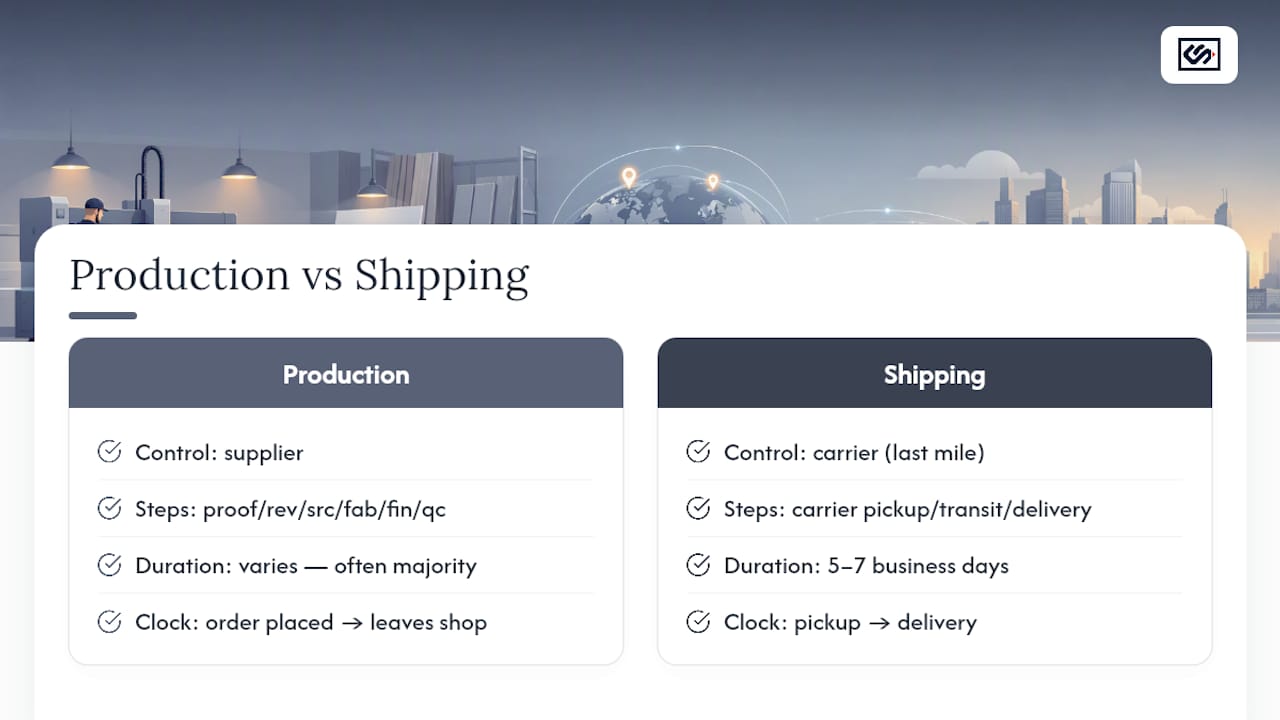
Production time (also called turnaround time) covers everything from the moment you place an order to the moment the finished sign leaves the shop: design proofing, file review, material sourcing, fabrication, finishing, and quality inspection. This is where most lead time hides, and it is entirely within your supplier's control.

Shipping time (the last mile) starts the second the carrier picks up the package. Transit windows vary by carrier, distance, and service level — ground shipping across the country can add 5–7 business days on top of whatever the production clock already consumed.
Where lead time actually hides
Most delays do not happen on the production floor. They happen in the gaps:
- Proof approval delays. A digital proof sitting in someone's inbox for 48 hours is 48 hours of production time lost.
- File problems. Low-resolution artwork, missing fonts, or incorrect bleed settings send a job back to square one.
- Material backorders. Specialty substrates for carved cedar signs or illuminated cabinet faces occasionally require lead time from suppliers.
- Carrier cutoff times. Missing a carrier pickup by one hour means a full extra business day in transit.
Example timelines: yard sign vs. channel letters
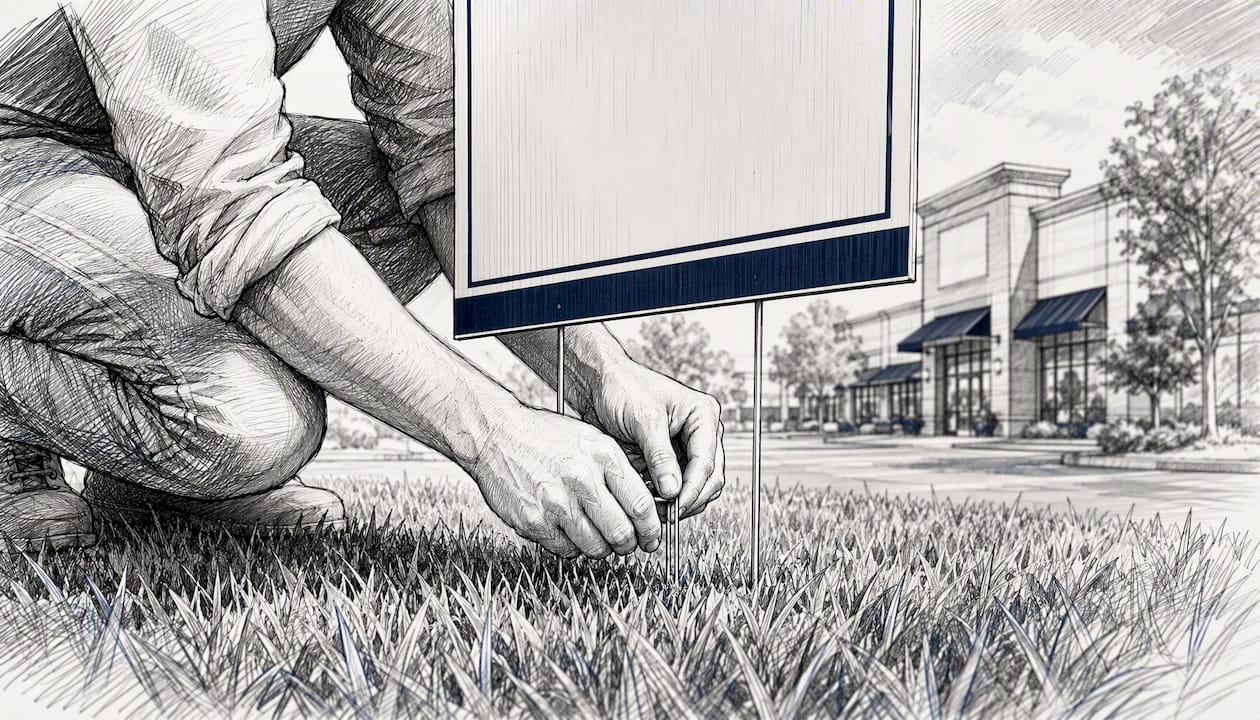
A yard sign (corrugated plastic, single color) typically runs 1–2 business days in production and 2–5 business days in ground shipping, putting total delivery at roughly 3–7 business days from a clean, approved file.
A channel-letter sign (exterior illuminated, custom fabrication) is a different story. Fabrication alone runs 5–10 business days for most shops, and freight shipping adds another 3–7 days. Factor in one proof revision round and a permit application, and a realistic timeline is 3–4 weeks from order to installation.
Knowing which clock is running — and where it is slowest — lets you plan around it instead of being surprised by it.
How fast sign delivery benefits your small or medium business
Speed in signage is not just about convenience. It connects directly to revenue, brand perception, and operational efficiency. Here are the primary benefits, ranked by impact for small and medium-sized businesses:
- On-time campaign launches. A seasonal promotion that goes up three days late misses the peak buying window. Retail seasonality is unforgiving — U.S. retail sales data consistently shows concentrated spending in narrow windows around holidays and back-to-school periods.
- Increased foot traffic from day one. Your exterior sign is your best salesperson. It works 24 hours a day, and it starts working the moment it goes up. A grand opening without exterior signage is a missed introduction.
- Improved brand trust. A complete, professional storefront signals stability and attention to detail. Customers notice when something is missing, even if they cannot name it.
- Fewer rework and installation delays. Fast suppliers with clear proofing workflows catch errors before fabrication, not after. That saves you the cost and time of reprints.
- Better event responsiveness. A vehicle wrap for a trade show, a window graphic for a pop-up, or a banner for a community event all have hard deadlines. Fast turnaround gives you the flexibility to respond to opportunities as they appear.
Consumer behavior reinforces all of this. Industry surveys show that roughly 74% of shoppers expect delivery within two days and that many factor delivery windows directly into purchasing decisions. While those figures come from e-commerce research, the underlying psychology applies equally to B2B sign orders: when a supplier cannot give you a clear, reliable timeline, confidence in the whole transaction drops.
Pro Tip: For any sign tied to a specific event or opening date, work backward from that date. Add your installation window, then your shipping window, then your production window. That is your order deadline — not the day before the event.
What the research says about delivery speed and revenue
The connection between fulfillment speed and business outcomes is well-documented in retail and e-commerce, and the same dynamics apply when you are the one waiting on a supplier.
Research on same-day and next-day delivery shows that a large share of shoppers abandon purchases when delivery timelines feel slow or unclear. Transparency about cutoff times and realistic delivery windows drives most of the perceived benefit — not necessarily same-day service itself. For sign buyers, this translates directly: a supplier who gives you a guaranteed ship date and tracks it honestly is more valuable than one who promises speed but delivers vague estimates.
Supply Chain Digital's analysis makes a useful point: same-day delivery still represents less than 5% of total parcel volumes, and reliability consistently outperforms raw speed as a driver of customer satisfaction. The lesson for sign buyers is the same. A supplier who ships on day 4 every single time beats one who promises day 2 but delivers on day 6.
The revenue risk of a missed sign deadline is real and measurable. Consider a restaurant opening a second location: if exterior signage is delayed by one week, the business loses a full week of walk-in traffic during the highest-attention period a new location ever gets. That is not recoverable. Research on execution speed in business contexts confirms that delays after a decision is made — after the "yes" — are where revenue leaks most predictably.
Major retailers understand this. Amazon's investment in neighborhood-level micro-fulfillment is a direct response to rising consumer expectations around speed. That investment raises the bar for every supplier in every category, including signage.
The practical takeaway: perceived speed (clear promises, tracking, honest cutoffs) matters as much as actual transit time. Both shape whether a customer trusts you enough to order again.
Typical sign turnaround times and cost trade-offs
Lead times and costs vary significantly by sign type. The table below reflects typical ranges for common sign categories under standard production conditions with a clean, approved file.
How rush options affect cost
Expediting a sign order typically adds cost at two points: production and shipping. A few practical rules:
- Rush production (cutting a 5-day job to 2–3 days) generally adds 20–50% to fabrication cost, depending on the shop and the sign type.
- Expedited shipping (overnight or 2-day air vs. ground) can double or triple the freight cost, particularly for large or heavy signs.
- The most cost-effective way to get a sign faster is to eliminate proof delays, not to pay for rush production. A clean file and a single-round approval can shave 2–3 days off any order at zero added cost.
Quantity effects on lead time
Small runs (1–5 signs) often move faster through production because they fit into open press or fabrication slots. Large bulk orders require batch scheduling and may extend production by several days. If you need 50 yard signs for a grand opening, order earlier than you think you need to — batch jobs compete for the same production capacity as rush singles.
How to shorten your sign order timeline
Most lead-time problems are self-inflicted. Here is a step-by-step process that reliably removes days from any sign order:
- Take accurate site measurements before you start. Wrong dimensions mean a reorder. Measure twice, confirm with your installer if you have one.
- Check permit requirements early. Some exterior signs require a municipal permit that takes 5–15 business days to process. Starting that clock late is the single most common cause of missed opening dates.
- Prepare print-ready files. Submit artwork as a print-ready PDF with fonts outlined, images at 300 DPI minimum, and correct bleed settings. File problems are the leading cause of proof delays.
- Designate a single approver. Committee approvals kill timelines. One person with authority to approve the proof, responding within 2 hours of receipt, is the fastest path through the proofing stage.
- Limit proof rounds to one. Review the proof thoroughly the first time. Consolidate all feedback into a single revision request. A second proof round adds at least one business day.
- Choose your shipping method before you order. Know your deadline, calculate backward, and select the shipping tier that gets the sign there on time. Do not make this decision after the sign is already built.
- Ask about local pickup. If your supplier has a production facility within driving distance, local pickup eliminates shipping time entirely and gives you same-day access once fabrication is complete.
Pro Tip: Keep a "sign brief" template on file: dimensions, substrate, artwork file location, designated approver, and deadline. Filling it out before you contact a supplier cuts the back-and-forth by half and gets your job into production faster.
How to choose a sign supplier when speed matters
Not every sign supplier treats deadlines the same way. Asking the right questions before you place an order separates reliable partners from ones who will leave you scrambling.
Questions to ask any supplier
- What is your guaranteed ship date for this sign type, in writing?
- What is your standard proof turnaround time after I submit files?
- Do you offer expedited production, and what does it cost?
- Which carriers do you use, and do you have a contingency if one carrier has a service disruption?
- Can you coordinate installation, or do I need to source that separately?
Red flags to watch for
- Vague lead times. "Usually about a week" is not a commitment. A reliable supplier gives you a specific ship date.
- No proofing workflow. If a supplier skips digital proofs, errors get fabricated into the sign. That costs you time and money.
- Single-carrier dependency. Suppliers who ship exclusively through one carrier have no fallback when that carrier has delays.
- Unclear rush pricing. If a supplier cannot tell you what expedited production costs before you order, expect surprises on the invoice.
What a fast proofing workflow looks like in practice
A business owner orders exterior channel letters for a restaurant opening in 14 days. The supplier sends a digital proof within 4 business hours, the owner approves it the same afternoon, and fabrication starts the next morning. The supplier ships on day 8 with a tracking number and a confirmed delivery date — leaving 3 days for installation before opening day. That is what a reliable, fast-turn supplier looks like in practice.
Crispsign is built around exactly this kind of workflow. The trust signals to look for — and that Crispsign provides — include a clear production timeline communicated at order, digital proofs with fast turnaround, expedited fabrication options, nationwide shipping with tracking, and optional installation coordination through a vetted third-party network.
What to do when your deadline is tomorrow
Sometimes the timeline collapses. A permit gets approved faster than expected, a lease start date moves up, or a competitor opens across the street and you need to respond immediately. Here is a realistic emergency playbook:
- Verify permit requirements first. Some temporary signs (banners, A-frames, window clings) do not require permits. Permanent exterior signs almost always do. Know which category your emergency sign falls into before you spend money.
- Check for local pickup availability. Contact sign shops within driving distance. A shop that can print and finish a vinyl banner or window graphic same-day and have it ready for pickup by end of business is your fastest path to visibility.
- Request rush proofing explicitly. Tell the supplier your deadline upfront. Ask for a proof within 2 hours, not end of day. Most shops can accommodate this for simple sign types.
- Choose the simplest material that works. A full-color vinyl banner on a pole or A-frame can go up in minutes and communicates your message immediately. Save the channel letters for when you have time.
- Confirm installation logistics. If you are DIY-installing a temporary sign, make sure you have the hardware. If you need a professional installer, call them the same day you order — their schedule fills up too.
Temporary options while you wait for permanent signs
When permanent signage is still in production, these options keep you visible:
- Vinyl banners on grommeted frames or A-frame stands: fast to print, easy to install, effective for grand openings and promotions.
- Window clings and removable vinyl graphics: printable same-day at many local shops, no permit required in most jurisdictions, and fully removable when permanent signs arrive.
- Digital displays: Digital signage allows instant message updates and can protect your campaign timing while printed signs are in production. The global digital signage market is forecast to reach $27.8 billion by 2026, reflecting how widely businesses are adopting this as a practical tool. Some operators report meaningful sales uplift near digital displays, making them a useful complement to permanent signage, not just a stopgap.
- Social media and local ads: geo-targeted ads on Google or Meta can drive foot traffic to a new location before the exterior sign is even installed.
What running a fast-turn sign shop actually teaches you
The biggest lesson from production operations is that speed problems are almost never about the press or the fabrication equipment. They are about information gaps and decision bottlenecks.
Three things that reliably speed up every order:
- Set a hard cutoff for proof approvals. When customers know that a proof not approved by 2 PM does not enter production until the next morning, they prioritize the approval. Vague "approve when you can" language produces vague timelines.
- Require a single designated approver from the start. The most common cause of a second proof round is a second stakeholder who was not in the first review. Name one person, get their contact before the proof goes out, and hold that line.
- Keep proof rounds to one. This sounds obvious, but it requires the customer to do their homework on the first review. A brief that captures all requirements upfront — dimensions, copy, colors, logo files — makes a one-round approval realistic.
At Crispsign, the production workflow is built around these principles. Fast turnaround is not a promise layered on top of a standard process — it is the process. Every order starts with a complete brief, every proof goes out within a defined window, and every ship date is a commitment, not an estimate.
Crispsign gets your signs built and shipped on time
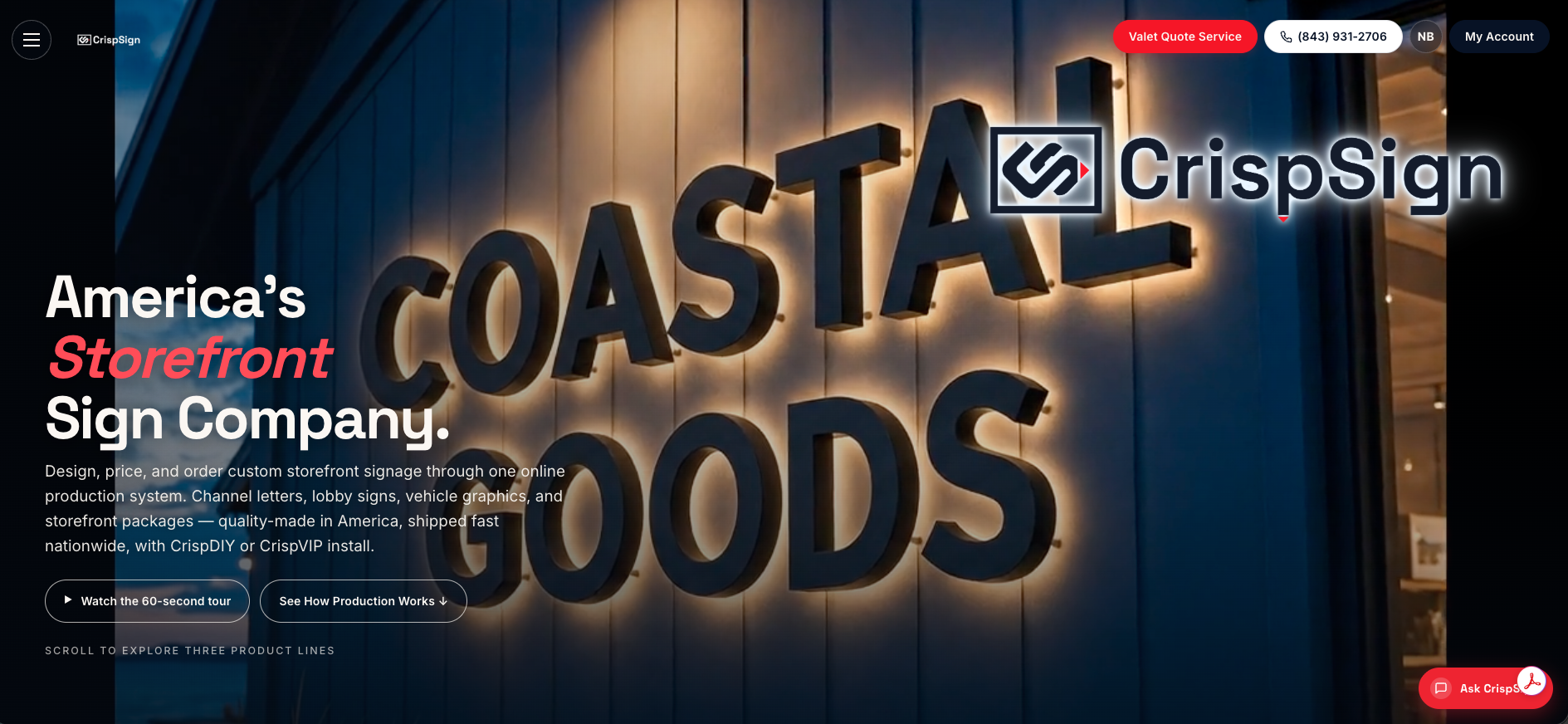
When your opening date is set and your campaign is planned, the last thing you need is a sign supplier who gives you a vague "about two weeks" and goes quiet. Crispsign is built for exactly the situation this article describes: a business with a real deadline, a real budget, and zero tolerance for a late sign.
Here is what you get when you order with Crispsign: digital proofs with fast turnaround, expedited fabrication options for tight timelines, nationwide shipping with a confirmed ship date, and optional installation coordination so you are not hunting for an installer the week your sign arrives. Every product — from exterior channel letters and carved cedar signs to vehicle wraps and window vinyl — is fabricated to spec and shipped with tracking.
Ready to lock in your timeline? Get your instant estimate at Crispsign and tell us your deadline on the order form. We will confirm your ship date before fabrication starts.
Sources
- Why Effective Same-Day Delivery Needs More Than Just Speed | Supply Chain Digital
- Same-Day and Next-Day Delivery: When Speed Is Worth It (and How to Offer It Without Losing Money) — Shipink
- How the benefits of digital signage can help your business grow
- 9 Benefits of Digital Signage (With Real Data) | OptiSigns | OptiSigns
- Monthly Retail Trade Report
FAQ
Why does fast sign delivery matter for a small business?
Fast delivery protects your launch timing and prevents lost foot traffic during the highest-visibility window a new location or promotion ever gets. A sign that arrives after your opening date cannot recover those first impressions.
What is the difference between production time and shipping time for signs?
Production time covers fabrication from order to shop exit; shipping time is carrier transit from pickup to your door. Both must be planned separately — a 2-day production promise means nothing if ground shipping adds 7 more days.
How can I speed up my sign order without paying for rush production?
Submit a print-ready file with fonts outlined and images at 300 DPI, designate a single approver, and approve the digital proof within 2 hours of receipt. Eliminating proof delays is the fastest way to shorten a timeline at no added cost.
Does Crispsign offer expedited sign production and shipping?
Yes. Crispsign offers expedited fabrication options, confirmed ship dates communicated before production starts, and nationwide shipping with tracking — plus optional installation coordination for businesses that need a complete, on-time solution.
What are good temporary sign options while waiting for permanent signage?
Vinyl banners, window clings, removable vinyl graphics, and digital displays are all fast-to-deploy options. Digital signage in particular allows instant message updates and can protect campaign timing while permanent signs are still in production.