Why Storefront Signs Matter for Your Small Business

Your storefront sign is your best salesperson. It works 24 hours a day, seven days a week, asking nothing in return except a one-time investment in quality. Research shows 79% of consumers believe a business's signage reflects the quality of its products or services. That single statistic explains why storefront signs matter more than most small business owners realize.
Here is what effective storefront identity signage delivers:
- First impressions in seconds. Customers judge your business before they reach the door, often within a few seconds of visual contact.
- Foot traffic on autopilot. Over 76% of consumers have visited a store specifically because attractive signage caught their eye.
- Brand credibility. A permanent, well-made sign signals stability and professionalism to people who know nothing about you yet.
- Customer navigation. Clear signs reduce confusion, guide shoppers through your space, and lower the chance they leave frustrated.
- Purchase influence. Over 75% of shoppers report buying something because a sign caught their attention.
Why storefront signs matter for visibility and foot traffic
A sign that nobody can read from the sidewalk is a sign that does not exist. Visibility is the foundation of every other benefit signage provides, and it depends on four factors working together: placement, size, illumination, and legibility.
Placement means positioning your sign where passing pedestrians and drivers can see it without craning their necks. Signs mounted perpendicular to the facade extend visibility along the sidewalk far better than flat-mounted panels. Size needs to match real-world viewing distance. A name that looks bold on a design file can disappear against a brick facade from 50 feet away.
Illumination is the factor most new business owners underestimate. A sign that goes dark at sunset loses half its working hours. LED-lit channel letters and backlit panels keep your name visible during evening foot traffic, which is often peak time for restaurants, gyms, and retail shops. Legibility ties it all together: high-contrast colors, clean sans-serif fonts, and a single clear message let passersby absorb your name and category in a glance.
Key techniques that measurably improve visibility:
- Mount primary signage at eye level or slightly above, aligned with natural sightlines
- Use high-contrast color pairings (dark text on light backgrounds, or vice versa)
- Choose illuminated options, particularly LED, for consistent 24/7 presence
- Keep the message to one idea: name, category, or a single offer
- Add secondary signage (A-frames, window graphics) to extend reach along the approach path
How your sign shapes and communicates brand identity
A storefront sign is a brand beacon. It communicates personality, values, and category before a single word is spoken inside your store. The typography you choose, the colors you use, and the materials you select all send signals that customers process instantly and emotionally.

Typography alone carries enormous weight. A clean, modern sans-serif reads as contemporary and accessible. A hand-lettered script reads as artisanal and personal. Neither is wrong, but both must match what customers will find when they walk through the door. Inconsistency between the sign outside and the experience inside creates a subtle but real sense of distrust.
Color works the same way. Research shows that nearly 85% of shoppers are drawn to bright and colorful signage, with blue and red ranking as the most popular choices. That does not mean every business should use those colors, but it confirms that color is an active decision with measurable consequences.
Material choice communicates permanence. Custom-cut aluminum letters, dimensional acrylic, and illuminated channel letters all signal that a business is here to stay. Temporary-looking materials, like vinyl banners left up past opening week, send the opposite message. For startups especially, professional permanent signage signals stability and builds trust immediately, before a customer has read a single review.
Brand identity signage works best when it is consistent across every touchpoint:
- Exterior primary sign matches interior signage in font, color, and tone
- Window graphics reinforce the same visual language
- Promotional displays use the same palette and hierarchy
- Wayfinding signs feel like they belong to the same family
How clear signage improves the customer experience
Poor signage does not just fail to attract customers. It actively drives them away. 77% of consumers have had trouble finding a business due to poor or missing signage, and a customer who cannot find you simply goes somewhere else.
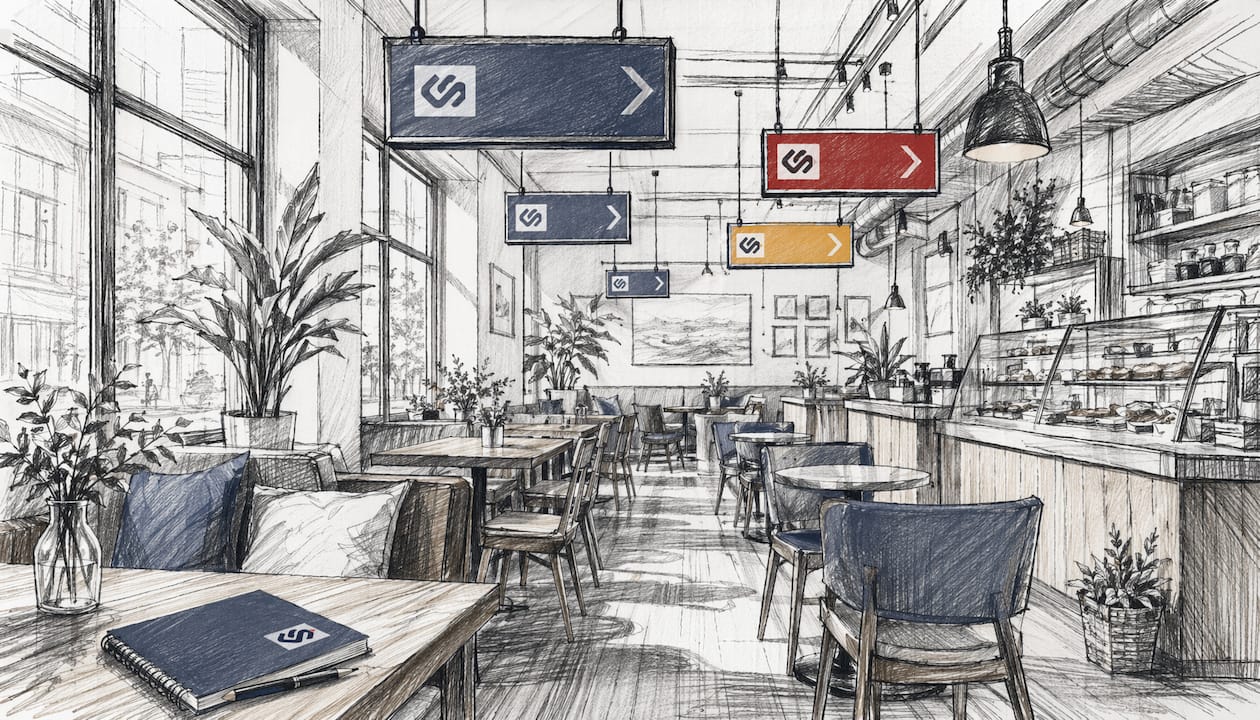
Once someone is inside your store, wayfinding signs take over. Clear category markers, directional arrows, and department labels reduce friction and help shoppers find what they came for without asking for help. That matters because customers who feel disoriented are far less likely to return. Signage that guides people confidently through your space removes a layer of stress from the shopping experience.
Accessibility is a legal and practical requirement. The Americans with Disabilities Act sets specific standards for contrast ratios, tactile characters, and mounting heights for permanent signs in public spaces. Meeting those standards is not just about compliance. It makes your store genuinely easier to use for every customer, including older shoppers and people with low vision.
Informational and promotional signs also support decisions at the point of purchase. A well-placed sign highlighting a daily special, a new arrival, or a limited-time offer gives customers a reason to act now rather than think about it later.
Effective design and placement strategies for your storefront sign
Good design is not about being flashy. It is about being clear, consistent, and easy to trust from across the street.
- Legibility first. Use large fonts (minimum 1 inch of letter height per 10 feet of viewing distance), high contrast, and matte finishes to prevent glare.
- Visual hierarchy. Lead with your business name, follow with your category or tagline. Never let a decorative element compete with your name for attention.
- Placement. Position your primary sign perpendicular to the facade when possible. Place secondary signs at eye level near the entrance.
- Zoning compliance. Most municipalities regulate sign size, placement, and illumination. Ignoring local ordinances can result in costly removal orders, so check with your city's planning department before fabricating.
- Material durability. Aluminum, acrylic, and powder-coated steel hold up against weather and UV exposure far better than printed foam or vinyl panels.
- Illumination. LED options reduce energy costs while providing consistent brightness day and night.
Pro Tip: Stand across the street from your storefront and photograph it on your phone. Then look at the image as if you were a stranger. If you cannot read the business name or identify the category within three seconds, your sign needs adjustment before anything else.
Emerging trends shaping storefront signage in 2026
The signage industry has shifted toward digital integration, personalization, and energy efficiency. Static signs are not going away, but the most forward-thinking storefronts are layering digital elements on top of permanent identity signage.
QR-enabled signs now bridge the physical and digital experience, letting customers access menus, loyalty programs, or appointment booking without staff involvement. Motion-triggered LED displays activate as pedestrians approach, creating attention-grabbing moments that static panels cannot replicate. Digital touchscreens in window displays engage after-hours browsers who would otherwise walk past. The personalized items market is projected to reach $201 billion in 2026, driving demand for updatable, customizable signage systems that adapt to seasonal campaigns.
Energy efficiency is also reshaping material choices. LED illumination uses significantly less power than older fluorescent or neon systems, and the cost savings compound over years of operation. For small business owners watching every expense, that is a practical reason to upgrade, not just an environmental one.
- Digital displays allow real-time messaging updates without reprinting
- QR codes connect physical signage to digital analytics, letting you measure engagement
- Motion-triggered elements increase attention capture from passing foot traffic
- Energy-efficient LED systems lower operating costs over the sign's lifespan
- Personalized and seasonal signage keeps your storefront feeling current year-round
Treat your signage as a coordinated brand ecosystem
The most effective storefronts treat signage not as a single asset but as a coordinated system, from the primary exterior sign to interior wayfinding to point-of-purchase displays. When those elements share a consistent visual language, they reinforce each other and guide customers from the sidewalk to the checkout without friction.
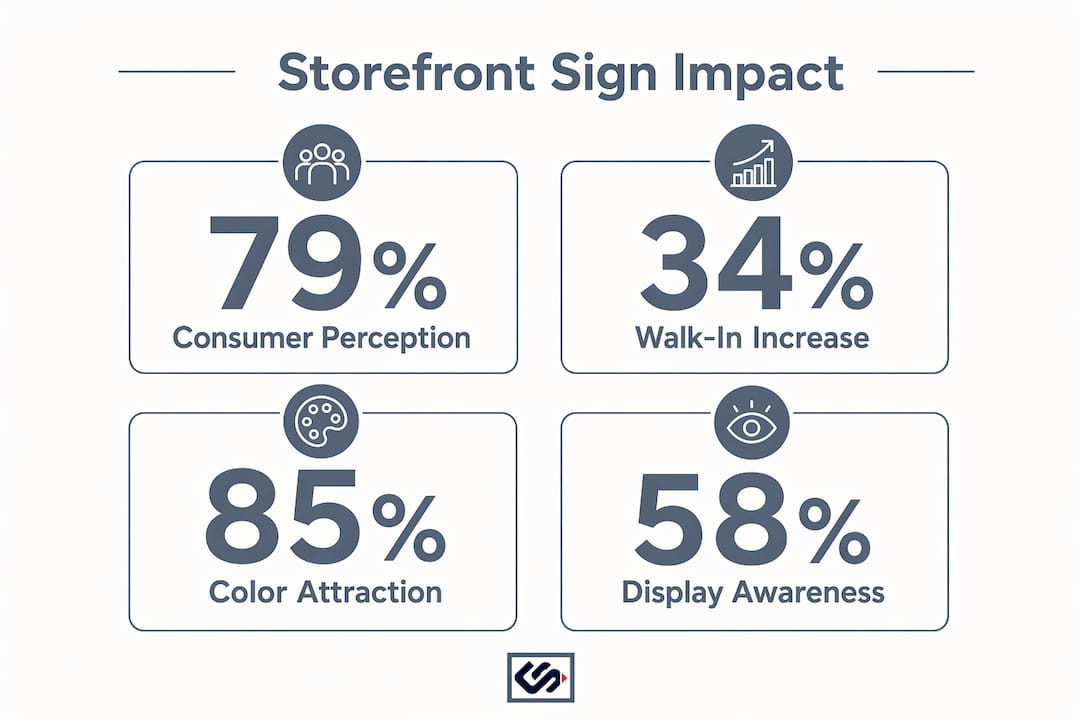
Businesses that implement coordinated signage systems see an average 34% increase in walk-in inquiries within 90 days compared to those with isolated sign elements. That gap exists because coordinated signage removes doubt at every step of the customer journey. Each sign confirms that the customer is in the right place and that the business knows what it is doing.
Fragmented signage does the opposite. A polished exterior sign paired with handwritten interior labels and mismatched window graphics creates a "almost there" feeling that erodes confidence. Customers read visual consistency as a proxy for operational consistency.
Key components of a coordinated signage ecosystem:
- Primary exterior sign: Your identity anchor, fabricated to last and lit for 24/7 visibility
- Window graphics: Reinforce brand colors and messaging without cluttering the glass
- Wayfinding signs: Guide customers from entry to product to checkout with minimal friction
- Point-of-purchase displays: Influence decisions at the moment customers are ready to buy
- ADA-compliant signs: Meet legal standards while improving accessibility for all shoppers
Effective commercial lighting design ties the ecosystem together, making every sign element more readable and the overall storefront more inviting after dark.
How signage supports retail logistics and customer navigation
Retail logistics is not just about inventory and supply chains. It includes how efficiently customers move through your space and how quickly they find what they need. Signage is the infrastructure that makes that movement possible.
58% of shoppers actively notice in-store displays, and nearly half say those displays influenced their purchase decisions. That means your interior signs are not decoration. They are a sales tool operating silently at every point in the store. Category markers reduce the time customers spend searching. Directional signs prevent the dead-end frustration that sends people to the exit instead of the register. Promotional signs at decision points increase average transaction value by surfacing offers customers would have missed.
Good signage also reduces the burden on your staff. When customers can navigate independently, your team spends less time answering "where is the..." and more time on service that actually builds loyalty. That operational benefit is easy to overlook but real in practice. A well-signed store runs more smoothly, and customers who feel oriented tend to stay longer and spend more.
Get your signage right with Crispsign
Your storefront sign should work as hard as you do. Crispsign specializes in custom, quality-made signage fabricated to spec for small and medium-sized businesses across the United States. From exterior identity signs to ADA-compliant interior signage, every piece is built for visibility, durability, and brand consistency. Fast turnaround, transparent pricing, and professional results, without the back-and-forth. Get your instant estimate today and put your best sign forward.
Key Takeaways
Storefront signs are a small business's most persistent marketing asset, directly influencing foot traffic, brand trust, and in-store purchase decisions.
| Point | Details |
|---|---|
| Consumer perception is tied to sign quality | 79% of consumers believe a business's signage reflects the quality of its products or services. |
| Signs drive real foot traffic | Over 76% of consumers have visited a store specifically because attractive signage caught their eye. |
| Coordinated systems outperform isolated signs | Businesses with coordinated signage see a 34% increase in walk-in inquiries within 90 days. |
| In-store signs influence purchases | 58% of shoppers notice in-store displays; nearly half say those displays influenced their buying decisions. |
| Permanence builds trust | Custom-cut aluminum and illuminated signs signal stability, especially for new and startup businesses. |
FAQ
Why is signage important in retail?
Signage is a retail store's primary tool for attracting foot traffic, guiding customers through the space, and influencing purchase decisions. Research shows that 58% of shoppers notice in-store displays and nearly half say those displays shaped what they bought.
What is the importance of a storefront?
A storefront is the first proof that a business is organized, credible, and ready for customers. It communicates brand identity and category within seconds, before a customer reads a single word of marketing copy.
What do you call a storefront sign?
The industry term is storefront identity signage, which covers primary exterior signs, channel letters, monument signs, and illuminated panels that identify a business from the street.
Does a logo really matter for a business?
Yes, and your storefront sign is where that logo does its most visible work. Consistent use of your logo across exterior and interior signage builds recognition and supports consumer trust, particularly for businesses competing in crowded local markets.