
9 Ways Signage Boosts Retail Sales with Real Data

Retail signage is defined as any visual display used to attract customers, communicate product value, and guide buying decisions inside or outside a store. The ways signage boosts retail sales are measurable and well-documented. A 2024 Journal of Marketing study analyzing nearly 30 million shoppers found that in-store digital signage increases the purchase probability of featured products by 8.1% on average. That number compounds fast across a full product catalog. Retail owners and marketing managers who treat signage as a passive decoration miss one of the highest-return tools in their physical store.
1. Ways signage boosts retail sales through product visibility
Signage increases product discoverability before a customer even decides to look. When a sign highlights a specific item at eye level or near a display, it pulls attention that would otherwise drift past. Proximity-based signage placed near decision points like checkout counters or product shelves outperforms general brand loops for sales lift. The closer the sign is to the product, the shorter the gap between awareness and action.
Effective product visibility signage uses three core techniques:
- Color contrast: High-contrast color combinations make signs readable from 10 feet away and stop foot traffic in its tracks.
- Placement at eye level: Signs mounted at 5 to 6 feet draw the most attention in standard retail environments.
- Dynamic content rotation: Cycling through multiple products or offers keeps repeat visitors engaged and prevents sign blindness.
Pro Tip: Rotate your featured product signage weekly. Static displays lose effectiveness quickly because regular customers stop registering them.
2. How wayfinding signage guides shoppers and increases basket size
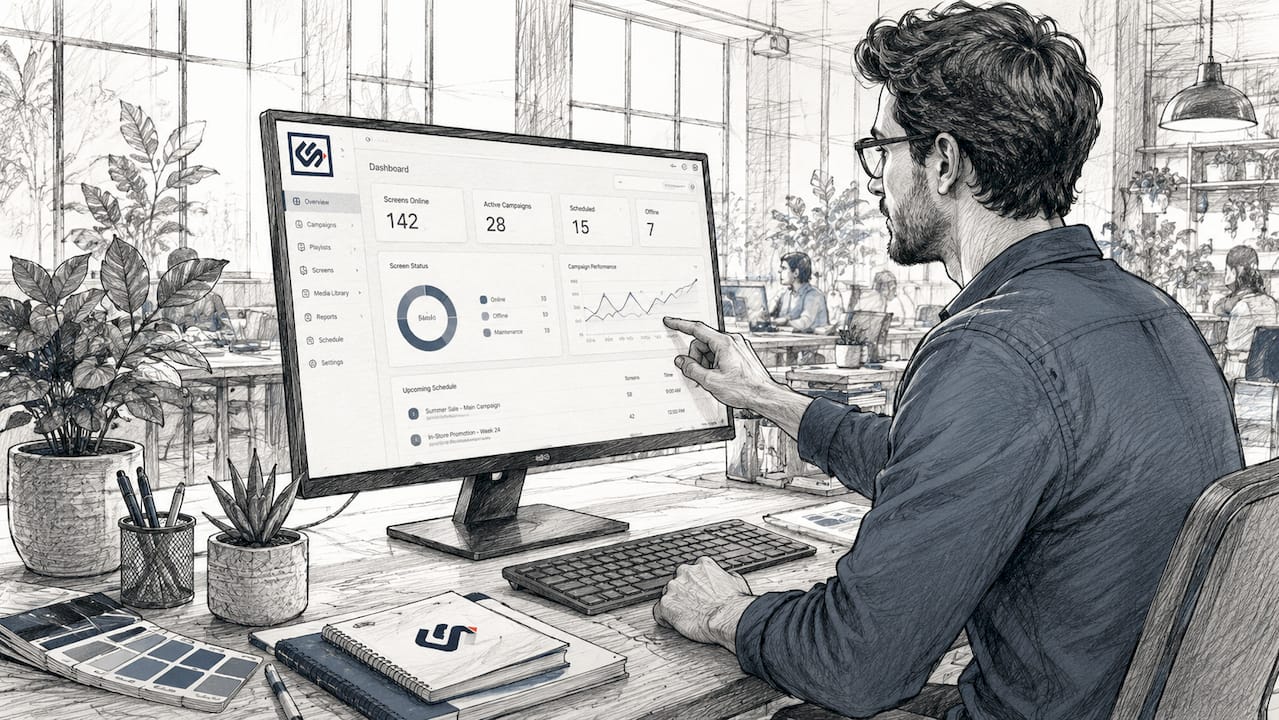
Wayfinding signage directs customer flow through your store in a way that maximizes exposure to more products. When shoppers know where to go, they spend less time frustrated and more time browsing. A well-mapped store layout supported by clear directional signs increases the average number of product categories a customer visits per trip.
The sequence matters. Here is how to build a wayfinding system that drives revenue:
- Place category markers at aisle entrances. Customers scan these first and use them to plan their route.
- Use floor graphics to direct traffic toward high-margin sections. Floor-level cues work on a subconscious level and are especially effective in wide-format retail spaces.
- Install decision-point signs at intersections. These are the moments shoppers pause. A well-placed sign here can redirect them toward a featured product or promotion.
- Add product grouping signs near complementary items. Pairing a "Complete the Look" or "Frequently Bought Together" sign near related products increases multi-item purchases.
Wayfinding is not just about navigation. It is a structured path to purchase that you design intentionally.
3. Point of purchase signage as the last mile of your marketing funnel
POP signage functions as the last mile of your marketing funnel, converting shoppers who already have purchase intent into buyers. It reinforces digital campaigns and increases basket size through contextual prompts at the shelf or register. A customer who saw your Instagram ad and walked into your store still needs one final nudge. POP signage delivers that nudge at exactly the right moment.
The most effective POP signs do three things: they confirm the product's value, they remind the customer of the promotion, and they remove hesitation. A sign that reads "As seen online. Buy 2, save 15%" connects your digital presence to the physical shelf. That connection builds confidence and closes the sale.
4. Promotional signage that drives impulse purchases
Promotional signage motivates immediate action by creating a sense of urgency and exclusivity. Limited-time offer signs, clearance tags, and "Today Only" banners all tap into the same consumer psychology: the fear of missing out on a deal. This is one of the most direct ways to increase average transaction value without changing your pricing structure.
Best practices for promotional signage include:
- Use specific numbers instead of vague claims. "Save $12" outperforms "Save Big" every time.
- Set a visible deadline. "Offer ends Sunday" creates urgency that "Limited Time" does not.
- Highlight the original price. Showing a crossed-out price next to the sale price makes the discount feel concrete and earned.
- Keep the sign uncluttered. One offer per sign. Two competing messages cancel each other out.
Retailers who update signage content frequently see higher sales lift than those using passive or static displays. The data confirms that relevance and timing are as important as design.
5. Digital signage integrated with POS and CRM data
Digital signage connected to your point of sale and customer relationship management systems turns a display into a performance tool. Closed-loop attribution connects signage exposure directly to purchase data, giving you a clear picture of which signs drive revenue and which ones do not. Without that connection, you are guessing.
The ROI case for integrated digital signage is strong. Retail digital signage ROI can reach $5 to $6 for every $1 invested when attribution models connect signage exposure to POS and CRM data. Some retail networks have seen sales performance increases of 25–32% through integrated digital signage systems linked to operational data. That is not a marginal improvement. It is a structural shift in how a store performs.
| Signage Type | Integration Level | Typical Sales Lift |
|---|---|---|
| Static printed signs | None | Baseline |
| Digital signs (standalone) | Low | Moderate |
| Digital signs + POS data | Medium | Significant |
| Digital signs + POS + CRM | High | 25–32% in some networks |
Pro Tip: Start with one high-traffic zone. Connect your digital display to your POS system and measure the sales lift on featured products over 30 days before scaling.
6. Storefront signage that pulls foot traffic from the street
Your storefront sign is the first sales tool a potential customer encounters. It works 24 hours a day, 7 days a week, without a salary. A well-designed exterior sign communicates your brand, your category, and your value in under three seconds. That is the window you have before a pedestrian or driver moves on.
Common exterior signage mistakes include fonts that are too small to read from a moving car, colors that blend into the building facade, and signs that fail to communicate what the store actually sells. Each of these errors costs you foot traffic before a customer ever walks through the door. Storefront signage that boosts foot traffic is specific, readable, and visually distinct from its surroundings.
7. Brand consistency across all signage touchpoints
Cohesive signage increases brand recall and builds customer trust, which drives repeat visits and long-term loyalty. When your window graphics, shelf signs, and checkout displays all share the same fonts, colors, and tone, customers experience your brand as professional and reliable. Inconsistency, on the other hand, signals disorganization and erodes confidence.
Brand consistency in signage is not just an aesthetic choice. It is a revenue strategy. Customers who trust a brand spend more per visit and return more often. Every sign your store displays is either building or undermining that trust.
"The sign your building wears is the handshake before the conversation. Make it firm, clear, and consistent with everything else your brand says."
8. Measuring the true incremental impact of your signage
Most retailers underestimate how much of their signage-driven revenue is genuinely new business. In a 2026 retail study, 88% of revenue generated during signage campaigns was incremental, meaning it represented true sales lift beyond simple purchase acceleration. That finding changes how you should think about signage budgets. You are not just moving purchases forward in time. You are creating purchases that would not have happened otherwise.
Measuring signage impact requires a test-and-control methodology. Run a promotion with signage in selected store zones and compare results to zones without it. Track units sold, average transaction value, and category attachment rate. Repeat the test with different sign formats, placements, and messages to build a reliable picture of what works in your specific environment.
9. Avoiding signage overload that undermines sales
Too many signs produce the same result as no signs at all: customers stop reading them. Sign overload creates visual noise that overwhelms shoppers and dilutes the impact of your most important messages. The stores that see the strongest signage results are disciplined about what they display and where.
A practical rule is to identify the three to five highest-value messages you want customers to receive on any given week. Build your signage program around those messages exclusively. Rotate them on a schedule tied to your promotional calendar. Review common signage mistakes regularly to catch errors before they cost you sales. Less signage, placed with intention, outperforms more signage placed everywhere.
Key Takeaways
Signage drives measurable retail revenue when it is placed with intention, connected to real data, and kept consistent with your broader brand.
| Point | Details |
|---|---|
| Proximity drives purchase | Signs placed near decision points outperform general brand displays for sales lift. |
| POP signage closes the sale | Point of purchase signs convert shoppers with existing intent into buyers at the shelf. |
| Digital integration multiplies ROI | Connecting signage to POS and CRM data can deliver $5–$6 return per $1 invested. |
| Consistency builds trust | Cohesive signage across all touchpoints increases brand recall and repeat visits. |
| Measure incrementally | 88% of signage campaign revenue can be genuinely new sales, not just accelerated purchases. |
What I have learned about signage strategy after years in retail marketing
Most retail owners I talk to think of signage as a one-time decision. You pick a design, print it, hang it, and move on. That mindset leaves serious money on the table.
The stores that consistently outperform their category treat signage as a live marketing channel. They test placements, rotate messages, and measure results the same way a digital marketer tracks ad performance. The data backs this up. An 8.1% lift in purchase probability from a single well-placed sign is not trivial when you multiply it across dozens of products and thousands of weekly visitors.
The other mistake I see constantly is prioritizing aesthetics over function. A beautiful sign that no one reads is a waste of budget. The best signs are readable, specific, and placed where the customer's eye already goes. Start there, then refine the design.
One more thing: do not ignore your exterior. Your storefront sign works harder than any other piece of marketing you own. If it is faded, generic, or hard to read from the street, fix it before you invest in anything else inside the store.
— Nick
Crispsign's signage solutions for retail businesses
Retail owners who want professional signage without the production headaches have a clear option. Crispsign builds custom signs fabricated to spec, with a production workflow designed for faster turnaround without cutting corners on quality.
For retail spaces that require ADA-compliant displays alongside branded visuals, Crispsign's CrispLobby ADA signage line covers lobby panels, vinyl graphics, and branded lobby logos that meet accessibility standards while reinforcing your store's identity. Whether you need a single storefront sign or a full in-store signage program, Crispsign delivers professional-grade results built around your brand. Get in touch to see what your store could look like with signage that actually works.
FAQ
How much can signage increase retail sales?
In-store digital signage increases purchase probability by 8.1% on average, and some integrated retail networks have seen sales lifts of 25–32%. The actual impact depends on placement, content relevance, and how frequently the signage is updated.
What is POP signage and why does it matter?
POP stands for point of purchase. POP signage is placed at or near the product at the moment of decision, making it the most direct tool for converting browsing into buying.
How do I measure the ROI of my retail signage?
Use a test-and-control method: run signage in selected zones and compare sales data to zones without it. Connecting digital signage to your POS system enables precise attribution and shows which signs drive real revenue.
Does storefront signage affect foot traffic?
A clear, readable storefront sign communicates your brand and category in under three seconds, which directly influences whether a passerby stops or keeps walking. Exterior signage is the first and most consistent customer touchpoint a retail business has.
How often should I update my in-store signage?
Update promotional signage weekly and align it with your current offers. Static displays lose effectiveness quickly with repeat customers, and frequent content updates consistently produce higher sales lift than passive displays.