How Signage Communicates Business Type to Customers

Signage is defined as the primary visual language a business uses to declare its identity, purpose, and quality to every person who passes by. How signage communicates business type is through deliberate design choices: color, font, material, and placement each send a specific signal before a customer reads a single word. A law firm's polished brass lettering says "established and trustworthy." A taco shop's bold red neon says "fast, fun, and affordable." These are not accidents. They are the result of understanding visual communication as a marketing discipline. Get it right, and your sign works for you around the clock.
How does signage communicate business type through design?
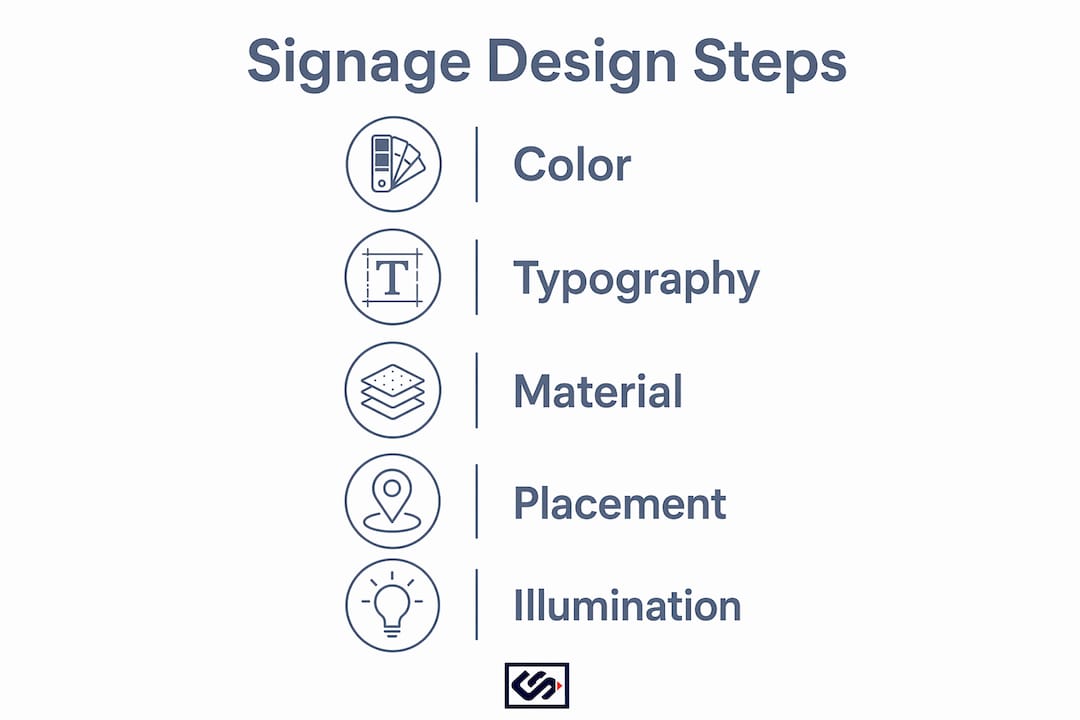
Signage communicates business type through three core design variables: color, typography, and material. Each one answers a subconscious question your customer is already asking. Visual signage cues including font, color, and material quality answer consumer questions on trustworthiness and relevance within seconds of contact. That speed matters because customers make engagement decisions before they consciously process what they have read.

Color psychology in business signage
Color is the fastest signal your sign sends. Blue communicates professionalism, calm, and reliability, which is why financial institutions and healthcare providers favor it. Red triggers urgency and appetite, making it the dominant choice in fast food and retail promotions. Green signals health, sustainability, and freshness, which is why organic grocers and wellness brands use it consistently. Black and gold together communicate luxury and exclusivity. Choosing the wrong color for your business category creates a mismatch that confuses customers before they ever walk through your door.
Font choice and what it tells customers
Typography carries tone. Serif fonts like Times New Roman or Garamond signal tradition, authority, and longevity. You see them on law offices, accounting firms, and private medical practices. Sans-serif fonts like Helvetica or Futura signal modernity, accessibility, and tech-forward thinking. Startups, co-working spaces, and consumer apps favor them. Script fonts suggest creativity and personal touch, fitting salons, bakeries, and boutique shops. The rule is simple: your font should match the emotional expectation your customer already has for your industry.
Material quality and perceived permanence
High-quality materials like acrylic or aluminum convey permanence, while poor design or temporary materials create barriers to customer conversion. A vinyl banner taped to a window signals "we might not be here next month." Fabricated channel letters mounted to a building say "we are invested in this location and this community." Material quality is not just an aesthetic choice. It is a trust signal that directly affects whether a passerby becomes a paying customer.
Pro Tip: Align every design choice with the emotional expectation your customer already holds for your industry. A pediatric dentist using aggressive red and black typography will lose patients before they book an appointment.
Which signage types work best for different business categories?
Selecting the right sign type is as important as the design itself. Different industries require different signage strategies: retail and restaurants prioritize outdoor visibility, while professional services focus on indoor branding. The physical context of your customer's approach determines which sign format delivers the most impact.
Retail and restaurant businesses depend on high-visibility outdoor signage to generate foot traffic. Channel letters mounted above a storefront entrance are the industry standard because they are readable from a distance, work in daylight and at night, and project a permanent, professional image. Blade signs that extend perpendicular to the building face are especially effective on pedestrian-heavy streets where customers walk parallel to storefronts and need a sign that catches their eye from the side.
Professional services firms (law offices, financial advisors, medical practices) prioritize indoor lobby signage to build trust once a client has already committed to entering. A polished lobby logo or dimensional wall panel reinforces the firm's credibility at the exact moment the client is forming their final impression. Outdoor signage for these businesses tends to be understated: a clean monument sign or suite directory rather than a large illuminated display.
Service businesses that operate in the field rather than from a fixed location benefit most from mobile signage. Vehicle decals and magnetic signs placed on company trucks or vans turn every job site into a local advertisement. Yard signs installed at active project locations generate neighborhood awareness at a very low cost per impression.
Mixed-use or destination businesses (gyms, spas, specialty retailers) often need both outdoor and indoor signage working together. Pylon signs visible from the road direct drivers to the location. Interior wayfinding signage then guides customers through the space and reinforces the brand at every turn.
Startups and pre-launch businesses can use temporary signage like vinyl banners and A-frames to generate awareness before permanent signs are installed. Temporary signage builds pre-launch anticipation and early customer engagement at a fraction of the cost of fabricated signs.
Pro Tip: Map your customer's physical approach path before selecting a sign type. A customer driving at 35 mph needs a pylon or monument sign readable from 200 feet away. A customer walking a downtown sidewalk needs a blade sign or window graphic at eye level.
How does signage function as a 24/7 marketing asset?
Signage is the only marketing channel that works without a budget renewal, a campaign manager, or an internet connection. Effective exterior signage functions as a business's most persistent physical marketing tool, delivering constant visibility and trust signals to the highest-intent local audience: people who are already physically near your location.
"Signage is not merely informational. It actively shapes consumer behavior, dictating who notices and engages with a business. Consumers subconsciously assess signage quality and messaging efficacy within seconds, shaping their decision to engage."
That behavioral reality has a direct financial consequence. A well-placed, professionally fabricated sign generates walk-in traffic every day without recurring cost. A poorly executed sign, or no sign at all, sends the same message in reverse: this business is temporary, uncertain, or not worth your time.
Professionally fabricated signs using quality materials convey stability and local commitment, which are crucial factors in converting passersby into first-time customers. This is especially true for new businesses, where signage is often the first and only brand touchpoint a local customer encounters before deciding whether to walk in.
Non-illuminated signs lose visibility after dark, making LED-lit signage a requirement for any business operating past sunset. A restaurant open until 10 PM with an unlit sign is effectively invisible to the dinner crowd driving by at 8 PM. LED illumination extends the sign's working hours to match the business's operating hours, and it enhances brand recall by making the sign visible in conditions where competitors' signs disappear.
Understanding how signage establishes a new business in the minds of local customers is the foundation of any effective storefront marketing plan.
What are the most common signage communication mistakes?
Most signage failures come from one of five predictable errors. Recognizing them before you invest in fabrication saves both money and credibility.
Using temporary or generic signage as a permanent solution. A vinyl banner is a tool for pre-launch awareness, not a substitute for a fabricated sign. Customers who see the same banner month after month conclude the business is either struggling or not serious. Temporary signage serves a specific early-stage purpose and should be replaced with permanent signage on a defined timeline.
Ignoring customer sightlines and approach paths. Analyzing customer approach paths determines whether channel letters, blade signs, or pylon signs are most suitable. A sign positioned for pedestrian viewing that sits in a parking-lot-access location misses its entire audience. Place signage where your actual customers will see it, not where installation is easiest.
Mismatching indoor and outdoor signage. A bold, modern exterior sign paired with a dated, hand-lettered interior creates cognitive dissonance. Customers notice the inconsistency even when they cannot name it. Coherence between all signage elements builds the subconscious trust that drives repeat visits.
Design errors that signal neglect. Faded colors, peeling vinyl, misspelled text, and inconsistent fonts all communicate the same thing: this business does not pay attention to details. For a restaurant, that is a food safety concern in the customer's mind. For a law firm, it is a competence concern. The sign your building wears reflects the standards you hold inside.
Failing to account for scale and readability. A logo that looks sharp on a business card becomes illegible at 20 feet. Signs must be designed at the scale they will be read, not the scale they were created. Test readability at the actual viewing distance before approving any fabrication.
Pro Tip: If your permanent sign is still weeks away, use a well-designed vinyl banner with your logo, brand colors, and a clear message. Done right, it builds anticipation. Done poorly, it sets a low expectation that your permanent sign will have to overcome.
For a detailed breakdown of what to avoid, the storefront signage mistakes guide covers the most common errors business owners make in 2026.
Key Takeaways
Signage communicates business type through deliberate design choices in color, font, material, and placement, each of which shapes customer trust and engagement before a single word is read.
| Point | Details |
|---|---|
| Design signals business identity | Color, font, and material each answer a subconscious customer question about trust and relevance. |
| Sign type must match business category | Retail needs outdoor visibility; professional services need indoor lobby presence; field businesses need mobile signage. |
| Signage works as a 24/7 asset | A professionally fabricated, illuminated sign generates walk-in traffic every day without recurring cost. |
| Coherence builds trust | Indoor and outdoor signage must match in tone, color, and quality to avoid confusing customers. |
| Temporary signage has a defined role | Use vinyl banners and A-frames for pre-launch awareness, then replace them with permanent fabricated signs on a set timeline. |
What I have learned from watching businesses get signage wrong
I have watched businesses spend thousands on interior design and then hang a generic vinyl banner outside for six months because "the permanent sign is coming." That banner becomes the brand. Customers form their first impression from it, and no amount of beautiful interior work undoes a first impression built on a $40 banner.
The insight most business owners miss is that signage is not a finishing touch. It is the opening statement. Your sign tells the neighborhood what kind of business you are, how serious you are about it, and whether you are worth their time. That judgment happens in seconds, and it happens whether you planned for it or not.
The other thing I have seen consistently: businesses that analyze their customer's physical approach path before choosing a sign type almost always outperform those that pick a sign based on price or aesthetics alone. A gym on a busy arterial road needs a pylon sign readable at speed. A boutique law firm in a downtown office building needs a polished lobby panel, not a large exterior display. Context is everything.
My honest recommendation for any new business owner: invest in your exterior sign first, get it fabricated professionally, and get it illuminated if you are open after dark. Everything else in your marketing budget can wait. The sign cannot.
— Nick
Crispsign builds signs that tell your story from the street
Your storefront sign is the first thing a potential customer sees. It should communicate exactly what you do, who you are, and why you are worth walking into. Crispsign designs and builds custom signage fabricated to spec for retail storefronts, professional offices, and service businesses across the country.
For professional businesses that need to build trust the moment a client walks in, Crispsign's ADA-compliant lobby signage combines accessibility requirements with polished, brand-consistent design. Every sign ships with a production review and is built to last. If you are ready to put a sign on your building that actually works, Crispsign delivers the quality your business deserves.
FAQ
How does signage communicate business type instantly?
Signage communicates business type through color, font, and material choices that trigger immediate subconscious associations. Consumers assess signage quality and messaging within seconds, deciding whether to engage with a business before they consciously process the text.
What types of signs work best for new businesses?
New businesses benefit most from a phased approach: temporary vinyl banners or A-frames for pre-launch awareness, followed by professionally fabricated exterior signs once the business opens. Temporary signage builds early engagement while permanent signage establishes long-term credibility.
Why does sign material matter for brand perception?
Material quality signals permanence and commitment. Acrylic, aluminum, and channel letter fabrication communicate that a business is established and invested in its location, while low-quality or temporary materials create doubt about the business's stability.
Do I need illuminated signage for my storefront?
Any business operating past sunset needs illuminated signage. Non-illuminated signs lose visibility after dark, which means lost walk-in traffic during evening hours when many customers are actively looking for businesses to visit.
How do indoor and outdoor signs work together?
Indoor and outdoor signage must match in color, tone, and material quality to build consistent brand trust. A mismatch between a polished exterior sign and a dated interior creates confusion that undermines customer confidence at the moment they are deciding whether to return.