Types of Restaurant Exterior Signs: A 2026 Strategy Guide
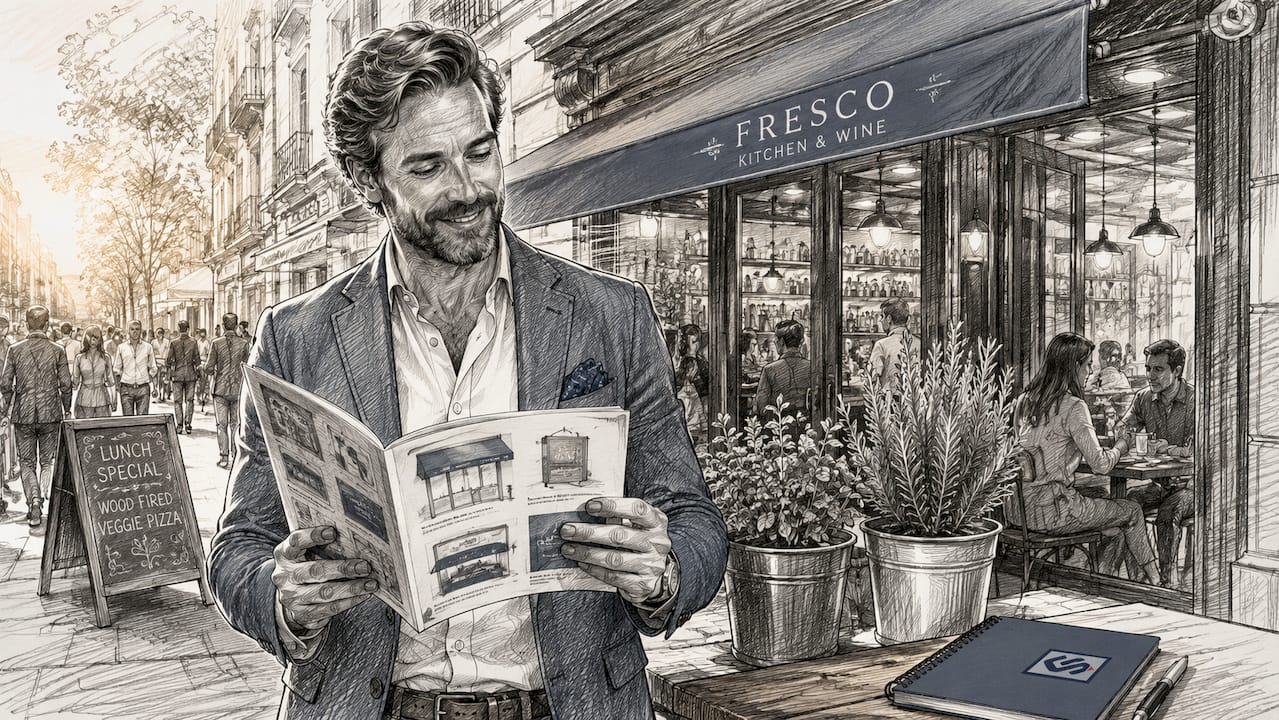
Restaurant exterior signage is defined as the complete system of building-mounted and portable signs that communicate a restaurant's identity, location, and offers to passing customers. The five primary types are fascia signs, A-boards, projecting signs, awnings, and digital displays. Each targets a different viewer distance and angle, which means relying on just one type leaves money on the table. The most effective restaurant facade signs follow the 30–40% text-to-white-space ratio for maximum readability. Understanding these categories gives you a clear framework for building a signage system that works around the clock.
1. Types of restaurant exterior signs: the layered system explained
The strongest outdoor signage programs treat sign types as layers, not standalone choices. A fascia sign handles long-range identity. A projecting blade sign catches pedestrians walking parallel to your building. An A-board closes the deal at the front door. Each layer targets a distinct sightline and traffic speed. Layering sign types to cover multiple viewer distances and angles is the single most effective strategy in competitive markets. Skipping any layer creates a visibility gap that no amount of social media can fully replace.
2. Fascia signs: your restaurant's permanent identity anchor
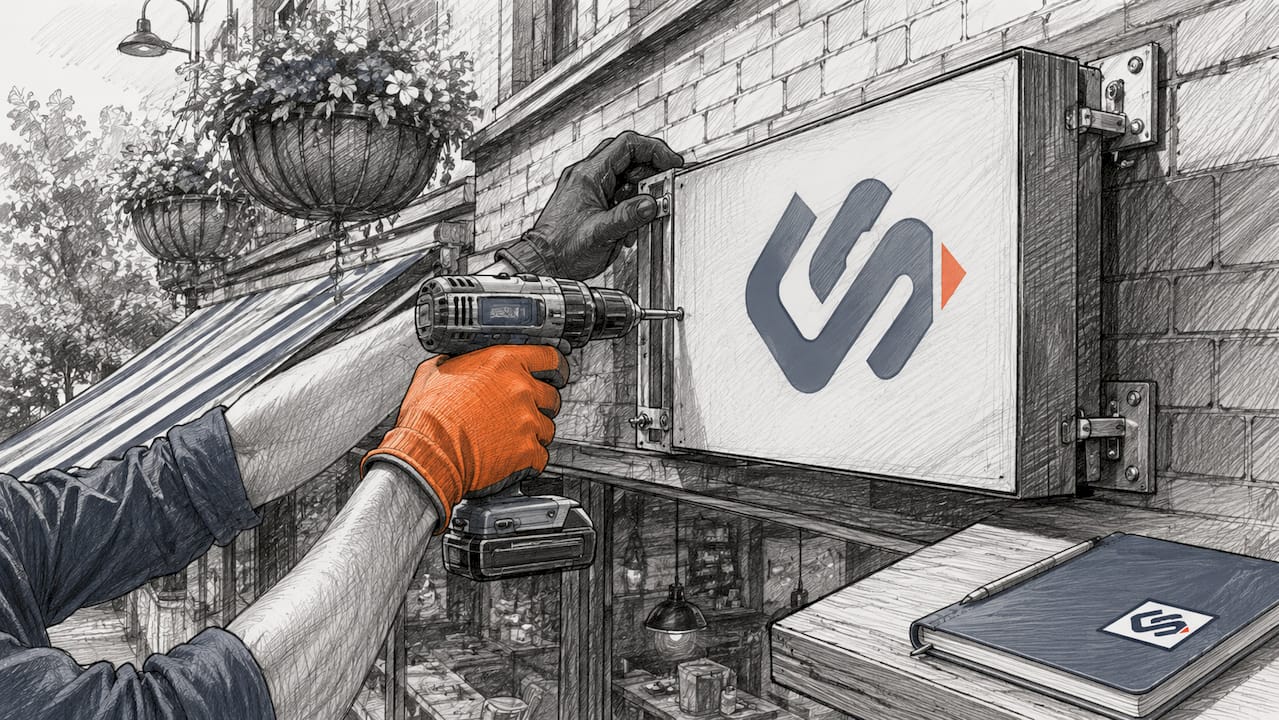
Fascia signs are building-mounted panels that run across the front of your restaurant, typically above the entrance. They are the sign your building wears every day, and they work as a 24/7 brand presence that defines your identity before a customer ever reads your menu. Fascia signs should be the first investment in any exterior signage program, not an afterthought.
The most common fascia formats include:
- Channel letters: Individual 3D letters mounted directly to the facade, available in front-lit, back-lit (halo), and open-face styles
- Flat panel signs: Printed or painted boards with high-contrast graphics, suited to heritage buildings or budget-conscious builds
- Lightbox signs: Illuminated cabinet signs that maintain visibility after dark without requiring individual letter fabrication
- 3D lettering with push-through acrylic: Letters with translucent faces that glow evenly at night
Day and night legibility are both non-negotiable. A sign that reads clearly at noon but disappears at 8:00 PM loses half its working hours. Illuminated channel letters solve this problem because the light source is built into the letter itself.
Pro Tip: Match your fascia sign's letter height to your viewing distance. A letter height of 1 inch is readable from roughly 30 feet. If your nearest parking lot is 60 feet away, your letters need to be at least 2 inches tall.
3. A-boards and sidewalk signs for daily foot traffic
A-boards, also called sandwich boards, are low-cost, portable pavement signs that speak directly to pedestrians at close range. They are the most flexible sign type in your arsenal because you can update the message every morning. A daily special, a happy hour time, or a "seats available now" notice converts browsers into diners in real time.
Key advantages of A-boards include:
- Low entry cost: A quality A-board costs a fraction of permanent signage and requires no installation permit in most jurisdictions
- Daily content control: Chalkboard or whiteboard surfaces let you change messaging without reprinting
- Placement flexibility: Move the board to where foot traffic is heaviest at different times of day
- High pedestrian engagement: Placement directly in a pedestrian pathway increases the chance of a spontaneous visit
A-boards do have limits. Most cities regulate how far a board can extend onto the sidewalk, and some require a permit. Check your local zoning rules before placing one. Also, a poorly written or illegible A-board hurts your brand more than no board at all.
Pro Tip: Limit your A-board message to seven words or fewer. Pedestrians make a split-second decision. A short, punchy line like "Lunch for $12. Right here." outperforms a paragraph every time.
4. Projecting signs and blade signs for pedestrian sightlines
Projecting signs, also called blade signs, extend perpendicular to the building face. They are the solution to a specific visibility problem: a pedestrian walking along the sidewalk cannot see your fascia sign because it faces the street, not the foot path. Blade signs increase pedestrian visibility by presenting your name and brand at a 90-degree angle to the building, readable from both directions along the sidewalk.
Effective projecting sign formats include:
- Traditional hanging signs: Wooden or metal frames with painted or printed panels, common in gastropubs and neighborhood cafes
- Illuminated blade signs: Internally lit or LED-outlined signs that maintain visibility at night
- Bracket-mounted flat signs: Simple, cost-effective panels on a fixed bracket, suited to narrow facades
- Double-sided lightboxes: Visible from both directions, maximizing coverage per installation
Projecting signs typically require local planning permission. The approval process considers height above the sidewalk, projection distance from the building, and illumination levels. Factor in a 4–8 week permitting timeline before your planned opening date. Pairing a projecting sign with your fascia sign covers both the street-facing and sidewalk-facing sightlines, which is the minimum two-layer setup any restaurant should have. For a deeper look at how blade signs reinforce brand identity, the signage and brand identity relationship is worth understanding before you finalize your design.
5. Awnings and canopy branding: shelter that sells
Awnings serve two functions at once: they protect customers from sun and rain, and they carry your brand across a large, visible surface. Custom printed awnings improve curb appeal and signal quality to potential customers before they step inside. A well-branded awning tells the street that this restaurant takes its presentation seriously.
What to consider when specifying a branded awning:
- Material durability: Solution-dyed acrylic fabrics resist UV fading and mildew better than polyester alternatives
- Print quality: Digital printing on awning fabric delivers sharp logos and color-accurate branding
- Frame type: Fixed frames suit permanent locations; retractable frames work for patios that need weather flexibility
- Color contrast: The awning color should contrast with the building facade to maximize visibility from a distance
Awnings are especially valuable for restaurants with outdoor dining areas. Effective patio signage increases customer comfort and signals a professional, well-managed operation. An awning that carries your logo, hours, and color palette does the work of three separate signs in one installation.
6. Digital displays and dynamic exterior signage
Digital exterior displays are LED or LCD screens mounted outside the restaurant to show rotating messages, promotions, or menu highlights. Digital signage attracts attention through motion and light in ways that static signs cannot match. The ability to update content remotely means you can push a lunch special at 11:00 AM and a dinner promotion at 4:00 PM without touching the sign.
| Feature | Static sign | Digital display |
|---|---|---|
| Content updates | Requires reprinting | Remote, instant |
| Upfront cost | Lower | Higher |
| Attention capture | Moderate | High (motion effect) |
| Maintenance | Minimal | Periodic hardware service |
| Weather resistance | Material-dependent | Requires rated enclosure |
Digital signs work best as a complement to permanent signage, not a replacement. A restaurant that removes its fascia sign in favor of a screen loses the permanence and brand weight that a physical sign provides. The right approach is to use a digital display for time-sensitive content while your fascia and projecting signs handle identity and wayfinding. Budget for installation, weatherproofing, and an annual maintenance contract when calculating total cost.
Key takeaways
The most effective restaurant exterior signage system combines at least three sign types to cover drivers, pedestrians, and close-range visitors simultaneously.
| Point | Details |
|---|---|
| Fascia signs come first | Build permanent brand identity before investing in any secondary sign type. |
| Layer for coverage | Each sign type targets a different sightline; gaps in layers mean lost customers. |
| A-boards drive daily conversions | Update messaging every morning to convert foot traffic with timely offers. |
| Awnings double as signage | Branded canopies deliver shelter and visibility in a single installation. |
| Digital signs need a permanent anchor | Use digital displays for promotions, but keep physical signs for identity and wayfinding. |
Why most restaurants get their signage strategy wrong
I've seen restaurant owners spend $8,000 on a beautiful interior fit-out and then hang a single printed banner outside. The banner fades in three months, and they wonder why foot traffic is flat. The problem is not the budget. The problem is treating signage as a one-time purchase rather than a system.
The restaurants that consistently pull walk-in customers are the ones that cover every sightline. A driver approaching from 200 feet sees the fascia sign. A pedestrian 30 feet away catches the blade sign. Someone standing at the door reads the A-board and decides to come in for the lunch special. That three-step sequence does not happen by accident. It requires deliberate planning before you spend a dollar on fabrication.
The other mistake I see constantly is ignoring common exterior sign errors like poor contrast, oversized logos, and under-lit signs. A sign that looks great in a design file can fail completely on a building if the background color washes out the lettering at dusk. Always review a sign in its actual environment, at multiple times of day, before signing off on production.
My honest recommendation: start with a quality fascia sign, add a projecting blade sign if you have sidewalk traffic, and use an A-board for daily messaging. That combination covers the majority of customer touchpoints at a manageable cost. Add digital displays and awnings when budget allows, not before the foundation is solid.
— Nick
Crispsign builds restaurant exterior signage that works from the street in
Crispsign specializes in custom exterior signage fabricated to spec for restaurants and storefronts across the country. Whether you need channel letter fascia signs, blade signs, or ADA-compliant wayfinding for your dining areas, Crispsign handles design, production, and shipping in a single workflow.
Every project goes through a production review before it ships, so what you approved in the proof is what arrives on your building. Crispsign also offers lobby and entrance signage for restaurants that need accessible, code-compliant interior signs to match their exterior system. Get a quote and build a signage program that covers every sightline, from the street to the front door.
FAQ
What are the main types of restaurant exterior signs?
The five main types are fascia signs, A-boards, projecting signs, awnings, and digital displays. Each targets a different viewer distance and angle to maximize customer attraction.
What is outdoor dining signage?
Outdoor dining signage refers to signs placed in or around patio and terrace areas to guide guests, communicate seating availability, and reinforce branding. Effective patio signage improves guest flow and signals a professional operation.
How many sign types does a restaurant need?
A restaurant needs at least three sign types to cover drivers, sidewalk pedestrians, and close-range visitors. A fascia sign, a projecting blade sign, and an A-board form the minimum effective system.
Do projecting signs require permits?
Projecting signs typically require local planning permission before installation. Approval timelines vary by municipality, so build in a 4–8 week buffer when planning your signage program.
Are digital exterior signs worth the cost for restaurants?
Digital exterior signs deliver strong attention capture through motion and allow instant content updates, but they carry higher upfront and maintenance costs than static signs. They work best as a complement to permanent fascia and blade signs, not as a standalone solution.